


“Despite my age and the burden it brings, there is still so much I wish to do,” 90-year-old Tsao Ching (曹慶) said.
Tsao retired from a basic labor position at Taiwan Sugar Corp 30 years ago. In the years that followed, he spent all of his NT$1 million (US$31,814 at the current exchange rate) retirement fund to establish three charities: the Genesis Social Welfare Foundation (創世社會福利基金會), the Huashan Social Welfare Foundation (華山基金會) and the Renan Social Welfare Foundation (人安基金會).
Genesis was launched in 1986 as a care facility for people in a vegetative state and became a foundation the following year.
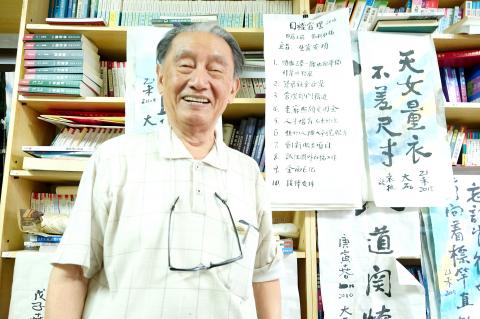
Photo: Chen Ping-hung, Taipei Times
Through his foundations, Tsao annually helps more than 6,000 people in a persistent vegetative state (PVS), more than 10,000 elderly people who are homeless or impoverished, and more than 10,000 families experiencing various difficulties.
Tsao works up to 17 hours per day on his foundations and has said he plans to open shelters for single mothers and pregnant women who have experienced abuse at home.
Tsao, who talks with a strong rural Chinese accent, came to Taiwan as a student escaping political turmoil in China.
He said that having witnessed the horrors of war first-hand instilled in him a great passion for life.
When he retired, he realized that while the government and civic organizations provide assistance to people suffering from various conditions, such as loss of sight and mental disorders, there were no support mechanisms for people in PVS, so he decided to establish facilities and make it his mission to help PVS patients.
In the beginning, Tsao had no resources and started by backpacking across the nation to drum up support for his cause, concealing his plans from his wife and daughter.
“In the beginning I hit a bottleneck, as, much to my surprise, people thought I had fraudulent intentions,” Tsao said.
Tsao spent four years traveling the nation, collecting contact information from 700 people who were interested in supporting his efforts, allowing him to establish Genesis, the nation’s first organization to assist people in PVS.
Initially, Tsao’s PVS hospice had only five patients. His source of funding was the supporters he met on his trip, whom he asked for donations.
To prepare for a situation in which he did not receive any donations, Tsao made arrangements with a local bread shop, which promised to provide him with bread for his patients.
In the end, donations came and Tsao used the bread to feed people living on the streets.
After the Genesis Foundation took off, Tsao launched Huashan to help elderly people and Renan to help the homeless.
Today, Genesis operates 17 care facilities nationwide, while Huashan has 360 “angel stations” throughout the nation that provide assistance to the elderly.
“I am not a person of great abilities, but I will do all that the Lord asks of me,” said Tsao, who is a Christian.
Genesis has grown from having 700 supporters to having more than 850,000 people who donate periodically. The foundation also receives donations in the form of store receipts, which can provide funds through the receipt lottery every two months.
Tsao said all of these amount to a stable source of funds, so he no longer needs to ask for donations; which demonstrates the reliability of public support for benevolent causes.
Last year, the three foundations collectively reported an income of NT$1.43 billion. This year they anticipate a combined revenue of NT$1.6 billion.
“The public generally dismisses people in vegetative state. When I was looking for a place to rent for the hospice, I was turned away repeatedly and eventually decided to build a place myself with donations. This actually worked out for the better since I could build a structure suitable for the needs of the patients,” he said.
“For the Taitung facility we used a lot of glass to take advantage of the many hours of daylight there — the sunlight is beneficial to the patients’ health,” he said.
Tsao said he would like to see his foundations’ work expand to overseas, giving back to poorer nations from whom Taiwan has benefitted through trade.
He is also making plans for when he is no longer around.
Genesis has already begun preparations for a replacement, who would take over once he is no longer able to carry out his duties, Tsao said.
A seven-member committee of Christians has joined the foundation’s board of directors to choose Tsao’s replacement, who is expected to be foundation vice chairman Tseng Ching-en (曾敬恩), 70.
Tseng is expected to retire as secretary-general of the Chinese Baptist Convention this month to commit herself fully to Genesis.

Yangmingshan National Park authorities yesterday urged visitors to respect public spaces and obey the law after a couple was caught on a camera livestream having sex at the park’s Qingtiangang (擎天崗) earlier in the day. The Shilin Police Precinct in Taipei said it has identified a suspect and his vehicle registration number, and would summon him for questioning. The case would be handled in accordance with public indecency charges, it added. The couple entered the park at about 11pm on Thursday and began fooling around by 1am yesterday, the police said, adding that the two were unaware of the park’s all-day live

Yangmingshan National Park’s Qingtiangang (擎天崗) nature area has gone viral after a park livestream camera observed a couple in the throes of intimate congress, which was broadcast live on YouTube, drawing large late-night crowds and sparking a backlash over noise, bright lights and disruption to wildlife habitat. The area’s livestream footage appeared to show a couple engaging in sexual activity on a picnic table in the park on Friday last week, with the uncensored footage streamed publicly online. The footage quickly spread across social media, prompting a tide of visitors to travel to the site to “check in” and recreate the

A former soldier and an active-duty army officer were yesterday indicted for allegedly selling classified military training materials to a Chinese intelligence operative for a total of NT$79,440. The Taipei District Prosecutors’ Office indicted Chen Tai-yin (陳泰尹) and Lee Chun-ta (李俊達) for contravening the National Security Act (國家安全法) and the Anti-Corruption Act (貪污治罪條例). Chen left the military in September 2013 after serving alongside then-staff sergeant Lee, now an army lieutenant, at the 21st Artillery Command of the army’s Sixth Corps from 2011 to 2013, according to the indictment. Chen met a Chinese intelligence operative identified as “Wang” (王) through a friend in November

Minister of Digital Affairs Lin Yi-ching (林宜敬) yesterday cited regulatory issues and national security concerns as an expert said that Taiwan is among the few Asian regions without Starlink. Lin made the remarks on Facebook after funP Innovation Group chief executive officer Nathan Chiu (邱繼弘) on Friday said Taiwan and four other countries in Asia — China, North Korea, Afghanistan and Syria — have no access to Starlink. Starlink has become available in 166 countries worldwide, including Ukraine, Malaysia, the Philippines and Vietnam, in the six years since it became commercial, he said. While China and North Korea block Starlink, Syria is not


 RSS
RSS