


Taiwanese powerlifter Lin Tzu-hui (林資惠) won the bronze in the women’s 79kg category at the Rio de Janeiro Paralympic Games on Sunday, but most Taiwanese could not watch because no television channel broadcast the Games.
Lin, 35, contracted polio when she was only nine months old. She won gold medals in the 75kg category at the 2004 Athens Paralympics and 2008 Beijing Paralympics. She also won the bronze in the same category at the 2012 London Paralympics.
Lin won the bronze this year despite an injury she sustained during training.
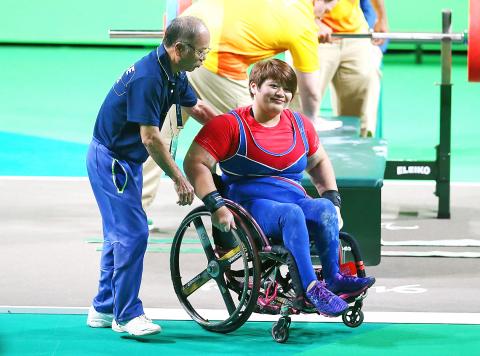
Photo: CNA
Taiwan’s only other medal was a silver in the men’s team table tennis tournament after the team lost to South Korea in the final on Friday last week.
However, Taiwanese could not watch the achievements on cable TV or the multimedia-on-demand (MOD) system offered by Chunghwa Telecom.
The lack of TV coverage spurred online discussion.
A netizen wrote on Professional Technology Temple — the nation’s largest academic online bulletin board — that he was hoping to watch some of the Games on MOD, but instead it reran events from the Summer Olympics.
“[Japan’s] NHK broadcasts the Paralympic Games live. Taiwan is a nation that discriminates against people with disabilities after all and lacks barrier-free facilities for them,” he said.
The comment drew mixed reaction.
One person said viewership is the determining factor when deciding whether to cover an event, adding that broadcasting companies are not charities.
Others said that not broadcasting the Paralympics cannot be equated with discriminating against people with disabilities.
They said TV networks chose not to broadcast the Paralympics because nobody watches them.
Taiwan is not the only nation grappling with a dearth of coverage of the Paralympics.
NBC in the US promised to allocate 66 hours of airtime for the Paralympics. However, that pales in comparison with the airtime dedicated to the Summer Olympics, which reached 6,755 hours, US blogger Sage Boggs said.
The lack of coverage of the Paralympics became ironic when four visually impaired runners in the 1,500m final ran faster than any Olympian in the same category, he wrote.
Pointing to the British network Channel 4’s coverage of the 2012 London Paralympics’ opening ceremony, which drew 11.2 million viewers, Boggs said it is not that there is not much appetite for the Paralympics in the US.
“It is just we’re too busy eating up football to realize there are athletes in Rio breaking world records,” he wrote.

FUKUOKA SITUATION: Japanese media reported that the pathogen is expected to be identified by the summer, while the CDC downplayed the idea that it was hMPV A “mysterious cold-like illness” reported in Japan’s Fukuoka Prefecture does not seem to be a new disease, but Japanese authorities have been asked about the situation, the Centers for Disease Control (CDC) said yesterday. The Fukuoka Prefectural Medical Association on Wednesday told a news conference that a “mystery cold” that has become a hot topic on social media is “highly likely to be caused by some kind of viral infection,” Japan’s KBC News reported. “Many people are experiencing symptoms starting with a sore throat, followed by a runny nose, phlegm and a severe cough,” KBC News reported, citing association officials. Health authorities are

Nvidia Corp CEO Jensen Huang (黃仁勳) arrived in Taiwan yesterday ahead of upcoming AI and technology events, saying he plans to meet with clients and Taiwan Semiconductor Manufacturing Co Chairman C.C. Wei (魏哲家) during his visit. After landing at Taipei Songshan Airport, Huang posed for photos with fans and handed out Yakult drinks to reporters and supporters waiting at the scene, saying he has “a lot to do” during the trip. Asked about reports that Nvidia’s planned headquarters site in Taipei’s Beitou Shilin Technology Park could break ground on May 27, Huang said that if the company holds an event, he would

Carrefour Taiwan is to begin using a new name from the start of July, but it cannot divulge the name until then, the chairman of the supermarket chain's parent company said today. President Chain Store Co chairman Lo Chih-hsien (羅智先) was asked by reporters after a shareholders' meeting to confirm whether the company has settled on a new name for the supermarket brand. In March, the government-registered name of two Carrefour Taiwan branches was quietly changed to "Le Chia Kang" (樂家康) in Chinese, raising speculation that has been selected as the name. Lo said that because of local regulations and contractual obligations, the
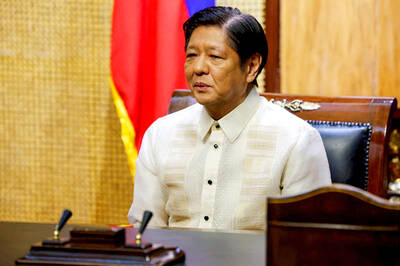
The Philippines would likely be involved in any conflict over Taiwan due to its proximity to the democracy claimed by China, President Ferdinand Marcos Jr said, reiterating a stance that risks angering Beijing. “In the Philippines, we do not have a choice because Taiwan is so close to the Philippines and we have almost 200,000 Filipino nationals living and working in Taiwan,” Marcos said in an interview with Japanese media in Manila on Monday. The Philippine leader’s comments come ahead of a state visit to Japan next week, where he is to meet with Japanese Prime Minister Sanae Takaichi to discuss security


 RSS
RSS