


The National Communications Commission (NCC) yesterday approved an amendment to the Regulations Governing the Classification of Television Programs (電視節目分級處理辦法), with the programs classified as suitable for children with parental guidance (PG) further divided into those that are appropriate viewing for teenagers aged between 12 and 14 years (PG-12) and those appropriate for teenagers between 15 and 17 (PG-15).
Current regulations stipulate that programs that are classified PG are recommended for audiences who are 12 years or older with parental guidance.
NCC spokesman Yu Hsiao-cheng (虞孝成) said the commission amended the regulations to make them consistent with those for movies and online games, adding that the regulations in Taiwan are now in sync with those of other nations. Television programs imported from other countries might not need to be re-rated if the program’s source country has a similar classification system to that of Taiwan, Yu said.
Yu said that the commission would hold a hearing next month with television channel operators and make necessary changes before implementing the new system.
The commission said the amendment was made after reviewing regulations implemented in the UK, Australia and South Korea.
The commission said it would allow programs classified “Protected” (P) to appear during prime time — between 7pm and 9pm — on regular channels on terrestrial or cable systems. P-rated programs are intended for children six years or older with parental guidance. These programs are only screened on movie channels between 7pm and 9pm.
Programs rated PG-12 can also be shown between 9pm and 11pm on regular channels after the new regulations take effect.
Movie channels would be allowed to show both PG-12 and PG-15 rated programs between 9pm and 11pm under the new regulations.
The commission said that it has also proposed partially lifting restrictions on programs on encrypted channels. With the exception of programs that are classified as having “hardcore pornographic content,” that involves sexual violence, sexual abuse or bestiality, explicit depictions of sexual organs no longer need to be removed or pixelated, it said.
However, the commission said that it would first seek public opinion concerning content for encrypted channels.
Yu said that the amendment also applies to television news program content, adding that the commission would present two options for people to consider.
“There are people who think television news content should remain G-rated [for all ages] at all times, whereas television news operators have asked for P-rated content, because G-rated footage might not always adequately express events,” he said.
The amendment requires TV operators to provide warnings before a program begins if it contains scenes of violence, horror, sexually explicit conduct, discriminatory language or alcohol or drug use, the commission said.

Yangmingshan National Park authorities yesterday urged visitors to respect public spaces and obey the law after a couple was caught on a camera livestream having sex at the park’s Qingtiangang (擎天崗) earlier in the day. The Shilin Police Precinct in Taipei said it has identified a suspect and his vehicle registration number, and would summon him for questioning. The case would be handled in accordance with public indecency charges, it added. The couple entered the park at about 11pm on Thursday and began fooling around by 1am yesterday, the police said, adding that the two were unaware of the park’s all-day live
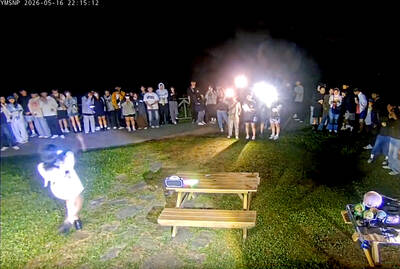
Yangmingshan National Park’s Qingtiangang (擎天崗) nature area has gone viral after a park livestream camera observed a couple in the throes of intimate congress, which was broadcast live on YouTube, drawing large late-night crowds and sparking a backlash over noise, bright lights and disruption to wildlife habitat. The area’s livestream footage appeared to show a couple engaging in sexual activity on a picnic table in the park on Friday last week, with the uncensored footage streamed publicly online. The footage quickly spread across social media, prompting a tide of visitors to travel to the site to “check in” and recreate the

A former soldier and an active-duty army officer were yesterday indicted for allegedly selling classified military training materials to a Chinese intelligence operative for a total of NT$79,440. The Taipei District Prosecutors’ Office indicted Chen Tai-yin (陳泰尹) and Lee Chun-ta (李俊達) for contravening the National Security Act (國家安全法) and the Anti-Corruption Act (貪污治罪條例). Chen left the military in September 2013 after serving alongside then-staff sergeant Lee, now an army lieutenant, at the 21st Artillery Command of the army’s Sixth Corps from 2011 to 2013, according to the indictment. Chen met a Chinese intelligence operative identified as “Wang” (王) through a friend in November

Minister of Digital Affairs Lin Yi-ching (林宜敬) yesterday cited regulatory issues and national security concerns as an expert said that Taiwan is among the few Asian regions without Starlink. Lin made the remarks on Facebook after funP Innovation Group chief executive officer Nathan Chiu (邱繼弘) on Friday said Taiwan and four other countries in Asia — China, North Korea, Afghanistan and Syria — have no access to Starlink. Starlink has become available in 166 countries worldwide, including Ukraine, Malaysia, the Philippines and Vietnam, in the six years since it became commercial, he said. While China and North Korea block Starlink, Syria is not


 RSS
RSS