


Products containing rhododendrol have been banned following complaints from consumers about depigmentation of the skin after they had used a product produced by Kanebo Cosmetics, the Food and Drug Administration (FDA) said on Tuesday last week.
The administration said that it had received many complaints from consumers that a Kanebo product containing rhododendrol had caused temporary depigmentation in the form of spots that appeared on their skin.
Kanebo is the only cosmetic company known to have used the substance in its products and following complaints the company’s Taiwan branch started a general recall of its products in Asia on July 4. By the end of last month, a total of 63,784 bottles, or about 99 percent of the product, had been recalled, the agency said.
Kanebo said the product contains natural minerals that help in the repression of melanin production, adding that the company spent 11 years researching the product.
The company also said that the product had passed a Japanese Ministry of Health, Labor and Welfare inspection.
Dermatologists said the depigmentation may have been due to an unforeseen allergic reaction to rhododendrol or simply because the substance is too effective.
The repression of melanin production by rhododendrol is 25 times that of vitamin C and as the substance is “toxic” to melanin, the depigmentation may simply be excessive repression, dermatologists said.
Food and Drug Administration medical supplies and cosmetic equipment division chief Lu Li-fu (呂理福) said the agency had received 354 complaints, with about 276 of those suspected of exhibiting depigmentation of the skin due to the use of the Kanebo product.
The other 47 were diagnosed as having depigmentation caused by other chemical substances, Lu said.
The depigmentation should disappear as long as patients diagnosed with the condition cease to use the product, Lu said, adding that some may require a brief period of medication before the effects of the depigmentation wear off.
The agency said that after extensive research into rhododendrol, it has banned its use in cosmetic products.
The agency said products containing the substance can no longer be imported or manufactured.
Additional reporting by Hung Su-ching

Taiwan has received more than US$70 million in royalties as of the end of last year from developing the F-16V jet as countries worldwide purchase or upgrade to this popular model, government and military officials said on Saturday. Taiwan funded the development of the F-16V jet and ended up the sole investor as other countries withdrew from the program. Now the F-16V is increasingly popular and countries must pay Taiwan a percentage in royalties when they purchase new F-16V aircraft or upgrade older F-16 models. The next five years are expected to be the peak for these royalties, with Taiwan potentially earning

STAY IN YOUR LANE: As the US and Israel attack Iran, the ministry has warned China not to overstep by including Taiwanese citizens in its evacuation orders The Ministry of Foreign Affairs (MOFA) yesterday rebuked a statement by China’s embassy in Israel that it would evacuate Taiwanese holders of Chinese travel documents from Israel amid the latter’s escalating conflict with Iran. Tensions have risen across the Middle East in the wake of US and Israeli airstrikes on Iran beginning Saturday. China subsequently issued an evacuation notice for its citizens. In a news release, the Chinese embassy in Israel said holders of “Taiwan compatriot permits (台胞證)” issued to Taiwanese nationals by Chinese authorities for travel to China — could register for evacuation to Egypt. In Taipei, the ministry yesterday said Taiwan
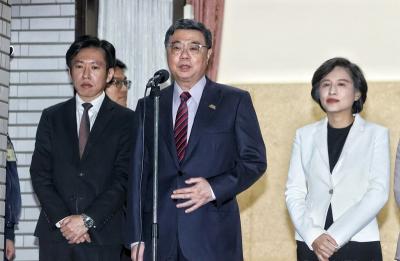
Taiwan is awaiting official notification from the US regarding the status of the Agreement on Reciprocal Trade (ART) after the US Supreme Court ruled US President Donald Trump's global tariffs unconstitutional. Speaking to reporters before a legislative hearing today, Premier Cho Jung-tai (卓榮泰) said that Taiwan's negotiation team remains focused on ensuring that the bilateral trade deal remains intact despite the legal challenge to Trump's tariff policy. "The US has pledged to notify its trade partners once the subsequent administrative and legal processes are finalized, and that certainly includes Taiwan," Cho said when asked about opposition parties’ doubts that the ART was
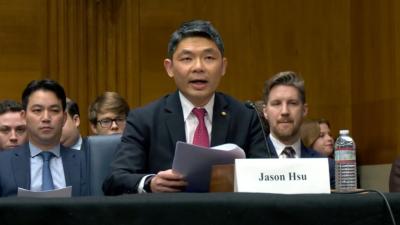
If China chose to invade Taiwan tomorrow, it would only have to sever three undersea fiber-optic cable clusters to cause a data blackout, Jason Hsu (許毓仁), a senior fellow at the Hudson Institute and former Chinese Nationalist Party (KMT) legislator, told a US security panel yesterday. In a Taiwan contingency, cable disruption would be one of the earliest preinvasion actions and the signal that escalation had begun, he said, adding that Taiwan’s current cable repair capabilities are insufficient. The US-China Economic and Security Review Commission (USCC) yesterday held a hearing on US-China Competition Under the Sea, with Hsu speaking on


 RSS
RSS