


The cross-strait service trade agreement is part of President Ma Ying-jeou’s (馬英九) “triangle policy” toward eventual unification with China and should not have been signed, a pro-independence advocacy group said yesterday.
“We believe that the agreement, along with the ‘one China’ principle, and a meeting between Ma and Chinese President Xi Jinping (習近平), form a triangle policy of Ma’s goal of eventual unification,” former presidential advisor Huang Tien-ling (黃天麟) wrote in a booklet published by the Taiwan Society.
A collection of several academic works, the booklet titled Crisis of the service trade agreement — a modern-day Trojan horse was officially launched yesterday at a press conference.
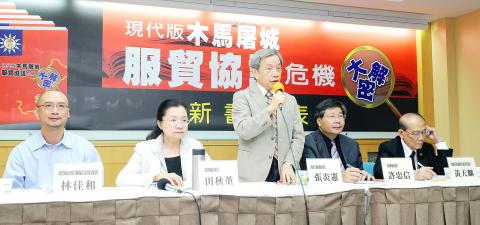
Photo: Wang Min-wei, Taipei Times
Breaking down the agreement into how it affects the economy, society, national security, democracy and institutionalized negotiations, the authors conclude that the pact is more of a political agreement than an economic one.
The cross-strait service trade agreement, which was signed in June, has touched upon the core aspect of the nation’s industries under the common market structure laid out in the Economic Cooperation Framework Agreement (ECFA) signed in 2009, and it could further tie the nation’s economy to the Chinese economy and have a devastating effect on small and medium-sized businesses, Huang said.
“Beijing’s strategy of reunification by trade is an open secret, which is why discussion of the agreement without a political deliberation would be foolish,” Huang said.
The agreement, which is due to be screened clause-by-clause in the legislature, was controversial due to the opaque way it was signed and the scale of its negative impacts on various local sectors of the service industry, in particular banking, retail and agriculture.
Closer cross-strait banking integration could cause a financial crisis if loans to Chinese end up as bad debts, National Taipei University professor Wang To-far (王塗發) told the press conference.
Once the trade in goods agreement is signed by the end of this year, Chinese investors would be able to dictate Taiwan’s retail market and integrate supply, wholesale and retail, retired National Taiwan University professor Kenneth Lin (林向愷) said.
The agricultural sector would face the same situation if the current ban on certain Chinese agricultural products is lifted, Lin added.
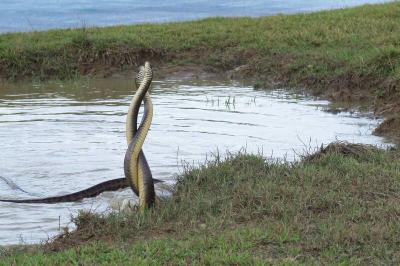
Kenting National Park service technician Yang Jien-fon (楊政峰) won a silver award in World Grand Prix Photography Awards Spring Season for his photograph of two male rat snakes intertwined in combat. Yang’s colleagues at Kenting National Park said he is a master of nature photography who has been held back by his job in civil service. The awards accept entries in all four seasons across six categories: architectural and urban photography, black-and-white and fine art photography, commercial and fashion photography, documentary and people photography, nature and experimental photography, and mobile photography. Awards are ranked according to scores and divided into platinum, gold and

More than half of the bamboo vipers captured in Tainan in the past few years were found in the city’s Sinhua District (新化), while other districts had smaller catches or none at all. Every year, Tainan captures about 6,000 snakes which have made their way into people’s homes. Of the six major venomous snakes in Taiwan, the cobra, the many-banded krait, the brown-spotted pit viper and the bamboo viper are the most frequently captured. The high concentration of bamboo vipers captured in Sinhua District is puzzling. Tainan Agriculture Bureau Forestry and Nature Conservation Division head Chu Chien-ming (朱健明) earlier this week said that the

The Chinese Nationalist Party (KMT) caucus yesterday said it opposes the introduction of migrant workers from India until a mechanism is in place to prevent workers from absconding. Minister of Labor Hung Sun-han (洪申翰) on Thursday told the Legislative Yuan that the first group of migrant workers from India could be introduced as early as this year, as part of a government program. The caucus’ opposition to the policy is based on the assessment that “the risk is too high,” KMT caucus secretary-general Lin Pei-hsiang (林沛祥) said. Taiwan has a serious and long-standing problem of migrant workers absconding from their contracts, indicating that

SPACE VETERAN: Kjell N. Lindgren, who helps lead NASA’s human spaceflight missions, has been on two expeditions on the ISS and has spent 311 days in space Taiwan-born US astronaut Kjell N. Lindgren is to visit Taiwan to promote technological partnerships through one of the programs organized by the US for its 250th national anniversary. Lindgren would be in Taiwan from Tuesday to Saturday next week as part of the US Bureau of Educational and Cultural Affairs’ US Speaker Program, organized to celebrate the 250th anniversary of the signing of the Declaration of Independence, the American Institute in Taiwan (AIT) said in a statement yesterday. Lindgren plans to engage with key leaders across the nation “to advance cutting-edge technological partnerships and inspire the next generation of scientists and engineers,”


 RSS
RSS