


Jewelry and silverware retailers are distressed over the confusion about whether their industry is to be opened up for Chinese investment and competition under the cross-strait service trade agreement.
Attempts to get a definitive answer from the government about the issue have failed, proprietors say.
Shih Wen-hsin (石文信), convener of the Taipei Jewelers’ Association, has weighed in with the criticism.
“Nobody knows what’s going on,” Shih said, referring to both business operators and government officials.
“It’s quite chaotic,” he said.
Shih said that jewelry and silverware shops are classified under the “services and channel sales” sector in Taiwan, and gold is open to retail and trading, but it is a controlled commodity in China.
“Thus when Chinese proprietors come to Taiwan [under the trade agreement], they do not have to pay customs duties. They can also operate gold and jewelry businesses as sole proprietors,” he said.
“However, if Taiwanese proprietors were to go to China, they will have to form a partnership with local companies and pay an import duty on gold of 17 percent,” he said.
Shih said there is a big difference between the Taiwanese and Chinese industry.
“We are not afraid of competition. The important issue is having a level playing field,” Shih said.
“In Taiwan, gold is quoted for sale according to the day’s international gold price. Each of our association’s members knows how to calculate the daily international gold price, foreign currency exchange rates, then add in transportation and insurance charges,” he said.
“A such, our members can explain to clients about costs and profit margins. [The process] is transparent and fair,” he said.
However, it is very different in China, Shih said.
“They have ‘gold price monopolization.’ China’s gold and silverware proprietors are joined together to monopolize and manipulate gold prices. The rights of Chinese consumers have long been violated. Chinese proprietors have a bad reputation in this sector,” he said.
“If we open up to Chinese investment and companies, it would lead to unfair competition in Taiwan,” Shih said.
Officials at the Bureau of Foreign Trade had earlier said that gold and silverware retailing is included in the cross-strait pact. However, they later said that the Ministry of Economic Affairs’ Department of Commerce and the Investment Commission were in charge of negotiating on which business sectors should be included in the agreement.
When contacted on Monday, Department of Commerce Deputy Chief Chen Mi-shun (陳秘順) said he did not know, as his department was not in charge of jewelry and silverware stores.
“We only provide services for business owners. We do not oversee their business activities,” he said.
“Our department formulates policies on measures to combat money laundering. But for reporting about money laundering, that is handled by the Money Laundering Prevention Center at the Ministry of Justice Investigation Bureau, he said.
“Retailing and business activities are not regulated by one single government agency,” he said.

Yangmingshan National Park authorities yesterday urged visitors to respect public spaces and obey the law after a couple was caught on a camera livestream having sex at the park’s Qingtiangang (擎天崗) earlier in the day. The Shilin Police Precinct in Taipei said it has identified a suspect and his vehicle registration number, and would summon him for questioning. The case would be handled in accordance with public indecency charges, it added. The couple entered the park at about 11pm on Thursday and began fooling around by 1am yesterday, the police said, adding that the two were unaware of the park’s all-day live
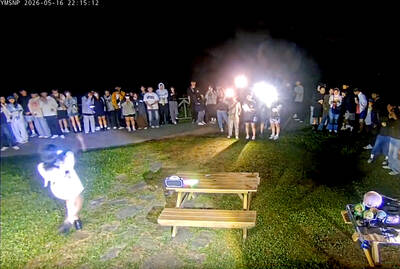
Yangmingshan National Park’s Qingtiangang (擎天崗) nature area has gone viral after a park livestream camera observed a couple in the throes of intimate congress, which was broadcast live on YouTube, drawing large late-night crowds and sparking a backlash over noise, bright lights and disruption to wildlife habitat. The area’s livestream footage appeared to show a couple engaging in sexual activity on a picnic table in the park on Friday last week, with the uncensored footage streamed publicly online. The footage quickly spread across social media, prompting a tide of visitors to travel to the site to “check in” and recreate the
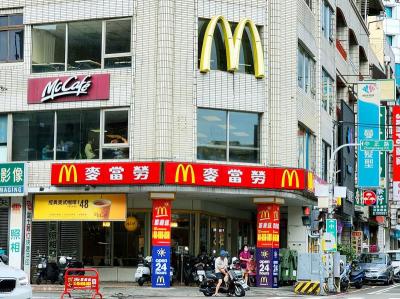
Fast food chain McDonald's is to raise prices by up to NT$5 on some products at its restaurants across Taiwan, starting on Wednesday next week, the company announced today. The prices of all extra value meals and sharing boxes are to increase by NT$5, while breakfast combos and creamy corn soup would go up by NT$3, the company said in a statement. The price of the main items of those meals, if ordered individually, would remain the same. Meanwhile, the price of a medium-sized lemon iced tea and hot cappuccino would rise by NT$3, extra dipping sauces for chicken nuggets would go up

Minister of Digital Affairs Lin Yi-ching (林宜敬) yesterday cited regulatory issues and national security concerns as an expert said that Taiwan is among the few Asian regions without Starlink. Lin made the remarks on Facebook after funP Innovation Group chief executive officer Nathan Chiu (邱繼弘) on Friday said Taiwan and four other countries in Asia — China, North Korea, Afghanistan and Syria — have no access to Starlink. Starlink has become available in 166 countries worldwide, including Ukraine, Malaysia, the Philippines and Vietnam, in the six years since it became commercial, he said. While China and North Korea block Starlink, Syria is not


 RSS
RSS