


Foreign visitors to Taipei can now wear a direction-inquiry sticker to get help finding their way around town, the Taipei City Government announced, in its latest effort to create a more tourist-friendly environment.
The blue stickers are available at 12 travel service centers.
Visitors who need directions can have the destination written in Chinese on the sticker, and carry it with them to get assistance more easily, Taipei City’s Department of Information and Tourism said yesterday.
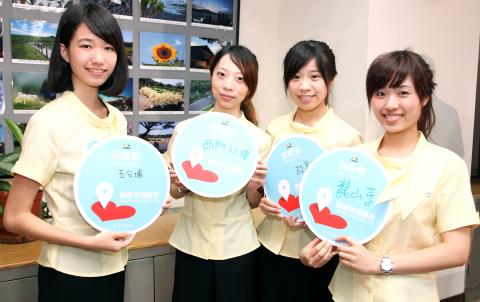
Photo: Lin Hsiang-mei, Taipei Times
Commissioner of the department Chao Hsin-ping (趙心屏) said 65 percent of foreign visitors to the service centers were seeking directions to tourist attractions.
The sticker, which says “I am going to .... Thanks for guiding me” in Chinese and English, will help foreign visitors and demonstrate the city’s friendliness, she said.
“Staff at the service centers used to write down the name of the destination and directions on memos for visitors who do not speak Chinese, and the sticker will help them get directions more easily,” she said.
“We also hope local residents who see visitors with such stickers in the streets can offer helps,” she said in a press conference at Taipei City Hall to introduce the stickers.
Yoshifumi Katakura, a Japanese travel writer who has lived in Taiwan for 16 years, said as the number of foreign visitors to Taipei has increased sharply over the years, the sticker is a friendly service for visitors who do not speak Chinese or backpackers who come to Taipei without a tour guide.
According to the department, 6.4 million foreign tourists visited Taipei last year.
More than 98 percent of foreign visitors are from China, followed by visitors from Japan, Hong Kong and Macau and South Korea.
Jule Foster, a visitor from Canada, applauded the department’s latest idea, and said the sticker should be helpful in areas with few or no English signs.
“I was in Maokong this morning, and didn’t find much English guidance in the area. It’d be nice and helpful to get around town with such a sticker,” she said.
Sarah Wantulok, a student from Poland, on the other hand, said she would not take the sticker because she has no trouble asking for directions on the streets.
“People are friendly here, and I can always get directions from local people, even though I don’t speak Chinese,” she said.
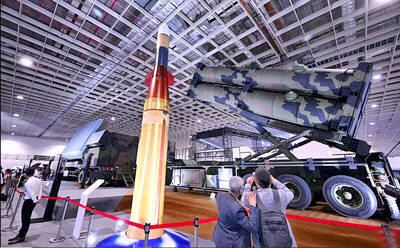
Taiwan is to commence mass production of the Tien Kung (天弓, “Sky Bow”) III, IV and V missiles by the second quarter of this year if the legislature approves the government’s NT$1.25 trillion (US$39.78 billion) special defense budget, an official said yesterday. Commenting on condition of anonymity, a defense official with knowledge of the matter said that the advanced systems are expected to provide crucial capabilities against ballistic and cruise missiles for the proposed “T-Dome,” an advanced, multi-layered air defense network. The Tien Kung III is an air defense missile with a maximum interception altitude of 35km. The Tien Kung IV and V
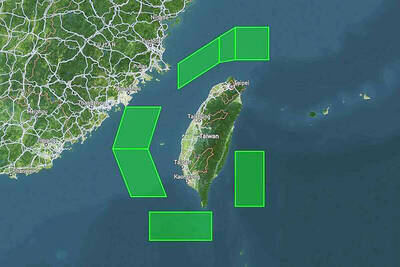
The disruption of 941 flights in and out of Taiwan due to China’s large-scale military exercises was no accident, but rather the result of a “quasi-blockade” used to simulate creating the air and sea routes needed for an amphibious landing, a military expert said. The disruptions occurred on Tuesday and lasted about 10 hours as China conducted live-fire drills in the Taiwan Strait. The Civil Aviation Administration (CAA) said the exercises affected 857 international flights and 84 domestic flights, affecting more than 100,000 travelers. Su Tzu-yun (蘇紫雲), a research fellow at the government-sponsored Institute for National Defense and Security Research, said the air
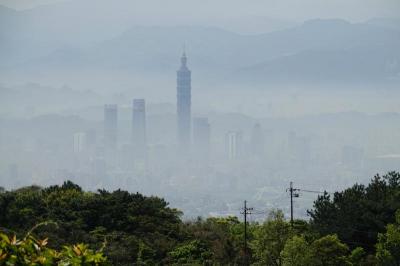
A strong continental cold air mass is to bring pollutants to Taiwan from tomorrow, the Ministry of Environment said today, as it issued an “orange” air quality alert for most of the country. All of Taiwan except for Hualien and Taitung counties is to be under an “orange” air quality alert tomorrow, indicating air quality that is unhealthy for sensitive groups. In China, areas from Shandong to Shanghai have been enveloped in haze since Saturday, the ministry said in a news release. Yesterday, hourly concentrations of PM2.5 in these areas ranged from 65 to 160 micrograms per cubic meter (mg/m³), and pollutants were
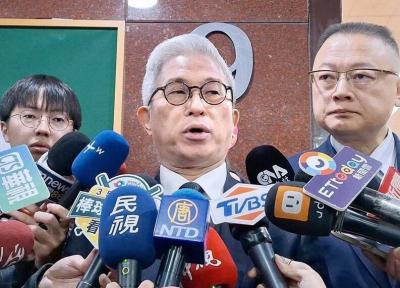
Taiwan’s armed forces have established response protocols for a wide range of sudden contingencies, including the “Wan Chun Plan” to protect the head of state, the Ministry of Defense (MND) said today. After US President Donald Trump on Saturday launched a series of airstrikes in Venezuela and kidnapped Venezuelan President Nicolas Maduro, concerns have been raised as to whether China would launch a similar “decapitation strike” on Taiwan. The armed forces regularly coordinate with relevant agencies and practice drills to ensure preparedness for a wide range of scenarios, Vice Minister of National Defense Hsu Szu-chien (徐斯儉) told reporters before a


 RSS
RSS