


While family members of 228 Massacre victims might draw a blank as to who Huang Rongcan (黃榮燦) is, they are most likely familiar with his print painting Terrible Inspection (恐怖的檢查), a work of art that has become one of the most famous depictions of the 228 Incident.
The 228 Incident refers to the military crackdown by the Chinese Nationalist Party (KMT) regime that began on Feb. 27, 1947. Tens of thousands were killed, the majority of them social elites and intellectuals.
Documentary director Hung Wei-chien (洪維健) said that about seven or eight years ago, he discovered the headstone with Huang’s name while participating in a research project commissioned by the Foundation for Compensation of Improper Verdicts During the Martial Law Era — a semi-official organization in charge of compensating political victims and their families.
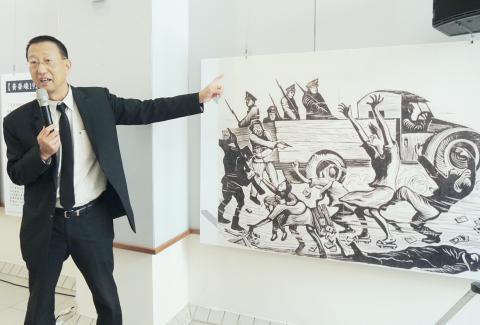
Photo: Yu Hsueh-lan, Taipei Times
“It was then that I became interested in the person [Huang] and started to try and piece together his life’s story,” Hung said, adding that he traveled to China to interview Huang’s younger brother — who was 90 years old at the time.
Hung said he traveled across Japan to find out more about Huang and to gather more of his works.
According to Hung, Huang was born in China’s Sichuan Povince and came to Taiwan in 1945. When the 228 Incident happened, he was working as an editor at a newspaper. He was so moved when he heard from a colleague of the 228 Massacre that he created the painting.
Last year, Hung produced a documentary titled Huang Rongcan’s City of Sadness (黃榮燦的悲情城市) and also initiated an art exhibition tour featuring Huang’s art works.
The original print of Terrible Inspection was given to Kakichi Uchiyama, a friend of Chinese novelist Lu Xun (魯迅), who was an acquaintance of Huang, before Uchiyama brought the print to Japan and donated it to Kamakura City’s Museum of Modern Art, which was founded in 1951.
The print was not seen again until 1975, Hung said.
Though Huang did not suffer during the 228 Massacre, his political inclinations — leaning toward the political left — made him a target of oppression during the Marital Law era, and Huang was sentenced to execution by shooting in 1952 — aged 32 — due to his involvement in the Wu Naiguang (吳乃光) case.
According to the Ministry of National Defense ruling, Wu, hailing from China’s Guangdong Province, a bookstore owner in Pingtung, continued his affiliation with the Chinese communists after coming to Taiwan with the then-KMT government.
Hung said that currently only New Tang Dynasty Television, an independent television channel founded by members of the Falun Gong and oversea compatriots, would screen his documentary, adding that other TV stations would only play the less politcally sensitive snippets of his documentary.
Chinese TV stations had also bought the documentary, and it is aired in China more often than in Taiwan, Hung said.
Hung, an activist supporting victims of the White Terror era and the 228 Incident, has spent a decade making documentaries for these victims, and said he could understand how they felt as he had also been imprisoned for five years on Green Island (綠島) along with his parents, who were jailed for attending a book club.

Taiwan has received more than US$70 million in royalties as of the end of last year from developing the F-16V jet as countries worldwide purchase or upgrade to this popular model, government and military officials said on Saturday. Taiwan funded the development of the F-16V jet and ended up the sole investor as other countries withdrew from the program. Now the F-16V is increasingly popular and countries must pay Taiwan a percentage in royalties when they purchase new F-16V aircraft or upgrade older F-16 models. The next five years are expected to be the peak for these royalties, with Taiwan potentially earning
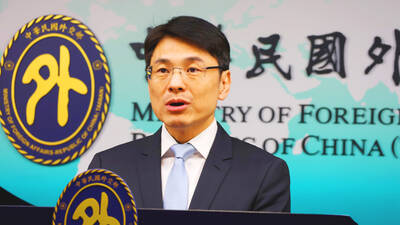
STAY IN YOUR LANE: As the US and Israel attack Iran, the ministry has warned China not to overstep by including Taiwanese citizens in its evacuation orders The Ministry of Foreign Affairs (MOFA) yesterday rebuked a statement by China’s embassy in Israel that it would evacuate Taiwanese holders of Chinese travel documents from Israel amid the latter’s escalating conflict with Iran. Tensions have risen across the Middle East in the wake of US and Israeli airstrikes on Iran beginning Saturday. China subsequently issued an evacuation notice for its citizens. In a news release, the Chinese embassy in Israel said holders of “Taiwan compatriot permits (台胞證)” issued to Taiwanese nationals by Chinese authorities for travel to China — could register for evacuation to Egypt. In Taipei, the ministry yesterday said Taiwan
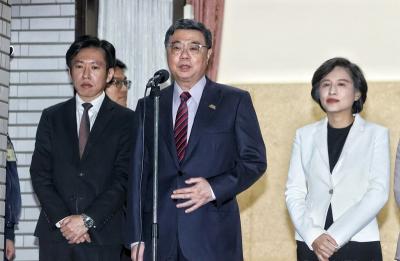
Taiwan is awaiting official notification from the US regarding the status of the Agreement on Reciprocal Trade (ART) after the US Supreme Court ruled US President Donald Trump's global tariffs unconstitutional. Speaking to reporters before a legislative hearing today, Premier Cho Jung-tai (卓榮泰) said that Taiwan's negotiation team remains focused on ensuring that the bilateral trade deal remains intact despite the legal challenge to Trump's tariff policy. "The US has pledged to notify its trade partners once the subsequent administrative and legal processes are finalized, and that certainly includes Taiwan," Cho said when asked about opposition parties’ doubts that the ART was
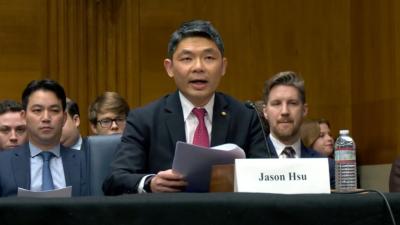
If China chose to invade Taiwan tomorrow, it would only have to sever three undersea fiber-optic cable clusters to cause a data blackout, Jason Hsu (許毓仁), a senior fellow at the Hudson Institute and former Chinese Nationalist Party (KMT) legislator, told a US security panel yesterday. In a Taiwan contingency, cable disruption would be one of the earliest preinvasion actions and the signal that escalation had begun, he said, adding that Taiwan’s current cable repair capabilities are insufficient. The US-China Economic and Security Review Commission (USCC) yesterday held a hearing on US-China Competition Under the Sea, with Hsu speaking on


 RSS
RSS