


The Vatican has long hoped to establish diplomatic relations with China, but that “could still be a long way off,” because dialogue between the two sides — let alone negotiations — has yet to develop, former ambassador to the Holy See Tou Chou-seng (杜筑生) said yesterday.
Having served as the nation’s ambassador to the Vatican, the only European state to maintain diplomatic ties with Taiwan, between 2003 and 2008, Tou recently published a book The International Status of the Holy See and its Relations with China (教廷的國際地位兼論教廷與中國的關係).
At a book launch, Tou spoke about the evolution of the Vatican’s China policy and possible future of relations between the Holy See, Taiwan and China, questions he said he was often asked about.
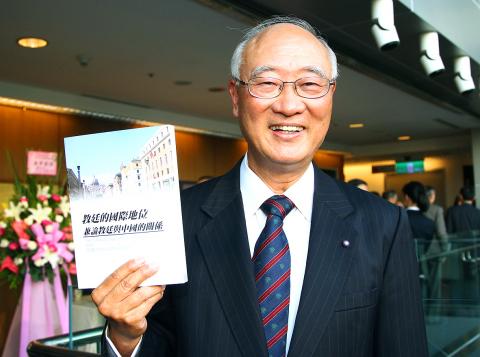
Photo: CNA
The incident last month, in which China stripped Ma Daqin (馬達欽), the auxiliary bishop of Shanghai, of his title has brought relations between China and the Vatican to a new low, Tou said.
Ma’s ordination, with the approval of China and the Vatican, had been seen as a hopeful sign that both sides could live with the disagreement over the appointment of Chinese bishops, but that hope was dashed after Ma was placed under house arrest for publicly renouncing the Chinese Catholic Patriotic Association (CCPA), Tou said.
The CCPA is China’s state-run organization that controls the state-backed Catholic Church and officially represents Chinese Catholics.
China runs the country’s Catholic church independently of the Vatican, and if the situation remains unchanged, its aim of establishing ties with the papal state is “a quixotic goal,” he said.
The Vatican has long held a “one China” policy, except during a period when Pope Paul VI served as pope and advocated a “two China” policy in 1964 that would see the UN recognize the People’s Republic of China without dropping the Republic of China, Tou said.
When former president Chen Shui-bian (陳水扁) was re-elected in 2004, he had wished that the nation’s diplomatic allies could add “Taiwan” to the names of their embassy in Taipei, Tou said.
“Although the Holy See did not oppose the idea, it has never changed the name of its embassy in Taipei. It is still called the ‘Apostolic Nunciature in China,’ while Holy See secretariat of state has addressed the nation’s embassy in Vatican as the ‘Embassy of China to the Holy See’ in correspondence,” Tou said.
Tou said that he had, on various occasions, inquired with the Vatican about the possibility of it switching recognition from Taipei to Beijing, following hints by Vatican officials.
“The answer I received was always the same: That could only happen when most people in China enjoy freedom of religious beliefs,” he said.
That does not mean that the Vatican would never establish diplomatic ties with China, but the time has not yet come, he said.
In his book, Tou said that the Vatican has repeatedly promised Taiwan that the Chinese Regional Bishops’ Conference, informally known as the Bishops’ Conference of Taiwan, and the nation’s embassy in the Vatican will be informed of any major decision it makes on cross-strait relations.
It will not make a decision that would catch Taiwan unprepared, he said.
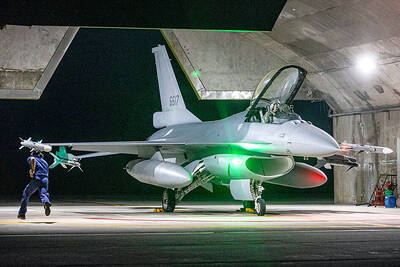
Taiwan has received more than US$70 million in royalties as of the end of last year from developing the F-16V jet as countries worldwide purchase or upgrade to this popular model, government and military officials said on Saturday. Taiwan funded the development of the F-16V jet and ended up the sole investor as other countries withdrew from the program. Now the F-16V is increasingly popular and countries must pay Taiwan a percentage in royalties when they purchase new F-16V aircraft or upgrade older F-16 models. The next five years are expected to be the peak for these royalties, with Taiwan potentially earning
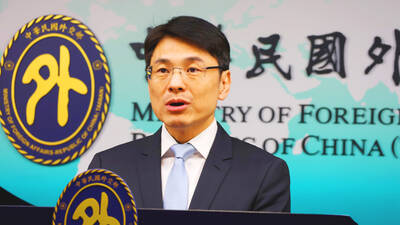
STAY IN YOUR LANE: As the US and Israel attack Iran, the ministry has warned China not to overstep by including Taiwanese citizens in its evacuation orders The Ministry of Foreign Affairs (MOFA) yesterday rebuked a statement by China’s embassy in Israel that it would evacuate Taiwanese holders of Chinese travel documents from Israel amid the latter’s escalating conflict with Iran. Tensions have risen across the Middle East in the wake of US and Israeli airstrikes on Iran beginning Saturday. China subsequently issued an evacuation notice for its citizens. In a news release, the Chinese embassy in Israel said holders of “Taiwan compatriot permits (台胞證)” issued to Taiwanese nationals by Chinese authorities for travel to China — could register for evacuation to Egypt. In Taipei, the ministry yesterday said Taiwan
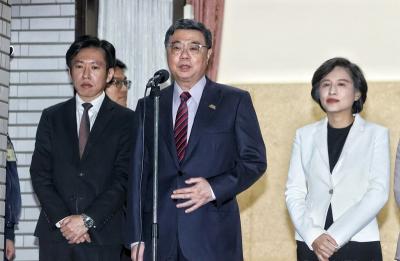
Taiwan is awaiting official notification from the US regarding the status of the Agreement on Reciprocal Trade (ART) after the US Supreme Court ruled US President Donald Trump's global tariffs unconstitutional. Speaking to reporters before a legislative hearing today, Premier Cho Jung-tai (卓榮泰) said that Taiwan's negotiation team remains focused on ensuring that the bilateral trade deal remains intact despite the legal challenge to Trump's tariff policy. "The US has pledged to notify its trade partners once the subsequent administrative and legal processes are finalized, and that certainly includes Taiwan," Cho said when asked about opposition parties’ doubts that the ART was
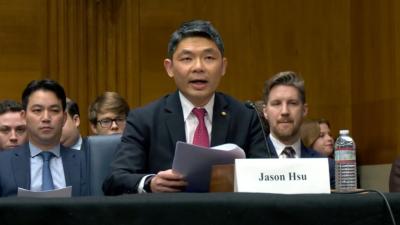
If China chose to invade Taiwan tomorrow, it would only have to sever three undersea fiber-optic cable clusters to cause a data blackout, Jason Hsu (許毓仁), a senior fellow at the Hudson Institute and former Chinese Nationalist Party (KMT) legislator, told a US security panel yesterday. In a Taiwan contingency, cable disruption would be one of the earliest preinvasion actions and the signal that escalation had begun, he said, adding that Taiwan’s current cable repair capabilities are insufficient. The US-China Economic and Security Review Commission (USCC) yesterday held a hearing on US-China Competition Under the Sea, with Hsu speaking on


 RSS
RSS