


Democratic Progressive Party (DPP) Legislator Kuan Bi-ling (管碧玲) yesterday accused the Government Information Office (GIO) of lowering the status of a proposed national film culture center in Kaohsiung for political reasons.
Kuan, who previously served as director of the city’s Bureau of Cultural Affairs and then its information office, issued a press release accusing the GIO of diminishing the status of the center by placing it under a similar facility to be built in Sinjhuang, Taipei County, despite the former DPP administration’s decision to give the two centers equal status with the aim of developing Taipei and Kaohsiung’s film industries.
MERGED
Kaohsiung’s information office was merged with the city’s Tourism Bureau last month.
The GIO proposed the plan to build the two centers to the Council of Economic Planning and Development for review on Wednesday.
Under the plan, a main center would be built in Sinjhuang next year, while a branch would be built in Neiweipi (內惟埤) in Kaohsiung in 2014. Construction is scheduled for completion by 2018.
The construction work is expected to cost NT$5.6 billion (US$174.2 million).
Kuan said the GIO’s proposal showed that total floor space of the branch in Kaohsiung would only be equal to one quarter the floor area of the center in Sinjhaung.
The center in Kaohsiung would not have any rooms for book collections, auditoriums, film studios or sets available to crews filming in the city, Kuan said.
EFFORTS
In terms of budget, the construction of the center in Kaohsiung would only account for NT$1.1 billion of the NT$5.6 billion total budget, Kuan said, adding that this showed the Cabinet was completely ignoring the city’s efforts to develop a local film industry.
Kuan described the GIO’s proposal as “a typical example of favoring northern Taiwan over southern Taiwan” and “a national policy based on political differences.”
Although the city’s Bureau of Cultural Affairs director Shih Jhe (史哲) gave the GIO credit for proposing to build one of the centers in Kaohsiung, he said the Kaohsiung center would be “too small.”
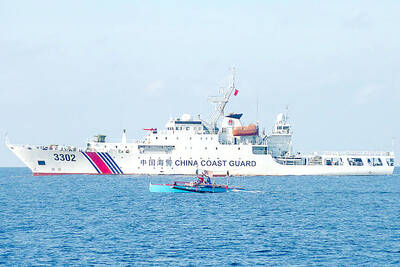
EXPANSIONIST: China deploys an average of 40 to 50 warships and coast guard vessels daily in the South China Sea, despite pledges not to militarize the region, an official said China is attempting to expand its influence across the First Island Chain and increase pressure on Japan by sending coast guard vessels into waters off of Taiwan under the pretext of maritime negotiations with Japan and the Philippines, a national security official said yesterday. China’s recent actions in the waters east of Taiwan and Japan and the Philippines’ exclusive economic zones (EEZ) are attempts to establish dominance in First Island Chain waters, said the official who declined to be named, adding that this is “expansion disguised as law enforcement.” Framing China’s actions solely as a cross-strait issue is a serious misjudgment that
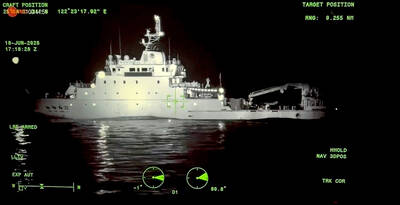
EXCUSES: Beijing is using government and research vessels as a pretext to harass the nation and enter its EEZ, and engage in ‘hegemonic expansion,’ the coast guard said The Coast Guard Administration yesterday said it drove away Chinese oceanographic research vessel Xiang Yang Hong 22 (向陽紅33) from restricted waters after warning it that it was in Taiwan’s exclusive economic zone (EEZ). The Chinese vessel entered restricted waters off the coast of Yilan County’s Suao (蘇澳) at 11:35pm on Thursday, the coast guard said, adding that it dispatched the Lanyu patrol vessel and the boat PP-10077 to shadow the Chinese ship and issue radio warnings ordering it to leave. China has no sovereignty over waters off Taiwan’s east coast, Lanyu’s crew told Xiang Yang Hong 22 over the radio, and demanded
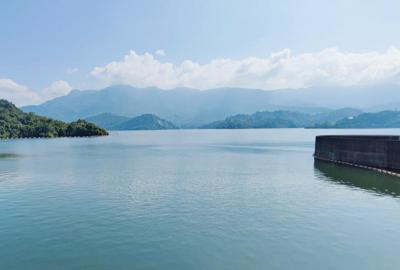
Several major reservoirs are estimated to have received 590 million tonnes of water inflow from June 4 to this morning, with storage levels at Wushantou Reservoir exceeding 50 percent and Zengwen Reservoir approaching 30 percent as of 9am today, data from the Water Resources Agency showed. Of the estimated 590 million tonnes, 450 million have already been stored in reservoirs, the data showed. As of 9am today, Baoshan Reservoir storage levels reached 100 percent, while Baoshan Second Reservoir, Yongheshan Reservoir and Techi Reservoir all exceeded 90 percent, data on the Water Resources Agency’s Web site showed. In addition, the Shimen Reservoir is at

BAIT AND SWITCH: Allowing KMT-run counties to sell to China while the threat of abrupt cancelations hangs overhead is another form of coercion, officials said Beijing is using agricultural purchase offers announced during the Straits Forum to deepen Taiwan’s dependence on the Chinese market, a Taiwanese official said yesterday as they criticized the Taitung County commissioner’s participation in the initiative. During the Straits Forum held in Xiamen on Saturday, Chinese officials announced a sales and purchase agreement for agricultural products from some counties led by the Chinese Nationalist Party (KMT). Taitung County Commissioner Yao Ching-ling (饒慶鈴), who was barred from attending the event in person by the Mainland Affairs Council, participated via video. Under the agreement, China would purchase atemoyas, pomeloes, tea and grouper harvested in Taitung,


 RSS
RSS