


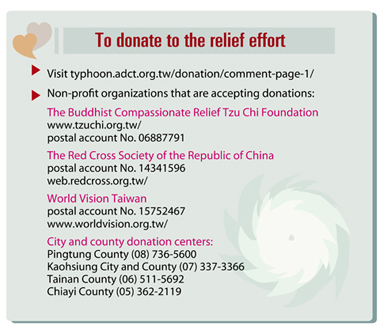
Under a scorching sun and a sudden downpour, ambassadors from Taiwan’s diplomatic allies in Taipei yesterday pulled out all stops to sell items from their countries to raise funds for the victims of Typhoon Marokot.
The two-day charity sale, sponsored by the International Cooperation and Development Fund, drew hundreds of buyers in Taipei.
Standing behind a table filled with handmade clay vases and leather goods from Nicaragua, Ambassador William Tapia said the sale was a display of gratitude and solidarity from the people of his country.

PHOTO: CHIEN JUNG-FONG, TAIPEI TIMES
“The people of Nicaragua have received much help from Taiwan during times of need. Taiwan was often the first country to come to Nicaragua’s aid when we needed relief. Now that a disaster has struck Taiwan, we are here to help,” he said.
“Even though our hearts are big, our wallets are small. But we still want to do something to show our solidarity,” he said.
Burkina Faso also set up a booth selling hand-made African tie-dye clothes. Paraguay, Honduras, the Dominican Republic, Haiti, Belize, the Marshall Islands and Nauru also joined in the effort by donating trinkets from their countries.
Bakary Singhateh, a Gambian student at National Taiwan Normal University, said he was deeply touched by the images of the typhoon he saw on TV.
To help with the relief work, he and other Gambian friends donated memorabilia they brought from home to the charity sale, he said.
Jasmine Huggins, charge d’affaires from Saint Kitts and Nevis said people from her country felt compelled to help, adding that if possible, she would be happy to go to the disaster zone to help with cleanup efforts.
“This is a demonstration that we are very willing to cooperate. No matter what amount, we are with Taiwan. We are expressing our solidarity with your country and your people,” El Salvadoran Ambassador Francisco Santana.
Minister of Foreign Affairs Francisco Ou (歐鴻鍊) and deputy foreign minister Javier Hou (侯清山) were scheduled to appear at the event, but both did not show up.

Yangmingshan National Park authorities yesterday urged visitors to respect public spaces and obey the law after a couple was caught on a camera livestream having sex at the park’s Qingtiangang (擎天崗) earlier in the day. The Shilin Police Precinct in Taipei said it has identified a suspect and his vehicle registration number, and would summon him for questioning. The case would be handled in accordance with public indecency charges, it added. The couple entered the park at about 11pm on Thursday and began fooling around by 1am yesterday, the police said, adding that the two were unaware of the park’s all-day live

Yangmingshan National Park’s Qingtiangang (擎天崗) nature area has gone viral after a park livestream camera observed a couple in the throes of intimate congress, which was broadcast live on YouTube, drawing large late-night crowds and sparking a backlash over noise, bright lights and disruption to wildlife habitat. The area’s livestream footage appeared to show a couple engaging in sexual activity on a picnic table in the park on Friday last week, with the uncensored footage streamed publicly online. The footage quickly spread across social media, prompting a tide of visitors to travel to the site to “check in” and recreate the

A former soldier and an active-duty army officer were yesterday indicted for allegedly selling classified military training materials to a Chinese intelligence operative for a total of NT$79,440. The Taipei District Prosecutors’ Office indicted Chen Tai-yin (陳泰尹) and Lee Chun-ta (李俊達) for contravening the National Security Act (國家安全法) and the Anti-Corruption Act (貪污治罪條例). Chen left the military in September 2013 after serving alongside then-staff sergeant Lee, now an army lieutenant, at the 21st Artillery Command of the army’s Sixth Corps from 2011 to 2013, according to the indictment. Chen met a Chinese intelligence operative identified as “Wang” (王) through a friend in November

Minister of Digital Affairs Lin Yi-ching (林宜敬) yesterday cited regulatory issues and national security concerns as an expert said that Taiwan is among the few Asian regions without Starlink. Lin made the remarks on Facebook after funP Innovation Group chief executive officer Nathan Chiu (邱繼弘) on Friday said Taiwan and four other countries in Asia — China, North Korea, Afghanistan and Syria — have no access to Starlink. Starlink has become available in 166 countries worldwide, including Ukraine, Malaysia, the Philippines and Vietnam, in the six years since it became commercial, he said. While China and North Korea block Starlink, Syria is not


 RSS
RSS