


Democratic Progressive Party (DPP) Legislator Chen Ying (陳瑩) — a Puyuma Aborigine — expressed concern yesterday that proposed amendments to the Local Government Act (地方制度法) may harm Aborigines’ political rights.
“The current version of the act stipulates that all heads of ‘mountain Aboriginal townships’ must be ‘mountain Aborigines.’ But if counties and cities are combined and upgraded as direct-administrated municipalities, such legal advantages for Aborigines will no longer exist,” she said during an Internal Administration Committee meeting at the legislature to review proposed amendments to the act.
Laws categorize the Aboriginal regions, which cover 55 townships, into 30 “mountain Aboriginal townships” and 25 “plains Aboriginal townships,” and stipulate that only “mountain Aborigines” can be mountain Aboriginal township mayors in order to ensure political participation.
However, Chen is concerned about recent proposals from the Cabinet, the DPP legislative caucus and several individual lawmakers across party lines to amend the Local Government Act.
Most of these proposals would allow counties and cities to merge so that they can pass the population threshold of 1.25 million to be upgraded to the status of direct-administrated municipalities.
Only Taipei and Kaohsiung cities have this status now, which gives them a greater degree of autonomy and bigger budgets.
So far, Taipei, Taichung, Nantou, Tainan, Kaohsiung and Pingtung cities and counties have expressed interest in becoming direct-administrated municipalities, whether individually or after mergers between city and county.
“When counties become direct-administrated municipalities, mountain Aboriginal townships — such as Wulai Township [烏來] in Taipei County and Heping Township [和平] in Taichung County — will become administrative districts,” Chen said.
“City district heads are appointed by mayors and there’s no regulation that they should be Aborigines,” she said.
Alang Qalavangan, an aide to Chen, said that if administrative upgrades happen in all counties that are interested in it, “15 townships — which is half of the total number of mountain Aboriginal townships — would become districts in cities.”
“This would be a disaster and a step backward for Aboriginal autonomy,” he said.
The director of the Council of Indigenous Peoples’ [CIP] Planning Department, Wang Chiu-i (汪秋一), said that the council had yet to consider it but promised that it would try to find a solution.
While Chinese Nationalist Party (KMT) Aboriginal lawmakers supported Chen on the issue, they disagreed with her about breaking the boundary between mountain and plains Aborigines.
“People move around a lot nowadays,” Chen said.
“It’s ridiculous to not allow a plains Aborigine who lives in a mountain Aboriginal township to vote for an Aboriginal candidate just because he or she is not a mountain Aborigine,” she said.
“It’s equally unreasonable that a mountain Aborigine who moves to a non-mountain Aborigine township be banned from voting for a plains Aboriginal candidate,” she said.
However, Aboriginal lawmakers Kung Wen-chi (孔文吉), Yang Jen-fu (楊仁福) and Chien Tung-ming (簡東明) of the KMT disagreed.
If mountain Aborigines could vote or run in a non-mountain Aboriginal electoral district, it would affect plains Aborigines’ rights of political participation, they said.
The three proposed a motion to hold Chen’s suggestions for now and asked the CIP to hold public hearings to gather opinions on the issues.

Taiwan has received more than US$70 million in royalties as of the end of last year from developing the F-16V jet as countries worldwide purchase or upgrade to this popular model, government and military officials said on Saturday. Taiwan funded the development of the F-16V jet and ended up the sole investor as other countries withdrew from the program. Now the F-16V is increasingly popular and countries must pay Taiwan a percentage in royalties when they purchase new F-16V aircraft or upgrade older F-16 models. The next five years are expected to be the peak for these royalties, with Taiwan potentially earning
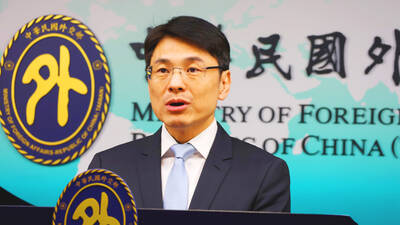
STAY IN YOUR LANE: As the US and Israel attack Iran, the ministry has warned China not to overstep by including Taiwanese citizens in its evacuation orders The Ministry of Foreign Affairs (MOFA) yesterday rebuked a statement by China’s embassy in Israel that it would evacuate Taiwanese holders of Chinese travel documents from Israel amid the latter’s escalating conflict with Iran. Tensions have risen across the Middle East in the wake of US and Israeli airstrikes on Iran beginning Saturday. China subsequently issued an evacuation notice for its citizens. In a news release, the Chinese embassy in Israel said holders of “Taiwan compatriot permits (台胞證)” issued to Taiwanese nationals by Chinese authorities for travel to China — could register for evacuation to Egypt. In Taipei, the ministry yesterday said Taiwan
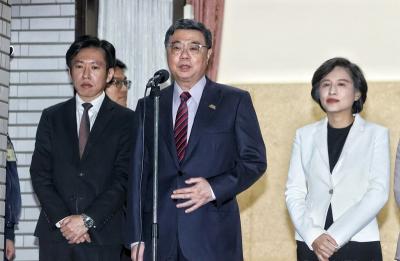
Taiwan is awaiting official notification from the US regarding the status of the Agreement on Reciprocal Trade (ART) after the US Supreme Court ruled US President Donald Trump's global tariffs unconstitutional. Speaking to reporters before a legislative hearing today, Premier Cho Jung-tai (卓榮泰) said that Taiwan's negotiation team remains focused on ensuring that the bilateral trade deal remains intact despite the legal challenge to Trump's tariff policy. "The US has pledged to notify its trade partners once the subsequent administrative and legal processes are finalized, and that certainly includes Taiwan," Cho said when asked about opposition parties’ doubts that the ART was
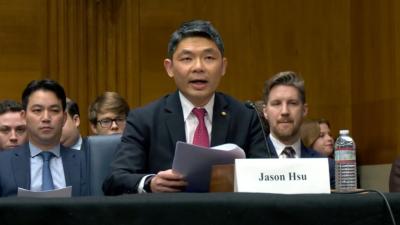
If China chose to invade Taiwan tomorrow, it would only have to sever three undersea fiber-optic cable clusters to cause a data blackout, Jason Hsu (許毓仁), a senior fellow at the Hudson Institute and former Chinese Nationalist Party (KMT) legislator, told a US security panel yesterday. In a Taiwan contingency, cable disruption would be one of the earliest preinvasion actions and the signal that escalation had begun, he said, adding that Taiwan’s current cable repair capabilities are insufficient. The US-China Economic and Security Review Commission (USCC) yesterday held a hearing on US-China Competition Under the Sea, with Hsu speaking on


 RSS
RSS