


She tangoed energetically, waltzed gracefully and quickstepped perfectly with her partner on the dance floor, enjoying herself and entertaining the audience.
Her fluid movements were constantly dynamic and at times she seemed to be floating, twirling to quick and complex cadences.
At 83, Sung Yu-heng (宋羽亨) is more than alive and well. She is truly kicking. With the figure of a teenage girl, she dances like a pro.

PHOTO: CNA
The retired Chiayi school teacher began to dance only seven years ago, but has since wowed audiences all over the country, shattering stereotypes and traditional beliefs about the kind of life elderly people should lead.
While many of her counterparts in Taiwan spend their days chatting in parks, taking care of grandchildren or shopping and cooking for their families, Sung practices complicated dance steps for two hours during most days of the week. Through her lifestyle, she has encouraged her peers to get out — if not hit the dance floor — to live their golden years to the fullest.
“I never thought my life would turn out this way … [with me] so energetic and happy,” Sung said.
Sung came in contact with dancing accidentally, at age 76. After her retirement, the widower said she worked in the morning as a quality control worker at one of the electronic factories owned by her daughter and son “to keep an eye on the children.”
She also spent a lot of time trading stocks by phone “to make some petty money” and played mahjong with friends into the evening “to protect herself against senile dementia.”
With her health declining and her wallet thinning from stocks trading and mahjong, Sung told one of her mahjong partners she probably needed to “overhaul” her lifestyle once and for all by doing physical exercise.
Several days later, her friends took her to a dance club — a perfect location for social dancing and to make friends. But she didn’t take to social dancing immediately.
“It was nothing but two people pushing and pulling,” Sung said.
After about a year of on-and-off social dancing, a teacher of international standard dances, her future dancing coach, Shih Ta-chien (施達乾), realized that Sung had talent and could be “carved into a jewel.”
Shih, a professional ballroom dancer, persuaded Sung to be his student, recognizing that despite her age, Sung had all it took to become a good dancer.
Partly through the efforts of her 41-year-old teacher, Sung became a good pupil, taking two-hour courses four times a week.
She later proved Shih right.
After studying with Shih for several years, Sung said she progressed from “having two left feet” to a respectable level, albeit with a substantial investment in time and money.
“Sung has a good physique, with muscles and bones that were much younger than people her age … First and foremost, dancing is so natural for her, as if it was in her blood,” Shih said.
Shih’s encouragements and spectators’ praise at small dance events gave Sung a lot of confidence, spurring her to want to learn more to master the steps and push herself.
Amazingly, Sung said, after putting in the effort, she became healthier than she had felt six years earlier. Most importantly, she feels carefree and lighthearted every time she walks away from the dance studio.
“You expect more and more of yourself; it’s a bit of an addictive feeling,” she said.
Fame came naturally and Sung gained widespread attention.
She and Shih have been invited to show their dance moves in Southeast Asia. The duo has appeared and danced in many of the major TV variety shows in Taiwan and have been invited to appear on other educational TV programs.
She was cited by local TV hosts as a role model for retirees seeking to stay healthy and spend their later years happily. In February, Sung and her instructor were special guests at the closing gala of the 2008 Professional Dance Championships Asian Tour Taipei Open.
After demonstrating their perfect footwork, the pair received a standing ovation by the packed audience, many of whom were leading professional dancers from around the world.
The audience went wild when Sung spun clockwise in her record-high of 33 times at one stroke.
The audience was particularly ecstatic upon hearing from the emcee that the dancing lady was 83 years old.
The rejuvenated Sung’s greatest dream is now to take part in international standard dance competitions abroad — including, if possible, competitions in Blackpool, England, the mecca of professional ballroom dancers.
“If possible, I will dance till I’m 120 … I’m still so young,” Sung said.
Meanwhile, Sung’s children have turned a blind eye to her expenditures on private lessons, dinners for the instructor, transportation and a growing wardrobe of sequins and slick dresses, with a steady increase in the money they provide her with.
“As long as mother stays happy and healthy, the money we pay for her dancing is much more worthwhile than paying for caretakers or medical bills,” her daughter said.
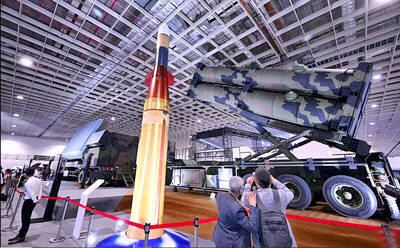
Taiwan is to commence mass production of the Tien Kung (天弓, “Sky Bow”) III, IV and V missiles by the second quarter of this year if the legislature approves the government’s NT$1.25 trillion (US$39.78 billion) special defense budget, an official said yesterday. Commenting on condition of anonymity, a defense official with knowledge of the matter said that the advanced systems are expected to provide crucial capabilities against ballistic and cruise missiles for the proposed “T-Dome,” an advanced, multi-layered air defense network. The Tien Kung III is an air defense missile with a maximum interception altitude of 35km. The Tien Kung IV and V
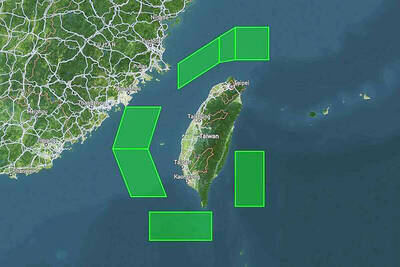
The disruption of 941 flights in and out of Taiwan due to China’s large-scale military exercises was no accident, but rather the result of a “quasi-blockade” used to simulate creating the air and sea routes needed for an amphibious landing, a military expert said. The disruptions occurred on Tuesday and lasted about 10 hours as China conducted live-fire drills in the Taiwan Strait. The Civil Aviation Administration (CAA) said the exercises affected 857 international flights and 84 domestic flights, affecting more than 100,000 travelers. Su Tzu-yun (蘇紫雲), a research fellow at the government-sponsored Institute for National Defense and Security Research, said the air

A strong continental cold air mass is to bring pollutants to Taiwan from tomorrow, the Ministry of Environment said today, as it issued an “orange” air quality alert for most of the country. All of Taiwan except for Hualien and Taitung counties is to be under an “orange” air quality alert tomorrow, indicating air quality that is unhealthy for sensitive groups. In China, areas from Shandong to Shanghai have been enveloped in haze since Saturday, the ministry said in a news release. Yesterday, hourly concentrations of PM2.5 in these areas ranged from 65 to 160 micrograms per cubic meter (mg/m³), and pollutants were
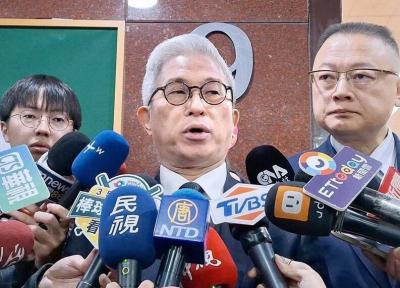
Taiwan’s armed forces have established response protocols for a wide range of sudden contingencies, including the “Wan Chun Plan” to protect the head of state, the Ministry of Defense (MND) said today. After US President Donald Trump on Saturday launched a series of airstrikes in Venezuela and kidnapped Venezuelan President Nicolas Maduro, concerns have been raised as to whether China would launch a similar “decapitation strike” on Taiwan. The armed forces regularly coordinate with relevant agencies and practice drills to ensure preparedness for a wide range of scenarios, Vice Minister of National Defense Hsu Szu-chien (徐斯儉) told reporters before a


 RSS
RSS