


Aboriginal legislators slammed the Council of Indigenous Peoples (CIP) during the legislature’s Internal Administration Committee meeting yesterday over a delay in proposing Aboriginal bills.
Their attack came as council Deputy Minister Wang Shun-fa (王順發) reported on the council’s projects for the next fiscal year, along with officials from other government agencies, including the Ministry of the Interior and the Mainland Affairs Council.
Besides promising to provide more employment opportunities for Aborigines, the council has delayed four legislative proposals.
“We [the council] are studying all different versions of the Aboriginal autonomous region bill. We will then call meetings with academics, experts, Aboriginal leaders and representatives from the government agencies concerned to discuss the matter, and draw up a plan on proposing bills on Aboriginal autonomy,” Wang told the lawmakers.
Wang said the council was still studying a bill to protect Aborigines’ rights to their traditional knowledge, one to define Aboriginal traditional domains and an amendment to the organic statute of the CIP.
“There is no consensus at this time, we need more discussions, need further studies — I suppose that means we won’t be able to get into the actual legislative review stage for these important bills during this session,” Chinese Nationalist Party (KMT) Legislator Chien Tung-ming (簡東明) said. “Now you’re putting everything back to zero!”
Most of the bills had been submitted by the former Democratic Progressive Party (DPP) government, but had yet to complete the legislative process because of disputes over details, he said.
Wang said the delays were the result of the CIP trying to make the bills acceptable to everyone. Chien remained unconvinced.
“It’s impossible to make a bill 100 percent acceptable to everyone, but if we don’t start reviewing them and debating on them, the bills can never become law,” Chien said.
“It’s written in the Aboriginal Basic Law [原住民族基本法] that relative laws should be passed within three years,” People First Party Legislator Lin Cheng-er (林正二) said. “That deadline has passed, but where are the other laws?”
“You talk about resolving the differences, reaching consensus and bridging the gap between Aborigines and non-Aborigines [before submitting bills to the legislature] — do you think it would convince the public?” Lin said.
Wang refused to give a timetable, promising only to “accelerate the process,” but Lin and Chien asked the CIP to at least submit something during this session.
Other KMT lawmakers also complained about the government’s lack of action.
“Voters are complaining that we legislators are not doing anything, but the fact is we have no laws at the Internal Administrations Committee to review,” KMT Legislator and committee convener Lee Chia-chin (李嘉進) said.
“The problem now is that the Cabinet under the leadership of Premier Liu Chao-shiuan [劉兆玄] is inactive, they talk more than they do,” Lee said.

Taiwan has received more than US$70 million in royalties as of the end of last year from developing the F-16V jet as countries worldwide purchase or upgrade to this popular model, government and military officials said on Saturday. Taiwan funded the development of the F-16V jet and ended up the sole investor as other countries withdrew from the program. Now the F-16V is increasingly popular and countries must pay Taiwan a percentage in royalties when they purchase new F-16V aircraft or upgrade older F-16 models. The next five years are expected to be the peak for these royalties, with Taiwan potentially earning
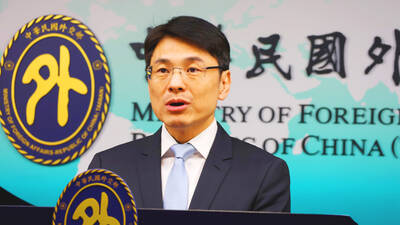
STAY IN YOUR LANE: As the US and Israel attack Iran, the ministry has warned China not to overstep by including Taiwanese citizens in its evacuation orders The Ministry of Foreign Affairs (MOFA) yesterday rebuked a statement by China’s embassy in Israel that it would evacuate Taiwanese holders of Chinese travel documents from Israel amid the latter’s escalating conflict with Iran. Tensions have risen across the Middle East in the wake of US and Israeli airstrikes on Iran beginning Saturday. China subsequently issued an evacuation notice for its citizens. In a news release, the Chinese embassy in Israel said holders of “Taiwan compatriot permits (台胞證)” issued to Taiwanese nationals by Chinese authorities for travel to China — could register for evacuation to Egypt. In Taipei, the ministry yesterday said Taiwan
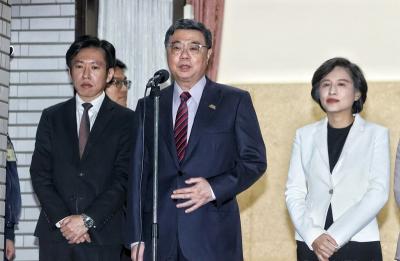
Taiwan is awaiting official notification from the US regarding the status of the Agreement on Reciprocal Trade (ART) after the US Supreme Court ruled US President Donald Trump's global tariffs unconstitutional. Speaking to reporters before a legislative hearing today, Premier Cho Jung-tai (卓榮泰) said that Taiwan's negotiation team remains focused on ensuring that the bilateral trade deal remains intact despite the legal challenge to Trump's tariff policy. "The US has pledged to notify its trade partners once the subsequent administrative and legal processes are finalized, and that certainly includes Taiwan," Cho said when asked about opposition parties’ doubts that the ART was
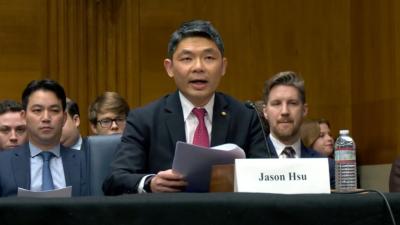
If China chose to invade Taiwan tomorrow, it would only have to sever three undersea fiber-optic cable clusters to cause a data blackout, Jason Hsu (許毓仁), a senior fellow at the Hudson Institute and former Chinese Nationalist Party (KMT) legislator, told a US security panel yesterday. In a Taiwan contingency, cable disruption would be one of the earliest preinvasion actions and the signal that escalation had begun, he said, adding that Taiwan’s current cable repair capabilities are insufficient. The US-China Economic and Security Review Commission (USCC) yesterday held a hearing on US-China Competition Under the Sea, with Hsu speaking on


 RSS
RSS