


The letters pour in from children around the world, telling a fairy far-off figure their holiday wishes.
Santa Claus? Uh-uh. These missives come from Jewish boys and girls who, for so long, had no one to write to each December. They're for an ageless Kansas City couple known simply by Yiddish derivatives for grandmother and grandfather, Bubbie and Zadie, with the postal address in ... Chiayi City, Taiwan.
The story starts in 1981 when Danny Bloom, thirtysomething and working in public relations at a community college in Alaska, decided he wanted to pen a holiday story he thought Jewish children could relate to.
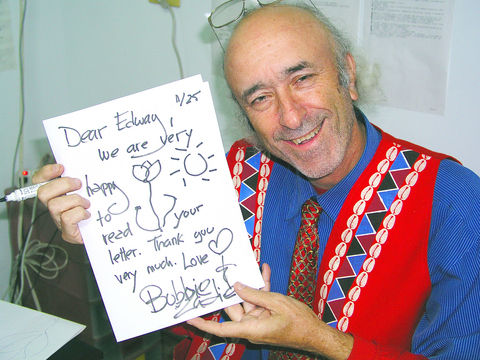
PHOTO: TSAI MIN-YI, TAIPEI TIMES
"I remember as a Jewish kid myself growing up in Massachusetts every winter reading the newspaper and seeing the TV shows about Santa Claus. Jewish kids couldn't participate," he said.
"I wanted to give someone that Jewish kids could communicate with in their own way," he said.
The story was born, telling of a diminutive grandma and grandpa, bundled up for the cold, who are able to fly through the skies on the first night of Hanukkah. Bubbie and Zadie once lived in Alaska but now run a tailor shop in Kansas City. They visit children everywhere, bringing them stories and songs instead of a sack full of gifts.
The response was more than Bloom ever imagined. Letters streamed in by the thousands and he found himself committed to a project whose prospects he was uncertain about at the start.
In 1985, Bloom's story was published as Bubbie and Zadie Come to My House. It wasn't a huge seller but, combined with publicity surrounding its release, it kept children's letters coming. Bloom answered them all with handwritten notes.
The popularity of Bubbie and Zadie has risen and fallen through the years, as Bloom moved to Japan and now, to Chiayi City, where he is a freelance writer.
He is 56, single, and rents a fifth-floor studio apartment, rides a bicycle and motor scooter because he has no car and sends e-mails from an Internet cafe because he doesn't have a computer.
With his book out of print, many of Bloom's young writers have found the book at a library, come across it on the Internet, or have parents who as children read the Bubbie and Zadie story themselves. Most children put a stamp on an envelope and send their letter the traditional way, though Bubbie and Zadie have gotten some by e-mail.
While some of the letters amount to Jewish children's wish lists much like their Gentile counterparts, most are exactly what Bloom hoped for -- messages of innocence and simplicity.
"Your Hanukkah story is so beautiful and I enjoyed having Grammy read it to me," wrote a seven-year-old Kansas City girl.
"I was so happy to get your letter in the mail because here in Idaho there are not many Jewish people," said an 11-year-old girl from Boise, Idaho. An 8-year-old boy from Teaneck, New Jersey, wrote: "My older sister says you might be fake! Are you?"
Bubbie and Zadie hear from adults, too. Many tell of their own grandparents.
When responding, Bloom says he tries to put himself in his own grandmother's frame of mind, not preaching about religion, just being a friendly older presence who treats children as his equals. He signs all his notes "Bubbie and Zadie."
Bloom calls the Bubbie and Zadie project his hobby. But with synagogues rare and Judaism virtually nonexistent in Taiwan, it may serve a larger purpose, too.
"This program connects me back to my own culture," he said. "These letters fill up my life with something I don't have."
Bloom's program is now in its 25th year and its creator has hopes that it might someday inspire a cartoon or film or that it might become a tradition supported by groups around the world.
"It's my big dream that writing to Bubbie and Zadie would become a part of American Jewish culture," he said.

Considering that most countries issue more than five denominations of banknotes, the central bank has decided to redesign all five denominations, the bank said as it prepares for the first major overhaul of the banknotes in more than 24 years. Central bank Governor Yang Chin-lung (楊金龍) is expected to report to the Legislative Yuan today on the bank’s operations and the redesign’s progress. The bank in a report sent to the legislature ahead of today’s meeting said it had commissioned a survey on the public’s preferences. Survey results showed that NT$100 and NT$1,000 banknotes are the most commonly used, while NT$200 and NT$2,000

The Centers for Disease Control (CDC) yesterday reported the first case of a new COVID-19 subvariant — BA.3.2 — in a 10-year-old Singaporean girl who had a fever upon arrival in Taiwan and tested positive for the disease. The girl left Taiwan on March 20 and the case did not have a direct impact on the local community, it said. The WHO added the BA.3.2 strain to its list of Variants Under Monitoring in December last year, but this was the first imported case of the COVID-19 variant in Taiwan, CDC Deputy Director-General Lin Ming-cheng (林明誠) said. The girl arrived in Taiwan on

ANNUAL EVENT: Two massive Pokemon balloons are to be set up in Daan Park, with an event zone operating from 10am to 6pm This year’s Taipei Floral Picnic is to be held at Daan Park today and tomorrow, featuring an exclusive Pokemon Go event, a themed food market, a coffee rave picnic area and stage performances, the Taipei Department of Information and Tourism said yesterday. Two massive Pokemon balloons are to be set up in the park as attractions, with an exclusive event zone operating from 10am to 6pm, it said. Participants who complete designated tasks on-site would have a chance to receive limited-edition souvenirs, it added. People could also try the newly launched game Pokemon Pokopia in the trial area, the department said. Three PokeStops are
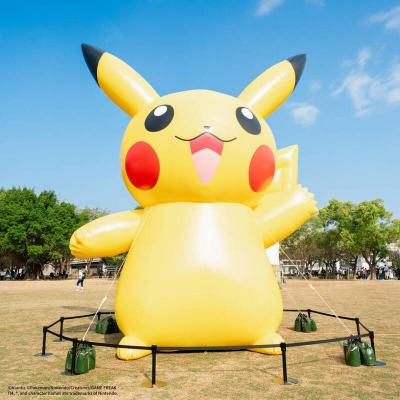
This year’s Taipei Floral Picnic is to be held at Daan Park this weekend, featuring an exclusive Pokemon Go event, a theme food market, a coffee rave picnic area and stage performances. Pokemon Go Two massive Pokemon balloons are to be set up in the park as photo attractions, with an exclusive event zone operating from 10am to 6pm. Participants who complete designated tasks on-site would have a chance to receive limited-edition souvenirs. Pokemon trainers could also experience the newly launched game Pokemon Pokopia in the trial area. Three PokeStops are to be set up in the park. Trainers are invited to take


 RSS
RSS