


The Satanic Verses, an English novel that has been blamed for nearly 60 deaths worldwide since its publication in 1988, has recently raised hackles in Taiwan as its Chinese-language version hit the bookshelves just two days after the Oct. 13 bombing in Bali, Indonesia.
Saying that national security should take precedence over freedom of expression, KMT lawmakers on Oct. 17 urged the government to ban the translation on the grounds that the book could incite Muslims to attack Taiwan.
The local publishing house, however, has said the work's literary value should be respected and the author's freedom of speech upheld.
KMT Legislator Her Jyh-huei (
The text is bound to infuriate Muslims, he said, suggesting that the Government Information Office (GIO) halt the sale of the translation.
Since its release on Oct. 15, the translation has become a best seller with over 10,000 copies sold in five days. Sales inadvertently benefited by the call for an injunction, according to the publisher, Ya-yen Publishing House.
"The country, bent on reviving the economy, can not risk being the target of terrorist assaults. Authorities concerned should give serious thought to banning the book," Her said.
Also in the book, Mohammed is attributed with fabricating the Koran and his wives are compared to prostitutes. Prophet Abraham is called a "bastard" and Archangel Gabriel is reduced to being a "pet" obeying its master.
Chiang Yi-wen (
"I ask all Muslims to execute them [Rushdie and his publishers], wherever they find them," Khomeni said in a 1989 statement on Teheran Radio.
An aide to Khomeini put a US$1 million price tag on Rushdie's head and in 1999, Iranian clerics increased the reward to US$2.8 million.
"The government must not take the book lightly, as the translator of the Japanese version of the book was brutally murdered in 1991 and the Italian translator severely injured that same year," Chiang said.
The issue also sparked a heated debate online, as some messages on local Web sites' criticized Ya-yen for ignoring the country's safety while pursuing profit.
"It is obnoxious for a publisher to capitalize on the threat of terrorism. Please immediately recall the books to prevent Taiwan from falling prey of terrorist attacks," one message said.
The bombing in the Philippines days later has further intensified the feeling of unease among the public. Some suspect terrorist organizations have shifted their attention to Asia where government and civilian agencies are less equipped for unprovoked attacks.
But the GIO said that it saw no reason to ban the translation now that the English version has been in the market for more than a decade. Also, there are no regulations empowering the agency to do otherwise, it noted.
Joyce Yen (
The translation was in the works for more than a year and the book's launch coming in the wake of the Bali bombing was purely a coincidence, she said.
Yen added that she believes that the fatwa's influence has waned, as no one has been harmed in connection with the book in the past eight years.
"Four years ago, Iranian President Mohammad Khatami called for an end to the fatwa," she said.
Reporters were unable to reach Yen in the first few days after the Bali bombing that killed nearly 200 people, many of them foreign tourists.
"I had been trying to keep a low profile," she said later. "I was surprised by the successive tragedies in [neighboring countries]."
To protect the translator, the publishing house listed the translator as "anonymous."
According to Yen, the translator is not concerned about the controversy or potential retaliation from the Muslim community.
PFP lawmaker Liu Wen-hsiung (
"Because of the obvious attempt at associating itself with real events, the book is dangerously misleading for an audience that knows little about Islam or Muslims," he said.
Calling the work profane, the lawmaker said freedom of expression stops where vilifications and misrepresentations of fact start.
In 1990 Rushdie issued an apology in which he affirmed his respect for the religion.
Many around the world have spoken out in his favor over the years. Naguib Mahfouz of Egpyt, winner of 1988's Nobel Literature Prize, said the following February that he considered the fatwa a form of intellectual terrorism -- the idea of killing someone because of what he wrote.
Yen noted that the book is a novel, and its theme is not related to Islam or any other religion. "This is absolutely not the book for anyone who wants to understand Islam," she said.
Indeed, publishing firms in Taiwan have long been leery of the book. The China Times Publishing Co, for instance, gave up its plan to publish a translation a decade ago.

UPGRADE: The Kang Ding-class frigate is replacing its Chaparall missiles with Tien Chien II and Hua Yang VLS, which would provide it with long-range, 360° air defense Taiwan plans to produce 1,200 to 1,376 Hai Chien II missiles (海劍二, Sea Sword II) — also known as TC-2N — to serve as the standard air defense system of the navy’s surface combatant fleet, a source said yesterday. Last week, the Hai Chien II, the naval version of the Tien Kung II missile (天劍二, Sky Sword II), completed a live-fire test in waters off the National Chungshan Institute of Science and Technology’s Jiupeng facility (九鵬) in Pingtung County’s Manjhou Township (滿州). The MIM72 Chaparral and other dated air defense missiles that currently arm Taiwanese ships have inadequate range to combat Chinese

REASONS FOR TRAVEL: An assistant professor said that proposed amendments to penalize drivers if they used drugs overseas would not deter people from traveling People who operate a motor vehicle under the influence of marijuana would have their driver’s license revoked, even if they used the substance while overseas, the Ministry of Transportation and Communications said yesterday, citing proposed amendments to the Road Traffic Management and Penalty Act (道路交通管理處罰條例). The amendments would also authorize the government to revoke the licenses of people determined to have used Category 1 or Category 2 narcotics, even if they were not operating a vehicle while under the influence of drugs, as well as ban them from taking the license test for three years, the ministry said. People aged 18 or
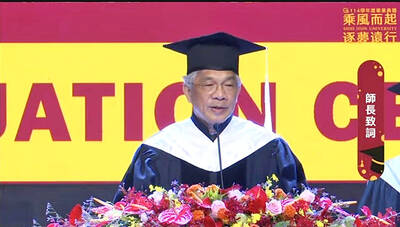
Shih Hsin University President Chen Ching-he (陳清河) yesterday issued a public apology for comments made in his commencement speech last week, stating that he has asked the school to suspend his duties and halt his wages for two months as a show of contrition. At the commencement ceremony on May 30, Chen said, “If you don’t manage your time well, or your own emotions, or your health, then I am telling every one of you — put a quick end to ‘you,’ because the world has no need for ‘you.’” The comments have sparked significant controversy online, and Chen through an open
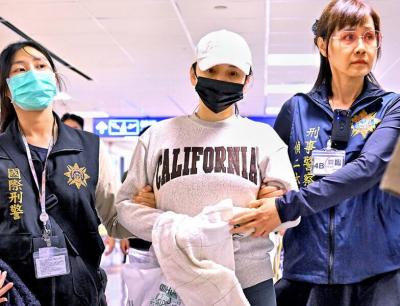
Johanne Liou (劉喬安), a Taiwanese woman who shot to unwanted fame during the Sunflower movement protests in 2014, returned to Taiwan last night after being deported from the US. She is to stand trial in Taiwan for charges involving embezzlement, fraud and drug crimes. The Criminal Investigation Bureau (CIB) said it took her into custody at Taiwan Taoyuan International Airport and would first question her before transferring her to the New Taipei District Prosecutors’ Office. She was arrested upon disembarking a flight from San Francisco that landed shortly before 7pm. Liou absconded to the US in 2019 after jumping bail


 RSS
RSS