


Two machines resembling robotic vacuum cleaners sped around a ring colliding, shooting sparks and catching fire as Iranian engineering students watched from behind plexiglass.
The dramatic clash was just one of many opportunities for competitors to go head-to-head at the country’s Tech Olympics to determine the future of its engineering talents.
Iran aspires to become a key regional player in emerging technologies, despite decades of international sanctions that have stifled its development.

Photo: AFP
The fields at this year’s competition included robot battles, programming, artificial intelligence (AI), as well as drones, cybersecurity and connected devices.
A few hours before his event, Alireza Hosseini put the final touches on combat robot Arash — a rudimentary machine of wires and wheels without the appearance of a humanoid.
“What’s more important than the design is the operator,” the 21-year-old university student told reporters, referring to the person who remotely controls the robot.
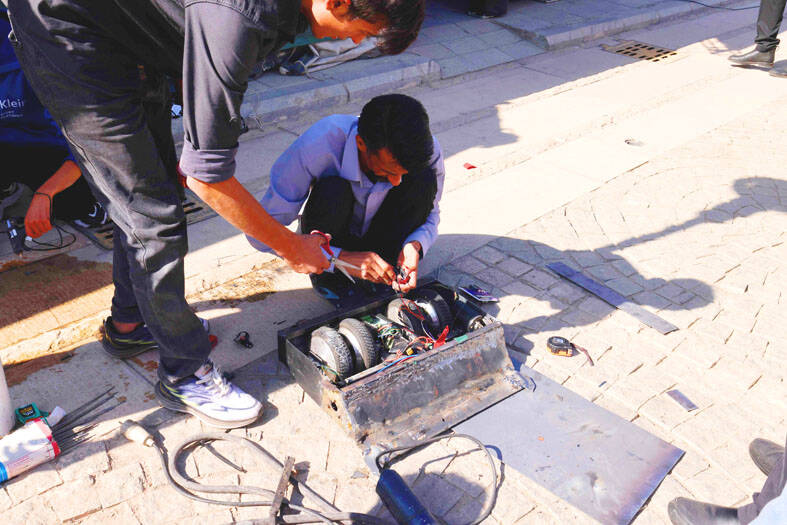
Photo: AFP
“The design only represents a third of the work, but the operator decides how and where the robot attacks,” said Hosseini, who is from Kerman in southern Iran.
Hosseini said his team of students in electrical engineering, electronics, computer science, mechanical engineering and design had been crowned Iran’s robotics champion three times.
Launched last year at the Iranian government’s initiative, the Tech Olympics serve as a talent pool for companies seeking potential recruits.
The coach of one team of under-18s appeared somewhat anxious before the start of the competition.
“Unfortunately, we started late and the robot isn’t quite ready yet,” said Mr Azizi, who did not give his first name.
Three referees were tasked with judging the robot fights, just like in wrestling, a sport at which Iran excels. The collisions between machines produce sparks and sometimes even balls of fire. Victory goes to the robot that disables its opponent.
The Tech Olympics take place on the outskirts of the capital, Tehran, at the Pardis Technology Park — nicknamed “Iran’s Silicon Valley” — where dozens of cutting-edge companies are.
The organizers boast that they received more than 10,000 applications for the competition, which was whittled down to 1,000 spots in the elimination rounds. A few foreign teams also participated.
Iranian media mentioned more than a dozen countries ranging from Iraq to Romania. Iran has invested sizeable sums in emerging technologies, including robotics, with dozens of companies using them for a variety of applications.
In September, the country unveiled its first AI-powered robot, capable of accurately answering a wide range of legal questions, local media reported.
The military has also harnessed the technologies, including for its Aria combat robot, which uses AI to detect obstacles and move autonomously. It was unveiled in September.
In 2021, veterinarians in Iran performed the first-ever remote surgery on a dog using Sina, a surgical robot entirely designed and manufactured domestically.
The Tech Olympics aims to prepare students for real-world situations.
Mohammad-Javad Asadolahi, a 21-year-old studying mechanical engineering at university, said that he and his classmates designed a drone — capable of taking off automatically and following a set trajectory — from scratch using “60 to 70 percent Iranian technology.”
“Our main difficulty was the lack of educational resources” in English and Persian, he said.
However, “thanks to our knowledge and research, we have gradually succeeded,” he added.

Greek swimmer Kristian Gkolomeev was the only athlete to “beat” a world record on Sunday at the Enhanced Games, winning the men’s 50m freestyle at the divisive competition where athletes were free to take performance-enhancing substances. His time of 20.81 seconds — which is not considered official — came in the final event of the night in Las Vegas, sparing the blushes of organizers who made claims that multiple world records would be surpassed due to a sophisticated doping regime. Gkolomeev, who was wearing a synthetic “supersuit” long banned at events such as the Olympics, outpaced Australia’s Cameron McEvoy’s 20.88 set in

Fred Kerley is competing unaugmented against drug-fuelled athletes at this weekend’s Enhanced Games and still hopes to race in the 2028 Olympics, the suspended former 100m world champion said on Friday. Arguably the biggest name at the divisive event in Las Vegas, where doping is permitted, the US sprinter said he had chosen not to take any of the banned substances including testosterone and steroids that his competitors have been using. “I don’t need it. God gave me fast feet for a reason. And I’m here to showcase my talent,” Kerley said. Kerley last September became the first US competitor and first track
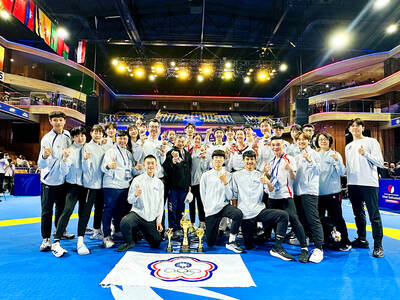
VICTORY ABROAD: The team took home a fistful of medals and secured spots for the autumn’s Asian Games, scheduled for September in Nagoya Taiwan’s women’s team captured the overall title at the Asian Taekwondo Championships in Mongolia on Sunday, finishing with two golds, one silver and one bronze medal. The strong showing, led by gold medalists Wang Chieh-ling and Chang Jui-en secured the full quota of available spots for Taiwan at the Asian Games in Nagoya, Japan, in September. Wang opened Taiwan’s medal run by winning gold in the women’s under-46kg class on Thursday, the first day of competition. Liu Yu-yun later earned a silver in the under-49kg class. On the final day on Sunday, Chang won Taiwan’s second gold medal in the under-62kg event, and
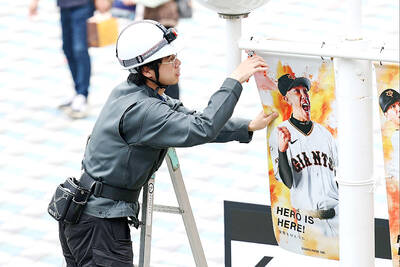
The manager of the Yomiuri Giants, one of Japan’s most popular baseball teams, resigned yesterday after he was arrested for allegedly physically attacking his teenage daughter. Shinnosuke Abe allegedly grabbed the 18-year-old and forced her to the floor at their home in central Tokyo on Monday evening, reported national broadcaster NHK and Kyodo News, citing unnamed police sources. “Leaving like this really means I’m causing you a lot of trouble, and I feel truly sorry about that,” Abe told a hastily arranged news conference, his eyes red with tears. The former star catcher, who is among baseball-obsessed Japan’s most recognized sports figures,


 RSS
RSS