


For judo lovers all over the world who make the pilgrimage to Tokyo’s Kodokan Judo Institute, it is an emotional experience to tread the hallowed mats — a unique chance to train at the sport’s mecca.
It would be like a club tennis player knocking up at Wimbledon, a village cricketer striding out to bat at Lord’s or a Sunday League soccer player doing keepy-uppies at Wembley, but in judo, the “home of the game” welcomes all comers.
Many spend small fortunes just to experience the thrill of throwing opponents where judo began and others have been known to break down in tears when they realize a life’s dream.
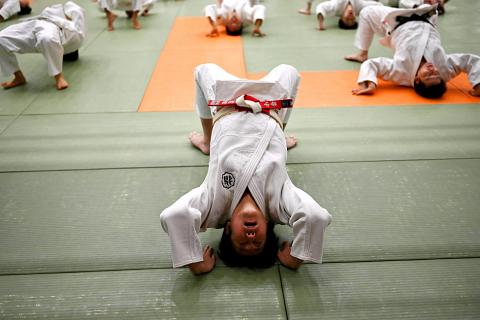
Photo: AFP
“It’s everything that is judo,” said Emyr Rees, a 29-year-old from Llanelli in South Wales, who added that he has been dreaming of visiting the Kodokan since he started the sport 16 years ago.
“Just the chance to be on the mat here, training with all these great instructors, learning from them. People from all over the world coming together, learning from each other, which is exactly one of the maxims of judo,” Rees told reporters.
The pinnacle for any judoka is to train in the iconic kangeiko, or winter training: 10 consecutive days of judo starting at 5:30am sharp that is not for the faint-hearted.
However, despite its global fame in the world of judo, the training is open to all — no matter where they come from — and anyone can train with anyone else regardless of age or standard.
Kodokan head coach Motonari Sameshima said that many foreigners are overcome with emotion when they step onto the tatami for the first time, bowing to the statue of the sport’s founder, Jigoro Kano, before they do so.
“One French woman even cried at the entrance. She said: ‘Finally, I have got here after saving up.’ She stood there at the entrance weeping. I myself became emotional watching her. That’s what this place does,” 70-year-old Sameshima told reporters.
For the kangeiko, an English-speaking coach guides foreign judoka through the rituals and explains the various groups they can join: randori, or free practice; women’s only training; specialized throws.
However, foreigners are not excused from the traditional roll call, nor the president’s New Year’s speech in Japanese, nor the strenuous warm-up guided by one of the youngest judoka.
Sameshima said that there was a language barrier, but added that judo was “a genuinely physical activity” that transcends language.
“Even if they don’t know the language, they throw and they are thrown. We feel pain, of course, when we are thrown, but we can get a connection with each other by doing so,” he said.
Over the 10-day kangeiko, 50 foreigners had registered from 16 countries.
Nick Forbes, a 29-year-old from Sydney, decided to make the trip of a lifetime after losing his job, using the severance money to fund his travel.
“I’ve always wanted to come to the mecca of judo. This is where it all started,” said Forbes, who was sleeping in an on-site, 18-person dormitory to keep costs down.
For Sandro Endler, a 48-year-old real-estate developer from Sao Paolo, Brazil, his trip to the Kodokan was the culmination of a childhood ambition.
“I started judo when I was seven years old. Back then, there was no Internet and coming to Japan to do judo seemed like a distant dream. Now I’m 48 and I’m finally fulfilling that dream,” he said.
He now lives in the US, but made the pilgrimage especially to the Kodokan.
“It’s the place that everyone who has ever done judo wants to come, and especially for the winter training. Everyone knows about it,” Endler said.
“Right now I’m pretty excited. It’s a dream come true and I can’t wait to get out there to train with people from all over the world,” he said.
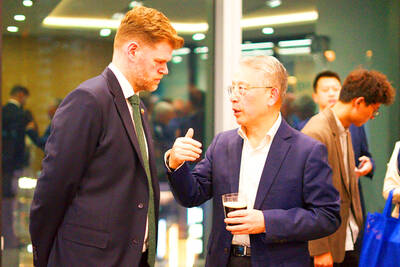
When Paddy Dwyer arrived in China in 1976, crowds jostled to catch a glimpse of him and his companions — the first Western soccer team to play in the country. China was emerging from the chaos of the Cultural Revolution, and on the brink of market reforms that would take the country from economic stagnation to explosive growth. “All we could see was lines of people running beside our bus, trying to look in the windows, to see their first visual of a white person,” he said. “It was all bicycles,” he said. “There were very few cars to be seen.” Dwyer,
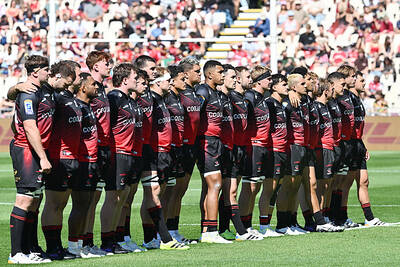
A new NZ$683 million (US$404 million) stadium that was a symbol of Christchurch’s struggle to rebuild after a deadly earthquake struck the New Zealand city is to host its first match tomorrow in front of a sellout crowd. A magnitude 6.2 earthquake killed 185 people in February 2011 and toppled or damaged buildings, including the city’s old Lancaster Park. The stadium, which hosted international rugby and cricket, and was home to the Canterbury Crusaders, was badly damaged and never reopened. It was bulldozed in 2019 and turned into sports fields, leaving the Crusaders without a permanent home. Government funding for a new stadium was

Some of Clearlake Capital Group’s largest investors are growing increasingly concerned about how much time the company’s co-founders are spending on sports investments as they have struggled to complete the fundraising for the private equity firm’s latest flagship fund. One of Clearlake’s co-founders, Behdad Eghbali, has been spending what some investors described as a disproportionate amount of time on the firm’s investment in Chelsea Football Club in recent months. Now, co-founder Jose E. Feliciano and his wife, Kwanza Jones, are nearing a record US$3.9 billion deal to acquire the San Diego Padres. That personal investment by Feliciano has set off the latest
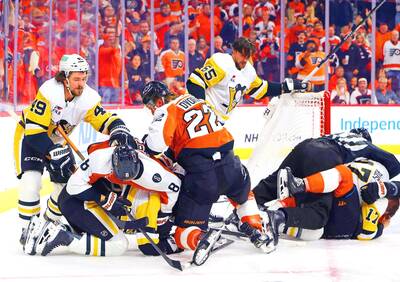
The Philadelphia Flyers and the Pittsburg Penguins on Wednesday put a squeeze on the penalty box in Game 3 of their NHL playoff series — with 11 players cramped inside their designated punishment areas. Each could have snapped a team photo after a melee broke out in the second period of the Flyers’ 5-2 win over the Penguins in their Eastern Conference first-round series. “It was a party in there,” penalized Flyers defenseman Nick Seeler said. The celebration extended into the joyous locker room after the Flyers took a 3-0 series lead. Penguins forward Bryan Rust slammed Travis Konecny to the ice behind the


 RSS
RSS