


Taichung City Mayor Chang Wen-yin (張溫鷹), a member of the ruling DPP, yesterday publicly announced her determination to run for re-election, openly challenging her own party's mayoral candidate Michael Tsai (蔡明憲) and the KMT's Jason Hu (胡志強).
"I will do my best to achieve success in the re-election bid," she said yesterday, addressing city government officials at a party organized to celebrate her 51st birthday and endorse her campaign for re-election.
Chang said that the party had dumped her because her polling numbers were not good enough. However, she still wanted to be the mayor of Taichung and was determined to run in the election.

PHOTO: HU WEI-MING, TAIPEI TIMES
Apparently undaunted by Chang's move, both Tsai and Hu yesterday said that they fully respect her final decision.
"I welcome her participation and competition in the election. No matter how many candidates there are, I'll always take my best shot," Hu told reporters yesterday afternoon.
Tsai also gave his blessing to Chang, but played down the likely negative impact on his electoral chances.
"Though she failed to acknowledge the democratic result of the party's [April] primary elections, which ruled that I should represent the DPP in the mayoral race, I hope the coming election will be a positive campaign with one competing fairly with the other," Tsai said.
Tsai, however, expressed his regrets that Chang failed to respect party ethics, adding that her decision will not only hurt him, but it will also damage Hu's campaign.
Both Hu and Tsai, nevertheless, said they were confident of winning.
Since Chang lost her party candidacy to Tsai in April, she must now run as an independent. Her decision to do so will certainly cost her her DPP membership, party Secretary General Hsu Jen-tu (
DPP Chairman Frank Hsieh (
There has been speculation that Chang's re-election chances were spiked as a result of infighting in the DPP. There is also concern over her possibly allying with the People First Party to expand her support, as the party's chairman, James Soong (宋楚瑜), has approached her in the past. Thus, Chang may not only steal votes from the DPP's Tsai, but also the KMT's Hu.
"There's no concrete evidence to support the media speculation, therefore, we should not mislead the voters," Hu said, brushing aside the notion that the PFP is contemplating throwing its support elsewhere.
Political analysts say that Chang may still maintain a competitive edge because of her strong local connections, which come from her husband Chen Wen-hsien (陳文憲) and her father-in-law Chen Duan-tang (陳端堂), who was a former Taichung mayor.

‘NO SECURITY RISK’: The Railway Bureau reassured the public that the technicians’ activities were limited to technical guidance and did not involve sensitive systems The Railway Bureau yesterday said it had invited eight Chinese technicians to assist with an airport MRT construction project. The bureau issued the confirmation after an Internet user said Chinese nationals had entered the construction zone of Taiwan Taoyuan International Airport’s Terminal 3 project. They asked why “individuals from an enemy state” were allowed access to such a major national infrastructure project, which raised serious concerns over Taiwan’s industrial safety, sensitive systems and information security. The bureau’s Northern Region Engineering Branch Office said subcontractor Taiwan Handle Industrial Co (台灣手把工業) of the Taoyuan airport MRT’s “Contract No. CU05 Project A14 Station Civil, MEP &

A US uncrewed surface vessel (USV) encountered multiple Chinese warships during an autonomous transit of the Taiwan Strait, US defense company Seasats said in a statement on Wednesday. Seasats announced that a Lightfish USV had completed the first autonomous transit of the Taiwan Strait. Over five days, the USV traversed the entire length of the Strait while constantly monitoring surface vessel traffic, the company said. The Lightfish encountered multiple Chinese warships, one of which was a Chinese People’s Liberation Army Navy (PLAN) Type 056 corvette, it said. The Chinese vessels were operating “well within Taiwan’s exclusive economic zone without transmitting their identity via the

Taiwan is still in the process of assessing the possibility of recruiting workers from Eswatini, the Ministry of Foreign Affairs said yesterday, adding that its goal is to help Eswatini upgrade its vocational training centers. If there are plans to recruit workers from Eswatini, safeguarding national security, protecting public health and ensuring the employment rights of Taiwanese would be prerequisites, Department of West Asian and African Affairs Director-General Yen Chia-liang (顏嘉良) told a news conference. Key considerations would also include filling labor shortages in specific industries, and fostering bilateral professional and technical exchanges, he said. Yen was asked about the progress of labor
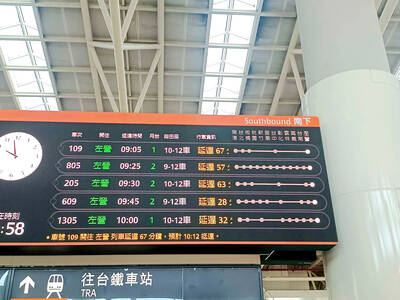
The nation’s usually punctual high-speed rail system yesterday was hit by major disruptions after all scheduled services were canceled and replaced with three hourly trains offering only non-reserved seating, affecting more than 200,000 passengers. Preliminary findings indicate the disruption was caused by a faulty power module in a track switch control cabinet, Taiwan High-Speed Rail Corp (THSRC) said, adding that as a full system inspection could only be conducted after operations end for the day, a decision on whether normal service would resume today would be announced before the first train departs. During a routine inspection early yesterday, a switch signal abnormality


 RSS
RSS