


While the opposition alliance criticizes Taiwan's former president Lee Teng-hui (李登輝) as "essentially a dictator with the appearance of a democrat," scholars view Lee's repeated changes of political partners as a reflection of his grand strategy to "gradually separate Taiwan's sovereignty from China's."
Lee, who left office just 13 months ago, recently returned to the political frontline to take personal command of the development of Taiwan's political landscape.
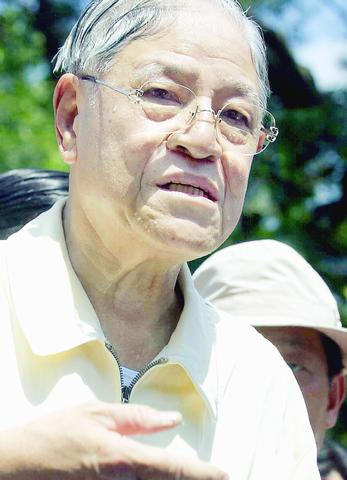
PHOTO: CHIANG YING -YING, TAIPEI TIMES
He recently took steps to form a new political party to help the ruling DPP form a stable majority in the Legislative Yuan after the year-end legislative election. His return has been marked by rebukes from opposition politicians, including his former No. 2, Lien Chan (連戰), chairman of the KMT, that blame the nation's current problems on "a few people who retain the attitude of sore losers."
During his 12 years as president, from 1988 when he succeeded the late Chiang Ching-kuo (蔣經國) until 2000, when he passed the office to Chen Shui-bian (陳水扁), Lee Teng-hui had two political partners. The first was James Soong (宋楚瑜) and the second Lien Chan.
But the Lee-Soong and Lee-Lien partnerships both ended in hostility. And, one year after Taiwan's transfer of political power, Lee has chosen President Chen as his third political ally, at a time of political chaos, and is once again making political plans.
In the eyes of Lee's opponents, the Lee-Soong relationship, once like that of father and son, soon ended like that between water and fire. History seemed to repeat itself with the close relationship between Lee and his handpicked successor, Lien Chan.
Now the former KMT chairman is siding with his DPP successor as president. "In Lee Teng-hui's world, there is no such thing as his abandonment of anyone, but only other people's betrayal and ungratefulness," Wang Tso-yung (王作榮), a former president of the Control Yuan once said.
Even Peng Ming-min, a senior advisor to the president and also a close friend of Lee, (彭明敏) said that: "No matter how formidable Lee is in a political struggle, he obviously is not good at choosing a successor (識人之明)."
Indeed, many political commentators argue that while the net result of Lee's 12-year presidency remains to be determined by history, the way in which he handles his political allies reflects the "strongman politics" of the authoritarian era which created him.
However Lee Yung-chih (李永熾), a historian at National Taiwan University, argues that to analyze Lee's approach to choosing his political allies, one should not see it from the angle of "political love-hate relationships" (政治恩怨). Rather, one should analyze it from the higher perspective of national strategy with Taiwan's sovereign independence as Lee's ultimate goal.
According to Lee Yung-chih, Lee Teng-hui first declared an end to the Chinese civil war, which was fought between the KMT and the Communists, by lifting the so-called "Temporary Provisions Effective During the Period of Communist Rebellion" soon after taking office. He then rationalized the reality of separate governance on either side of the Taiwan Strait by putting forward the idea of "one China, two political entities" (一個中國兩個政治實體).
In the third phase, he proclaimed, "The Republic of China on Taiwan is a sovereign state" and put the two sides on an equal footing. Finally, during his last year in office, Lee redefined the terms of cross strait politics yet again as a "special state to state relationship".
"Lee Teng-hui's sense of the direction of history is very clear. His grand strategy is to lead Taiwan step by step away from the structure of one China and, in pursuit of this aim, he gradually accumulated power through delicate political power struggles, and phased in this strategy," Lee Yung-chih said.
With this view in mind, the historian pointed out, Lee Teng-hui needed the mainlander heavyweights to stand by him in the beginning, especially those who commanded real power in the old regime. Soong was willing to support Lee at that critical moment, and it was only natural that they should fight side by side and share political resources. "But China policy and the direction of Taiwan's development that Soong envisioned were different from those of Lee and, as Lee began to put his policy of `Taiwanization' into effect, the two were bound to break up," he said. "By contrast, Lien Chan had shown his loyal support for Lee, following and echoing his ideas, and hence Lee preferred Lien to Soong as his successor and believed that Lien would continue his grand strategy," Lee Yung-chih said.
But following the KMT's defeat in the 2000 presidential election, Lien chose to ally with Soong, deviating from Lee's expectations and leaning towards China on cross-strait relations, and Taiwan's future direction. On top of that, with the encouragement of much of Taiwan's media, there is a trend for Taiwan to return to the "one China" structure.
Lee Yung-chih believes this is the key reason for Lee's comeback and alliance with Chen. He believes that Lee does not necessarily trust Chen, but is forming his new political group and allying with Chen for the sake of "Taiwan sovereignty," which he has pursued for the past 12 years. He has begun at the level of political struggle, by attacking Lien Chan in order to counter the opposition alliance's influence.
Chen Jun-lin (陳俊麟), Director of the DPP Survey Center, pointed out, that how much real influence Lee's political group will have and what concrete effect it will have on the year-end elections remains to be assessed when the group publishes its list of members in July. But Lee's ability to set the political agenda has already changed the tone of campaign debates. "If there were no Lee Teng-hui, the opposition alliance's election campaign would pinpoint the weaknesses of the ruling DPP, such as the `economic downturn' and `poor administration.'"
But now that Lee has stepped in, the campaigning focus has shifted toward `Taiwanization' and `democratization,' which are related to national development," Chen said. "But, after all, Chen is the current president, and if it appears to the outside world that it is Lee Teng-hui who is dominating political development, the Bian-Lee alliance will be even more difficult to maintain than the Lee-Lien and Lee-Soong alliances. So the DPP must act with caution," Chen said.
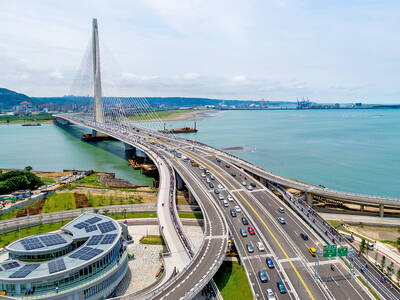
The Ministry of Transportation and Communications yesterday inaugurated the Danjiang Bridge across the Tamsui River in New Taipei City, saying that the structure would be an architectural icon and traffic artery for Taiwan. Feted as a major engineering achievement, the Danjiang Bridge is 920m long, 211m tall at the top of its pylon, and is the longest single-pylon asymmetric cable-stayed bridge in the world, the government’s Web site for the structure said. It was designed by late Iraqi-British architect Zaha Hadid. The structure, with a maximum deck of 70m, accommodates road and light rail traffic, and affords a 200m navigation channel for boats,
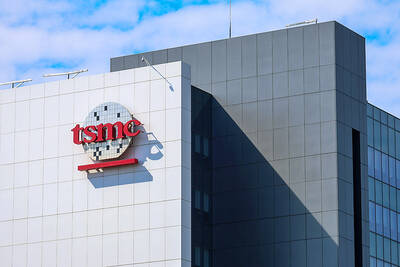
Taiwan Semiconductor Manufacturing Co (TSMC, 台積電), the world’s largest foundry service provider, yesterday said that global semiconductor revenue is projected to hit US$1.5 trillion in 2030, after the figure exceeds US$1 trillion this year, as artificial intelligence (AI) demand boosts consumption of token and compute power. “We are still at the beginning of the AI revolution, but we already see a significant impact across the whole semiconductor ecosystem,” TSMC deputy cochief operating officer Kevin Zhang (張曉強) said at the company’s annual technology symposium in Hsinchu City. “It is fair to say that in the past decade, smartphones and other mobile devices were
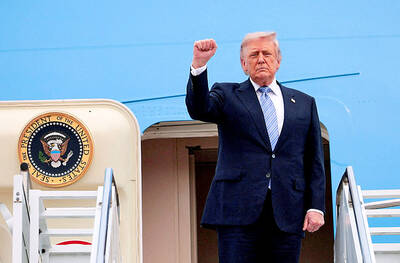
US-CHINA SUMMIT: MOFA welcomed US reassurance of no change in its Taiwan policy; Trump said he did not comment when Xi talked of opposing independence US President Donald Trump yesterday said he has not made a decision on whether to move forward with a major arms package for Taiwan after hearing concerns about it from Chinese President Xi Jinping (習近平). Trump’s comments on Taiwan came as he flew back to Washington after wrapping up critical talks in which both leaders said important progress was made in stabilizing US-China relations even as deep differences persist between the world’s two biggest powers on Iran and Taiwan. “I will make a determination,” Trump said, adding: “I’ll be making decisions. But, you know, I think the last thing we need right
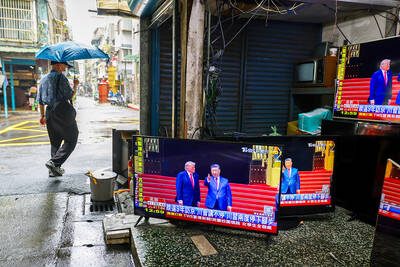
TAIWAN ISSUE: US treasury secretary Scott Bessent said on the first day of meetings that ‘it wouldn’t be a US-China summit without the Taiwan issue coming up’ There were no surprises on the first day of the summit between US President Donald Trump and Chinese President Xi Jinping (習近平), the Mainland Affairs Council (MAC) said yesterday, as the government reiterated that cross-strait stability is crucial to the Asia-Pacific region, as well as the world. As the two presidents met for a highly anticipated summit yesterday, Chinese state media reported that Xi warned Trump that missteps regarding Taiwan could push their two countries into “conflict.” Trump arrived in China with accolades for his host, calling Xi a “great leader” and “friend,” and extending an invitation to visit the White House


 RSS
RSS