


The recent incident at the Third Nuclear Power Plant (核三廠) in Pingtung County has caused high-ranking officials, including Premier Chang Chun-hsiung (張俊雄), to question the care taken by Taiwan Power Company (Taipower, 台電) at the nation's nuclear plants.
While no less than four separate groups from Taipower, the Atomic Energy Council (AEC) and the Cabinet search for answers, the premier lashed out at Taipower, saying that the company has a responsibility to the lives and property of Taiwan's 23 million citizens.
As the nation closely watches the investigation into Taiwan's worst-ever nuclear mishap, environmental activists are whispering about a separate, unexposed incident at another nuclear plant which might well have led to a far more dangerous conclusion.
Unexposed incident
On March 2, workers installing fuel rod assemblies into one of the two reactors at the First Nuclear Power Plant (
At the time, the plant had stopped operation for routine maintenance. Operators must replace one fourth of the more than 400 fuel rod assemblies in the boiling water reactor (沸水式反應爐) every 18 months.
Both the reactor and the fuel rod assemblies are supplied by a General Electric (GE) plant in North Carolina.
Sources said that one of the fuel rod assemblies, which had just been shipped to Taiwan from the GE plant, was damaged after it collided with part of the water pool in which the fuel rod assemblies sit.
Sources said that workers had installed all the fuel rods and were about to start the reactor when someone noticed the damaged rod assembly and abruptly stopped the process.
Anti-nuclear activists told the Taipei Times that if workers had started the reactor under such a delicate situation, it might well have caused the reactor to malfunction.
"A damaged fuel rod assembly might create difficulties ... for inserting the control rods into the reactor to control heat production," Shih Shin-min (施信民), chairman of the Taiwan Environmental Protection Union (TEPU), told the Taipei Times.
Control rods are placed in the water pool with the fuel rod assemblies in order to control the rate of the nuclear reaction, to prevent the fuel rods from getting so hot that they melt down.
"The accident reveals a lack of attention to detail," said Shih, who also teaches chemical engineering at National Taiwan University.
Taipower's supervising body, the Atomic Energy Council (AEC), however, said the mishap was not a big deal.
"The mistake was only a minor problem [with moving the fuel rod assemblies], which is far from any so-called accident," Shen Li (
After receiving Taipower's report, the AEC immediately began an investigation into the March 2 incident.
Shen confirmed that the cause of the problem was a collision of the fuel rod assemblies when they hit part of the water pool during maintenance.
"Workers removed the damaged one immediately and replaced it with a new one," Shen said, adding that all the fuel rod assemblies now installed in the reactor were in an acceptable condition.
However, Shen said that the plant has experienced similar problems in the past.
According to Shen, the AEC had considered replacing the plant's old transportation machinery and cranes and providing more thorough training for workers in order to avoid similar situations from occurring in the future.
Lin Li-fu (
"Humans are [only] human. Mistakes are inevitable," said Lin, adding that fuel rod assemblies are sometimes bumped while being moved at nuclear plants all over the world.
"Controlling fuel rod assemblies, which are submerged under some 7m of water is quite a challenge," Lin explained.
Using damaged fuel rod assemblies in the reactor, Lin said, was not specifically forbidden, but the risks involved in doing so must first be calculated.
"Such an evaluation ... takes time and may be turned into an issue with the media," Lin said. He speculated that Taipower chose to replace the damaged fuel rod assembly rather than wait for the AEC's evaluation.
Lin stressed that the plant's safety was no longer a cause for concern as the damaged fuel rod assembly had been replaced.
Actividts' doubts
Anti-nuclear activists, however, said that the plant operators should have earlier on identified the risk involved with using a damaged fuel rod in the reactor.
"We are greatly dissatisfied that Taipower hid the truth from the public," said Tsai Sen (
Tsai, who lives near Taiwan's oldest nuclear plant, said he has twice inquired about the incident with the plant's public relations office, but has received no answer thus far.
"They said that the mistake was not a problem at all, but did not explain why not," Tsai said.
Local residents said that since the plant began operating in 1978, they've never been made aware of the causes of accidents which have occurred because Taipower has been unwilling to reveal the truth. Instead, their only knowledge of the incidents has come from piecing together news reports.
According to TEPU, in September 1999, a truck carrying 31 barrels of radioactive waste crashed into a river flowing through the plant area.
In May 1997, an electricity generator stopped because depleted fuel rod assemblies had not been replaced.
In August 1995, electrical systems at the plant were shut down as a result of a lightning storm.
In January 1992, a series of human errors and mechanical failures led to a reactor shutdown.
In March 1991, air unexpectedly entered one of the reactors, causing high levels of radiation inside major steam pipes. Operators immediately brought the reactor offline.
In August 1990, a typhoon caused a transmission line to malfunction, forcing one of the reactors offline.
In October 1988, manufacturing flaws in a water pipe caused the leakage of radioactive waste water.
Each of the these incidents pale in comparison to a 56-day period between Sept. 3 and Oct. 28, 1985 when steam jet air ejectors detected that abnormally high levels of radioactive contamination were being emitted from a reactor, exposing both employees and the public. At the time, however, no one was told to evacuate. Daily work reports during that period of time have also mysteriously disappeared.
Activists said that Taipower's 22 years of experience in running nuclear power plants did not necessarily ensure the public's safety.
"Based on recent incidents which have occurred at the First Nuclear Power Plant and the Third Nuclear Power Plant, nuclear safety issues in Taiwan still lack transparency," said Lai Wei-chieh (
Lai claimed the monitoring network established by local residents, rescue teams and fire departments did not function adequately during the recent fire at the Third Nuclear Power Plant because Taipower officials at the plant procrastinated for at least an hour before reporting the accident.
AEC officials said that the council would supervise Taipower in carrying out safety checks at the first and second nuclear power plants in Taipei County.
"We will especially focus on the condition of transmission lines at the two plants as they were the cause of the recent incident at the Third Nuclear Power Plant," said the AEC's Shen.
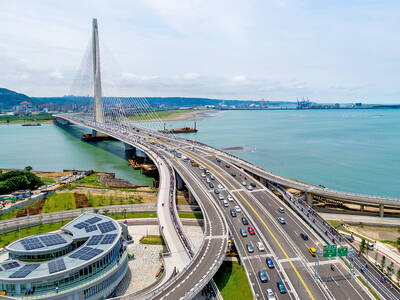
The Ministry of Transportation and Communications yesterday inaugurated the Danjiang Bridge across the Tamsui River in New Taipei City, saying that the structure would be an architectural icon and traffic artery for Taiwan. Feted as a major engineering achievement, the Danjiang Bridge is 920m long, 211m tall at the top of its pylon, and is the longest single-pylon asymmetric cable-stayed bridge in the world, the government’s Web site for the structure said. It was designed by late Iraqi-British architect Zaha Hadid. The structure, with a maximum deck of 70m, accommodates road and light rail traffic, and affords a 200m navigation channel for boats,
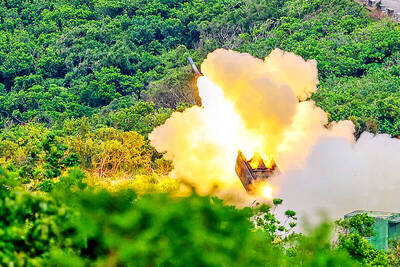
PRECISION STRIKES: The most significant reason to deploy HIMARS to outlying islands is to establish a ‘dead zone’ that the PLA would not dare enter, a source said A High Mobility Artillery Rocket System (HIMARS) would be deployed to Penghu County and Dongyin Island (東引) in Lienchiang County (Matsu) to force the Chinese military to retreat at least 100km from the coastline, a military source said yesterday. Taiwan has been procuring HIMARS and Army Tactical Missile Systems (ATACMS) from the US in batches. Once all batches have been delivered, Taiwan would possess 111 HIMARS units and 504 ATACMS, which have a range of 300km. Considering that “offense is the best defense,” the military plans to forward-deploy the systems to outlying islands such as Penghu and Dongyin so that

Taiwan Semiconductor Manufacturing Co (TSMC, 台積電), the world’s largest foundry service provider, yesterday said that global semiconductor revenue is projected to hit US$1.5 trillion in 2030, after the figure exceeds US$1 trillion this year, as artificial intelligence (AI) demand boosts consumption of token and compute power. “We are still at the beginning of the AI revolution, but we already see a significant impact across the whole semiconductor ecosystem,” TSMC deputy cochief operating officer Kevin Zhang (張曉強) said at the company’s annual technology symposium in Hsinchu City. “It is fair to say that in the past decade, smartphones and other mobile devices were

US-CHINA SUMMIT: MOFA welcomed US reassurance of no change in its Taiwan policy; Trump said he did not comment when Xi talked of opposing independence US President Donald Trump yesterday said he has not made a decision on whether to move forward with a major arms package for Taiwan after hearing concerns about it from Chinese President Xi Jinping (習近平). Trump’s comments on Taiwan came as he flew back to Washington after wrapping up critical talks in which both leaders said important progress was made in stabilizing US-China relations even as deep differences persist between the world’s two biggest powers on Iran and Taiwan. “I will make a determination,” Trump said, adding: “I’ll be making decisions. But, you know, I think the last thing we need right


 RSS
RSS