


When Wei Che-ho (魏哲和), a new face on the political scene, succeeded Weng Cheng-i (翁政義) to the leadership of the National Science Council (NSC) earlier this month, the issues he faced were old ones.
One of reasons for the personnel change was former chairman Weng's failure to keep firms in the Tainan Science-based Industrial Park (
In late February, Winbond Electronics Corp's (華邦電子) decision to cancel its 12-inch wafer plant project in the industrial park triggered a chain reaction which panicked governmental officials, including President Chen Shui-bian (陳水扁).
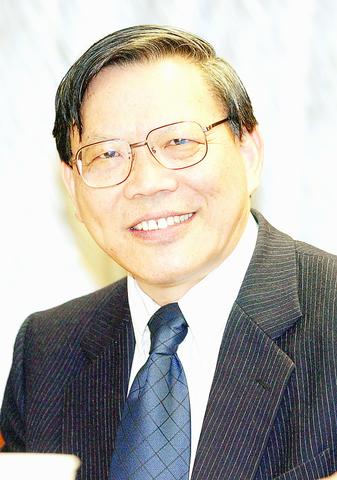
PHOTO: LIAO RAY-SHANG, TAIPEI TIMES
Most of the firms which aborted planned projects were DRAM chipmakers, including Silicon Integrated Systems Co (SIS, 矽統) and Chi Mei Electronics Corp (奇美電子). Chi Mei had invested NT$200 billion to build factories in the park.
Who is Wei?
Putting aside his good relations with the DPP-led central government, Wei, a 55-year-old electronic engineering professor at National Chiao Tung University (NCTU, 交大) in Hsinchu, has cultivated close relations with key people in the high-tech industry since his days in college. Stan Shih (施振榮), chief executive officer of Acer Inc (宏電), was one of Wei's college classmates.
After receiving a PhD in electrical engineering from the University of Washington, in Seattle, he returned to NCTU in 1976 to teach. Three years later he joined a team led by Lin Jung-sheng (
When Vice President Annette Lu (
However, due to pressure from legislators who believed Wei was holding too many posts, he stepped down from that position and a number of other posts, including that of vice principal of NCTU, to focus on NSC matters.
Though a newcomer at the NSC he faces many thorny old issues.
Chipmakers pull out of Tainan
On Thursday, when Wei answered questions about recent setbacks in developing the Tainan industrial park -- a chief concern being vibrations from the high-speed railroad which will pass close to the plant -- he said that the problems would eventually be solved by technology.
Parts of the park are only 200m from the planned rail line. The rail line's builder, Taiwan High Speed Rail Bureau, will construct the section near the park in April.
Amid the controversy, legislators, local officials and environmentalists began to argue about why these high-tech firms did not consider the vibrations a threat when they decided to build factories in the industrial park.
Companies said that the environmental impact assessment, released in 1999, noted that heavy vibrations would only be temporary and that they had been informed that the vibrations would eventually be reduced to meet their demands.
Officials at the NSC's office for the industrial park told the Taipei Times that in the environmental impact assessment for the railroad, the builder focused more on the noise problem to calm local opposition than the vibration problem threatening firms in the industrial park.
According to the office, there will be at least 17 chipmakers in the park. The vibration problem, if not solved, will affect long-term investment, including that from leading firms, such as Taiwan Semiconductor Manufacturing Co (TSMC,
Control Yuan members have carried out an investigation to see whether there has been any administrative negligence over the railroad project's environmental impact assessment and the vibration threat. The results of their investigation are not yet available.
Wei said last week that the NSC would stick to its original information regarding the acceptable level of vibration.
"The technical controversy over acceptable vibration levels will be decided by a Cabinet task force, established to coordinate agencies involved in the project for the high-speed line, by the end of March," Wei said.
Problems in Hsinchu as well
Taiwan's other science-based industrial park, in Hsinchu, for which the NSC also has responsibility, poses challenges to Wei as well.
Last week, the Environmental Protection Administration (EPA) demanded that Hsinchu Science-based Industrial Park (新竹科學園區) carry out a survey and analysis of its impact on the environment by the end of November.
EPA officials said that their demand was necessary to ensure the protection of the environment. No environmental impact assessment was conducted two decades ago when the park was established.
Wei said that environmental issues caused by the development of the park had been a subject of concern for years. He said that companies based in the park are making sincere efforts to improve the environment.
Wei said that measuring pollution from firms in and around the park would not be a problem.
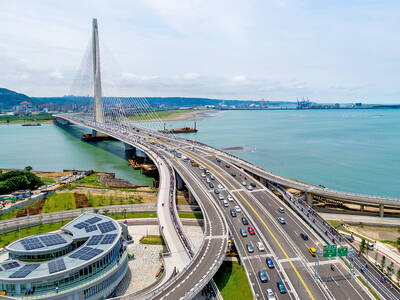
The Ministry of Transportation and Communications yesterday inaugurated the Danjiang Bridge across the Tamsui River in New Taipei City, saying that the structure would be an architectural icon and traffic artery for Taiwan. Feted as a major engineering achievement, the Danjiang Bridge is 920m long, 211m tall at the top of its pylon, and is the longest single-pylon asymmetric cable-stayed bridge in the world, the government’s Web site for the structure said. It was designed by late Iraqi-British architect Zaha Hadid. The structure, with a maximum deck of 70m, accommodates road and light rail traffic, and affords a 200m navigation channel for boats,
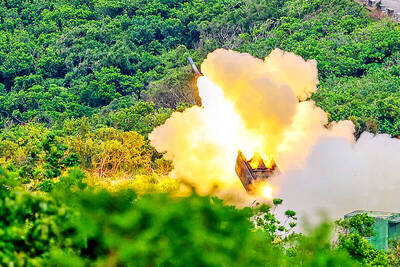
PRECISION STRIKES: The most significant reason to deploy HIMARS to outlying islands is to establish a ‘dead zone’ that the PLA would not dare enter, a source said A High Mobility Artillery Rocket System (HIMARS) would be deployed to Penghu County and Dongyin Island (東引) in Lienchiang County (Matsu) to force the Chinese military to retreat at least 100km from the coastline, a military source said yesterday. Taiwan has been procuring HIMARS and Army Tactical Missile Systems (ATACMS) from the US in batches. Once all batches have been delivered, Taiwan would possess 111 HIMARS units and 504 ATACMS, which have a range of 300km. Considering that “offense is the best defense,” the military plans to forward-deploy the systems to outlying islands such as Penghu and Dongyin so that
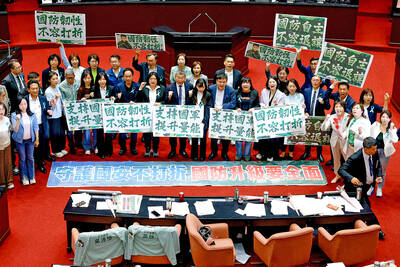
WHAT WAS ALL THAT FOR? Jaw Shaw-kong said that Cheng Li-wen had pushed for more drastic cuts and attacked him, just for the outcome to be nearly identical to his bill The legislature yesterday passed a supplementary budget bill to fund the purchase of separate packages of US military equipment, with the combined amount of spending capped at NT$780 billion (US$24.8 billion). The Chinese Nationalist Party (KMT) and Taiwan People’s Party (TPP) used their legislative majority to pass the bill, which runs until 2033 and has two main funding provisions. One was for NT$300 billion of arms sales already approved by the US for Taiwan on Dec. 17 last year, the other was for NT$480 billion for another arms package expected to be announced by Washington. The bill, which fell short of the NT$1.25

‘CLEAR MESSAGE’: The bill would set up an interagency ‘tiger team’ to review sanctions tools and other economic options to help deter any Chinese aggression toward Taiwan US Representative Young Kim has introduced a bill to deter Chinese aggression against Taiwan, calling for an interagency “tiger team” to preplan coordinated sanctions and economic measures in response to possible Chinese military or political action against Taiwan. “[Chinese President] Xi Jinping [習近平] has directed the People’s Liberation Army to be ready to invade Taiwan by 2027. China has a plan. America should have one too,” Kim said in a news release on Thursday last week. She introduced the “Deter PRC [People’s Republic of China] aggression against Taiwan act” to “ensure the US has a coordinated sanctions strategy ready should


 RSS
RSS