


Su Chuen-chang (
Su fought vigorously, even up until his recent hospitalization, for justice for his son who, along with two others, was convicted of the murders of a Hsichih couple in 1991.
The three, known as the Hsichih Trio, have remained on death row ever since 1995. Successive justice ministers have opted not to sign their death warrants in light of questions surrounding their case, but courts have repeatedly turned down appeals and requests for a retrial.
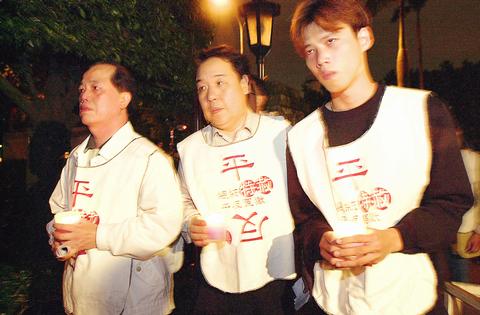
PHOTO: GEORGE TSORNG, TAIPEI TIMES
Su's death came just two days after the Supreme Court at last granted the Hsichih Trio a retrial.
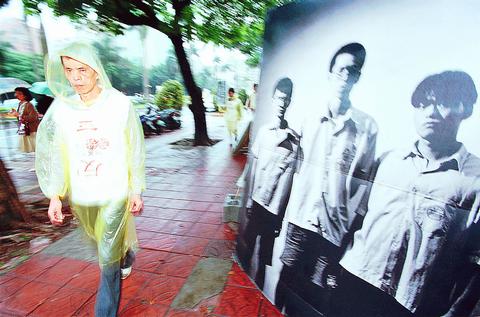
Human rights activists yesterday expressed their deep sorrow that the 52-year-old father's hopes of seeing his son walk out of jail innocent had not been realized.
"We urge the judiciary to no longer use the lives of Taiwan's people to pave the way toward justice," activists said at a press conference yesterday to mourn Su's passing.
FILE PHOTO: TAIPEI TIMES
The activists urged the court to hold a fair retrial and release the three as soon as possible.
Su's other son, Su Chien-wen (
"Dad has passed away. I hope you can keep it up. Please don't fall down and neglect dad's ten-year effort to rescue you," Su said sobbing. "You have to come home an innocent son."
Human rights activists called the elder Su's passing "a new beginning" for the rescue effort, which has lasted over nine years.
"The last 10 years of his life can be epitomized not only by his rescue efforts for his son but also by his campaign to improve Taiwan's judicial system," said Ku Yu-chen (
"Without his initiatives in the rescue mission over the years, the Trio would have been executed," Chen Chen-kan (
The team recalled Su's efforts to free his son, along with two other death-row inmates, Liu Bing-lang (劉秉郎) and Chuang Lin-hsun (莊林勳), by filming a documentary video about his campaign since 1995 when the Trio was sentenced to death.
"If my son ever had done the wrong thing, I wouldn't say anything about his legal execution," Su said in the video.
"But the law never provided any evidence and I couldn't stand my son being killed because of a miscarriage of justice."
Su, who had only a third grade education, did not know how to write complaints or requests at the time the trial began.
To start the rescue effort, he simply copied all the documents he could gather from the prosecutors and the courts and then sent them to law scholars.
"I just waited in the front of the Taiwan University for law scholars and asked them to have a look at the case," Su said in the video, "Many people thereafter started to notice and work on the case."
Su worked alone to rescue the Trio for the first five years. Since 1995, however, hundreds of thousands of people, including Amnesty International and the convener of the president's advisory group, Lee Yuan-tseh (李遠哲), have joined several demonstrations and appeals to both the former and present president to ask for the Trio's clemency.
Su's fight for the Trio cost him his business, his time and his health.
In 1997 he was dignosed with lung cancer and his health became steadily worse.
He was sent to the intensive care unit of the hospital on Sept. 29, one month before his death.
Earlier on the day he was sent to the hospital, despite his terminal condition, Su insisted on attending a press conference for a new book about the case that was being launched.
"He used to be the first one to attend all the rescue activities," human rights activists said as they mourned during a vigil for the older Su at Taipei's Chinan Church (

SILENCING CRITICS: In addition to blocking Taiwan, China aimed to prevent rights activists from speaking out against authoritarian states, a Cabinet department said The Ministry of Foreign Affairs (MOFA) yesterday condemned transnational repression by Beijing after RightsCon, a major digital human rights conference scheduled to be held in Zambia this week, was abruptly canceled due to Chinese pressure over Taiwanese participation. This year’s RightsCon, the world’s largest conference discussing issues “at the intersection of human rights and technology,” was scheduled to take place from tomorrow to Friday in Lusaka, and expected to draw 2,600 in-person attendees from 150 countries, along with 1,100 online participants. However, organizers were forced to cancel the event due to behind-the-scenes pressure from China, the ministry said, expressing its “strongest condemnation”
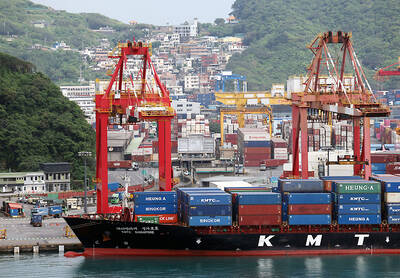
Taiwan’s economy grew far faster than expected in the first quarter, as booming demand for artificial intelligence (AI) applications drove a surge in exports, spilling over into investment and consumption, the Directorate-General of Budget, Accounting and Statistics (DGBAS) said yesterday. GDP growth was 13.69 percent year-on-year during the January-to-March period, beating the DGBAS’ February forecast by 2.23 percentage points and marking the most robust growth in nearly four decades, DGBAS senior official Chiang Hsin-yi (江心怡) told a news conference in Taipei. The result was powered by exports, which remain the backbone of Taiwan’s economy, Chiang said. Outbound shipments jumped 51.12 percent year-on-year to
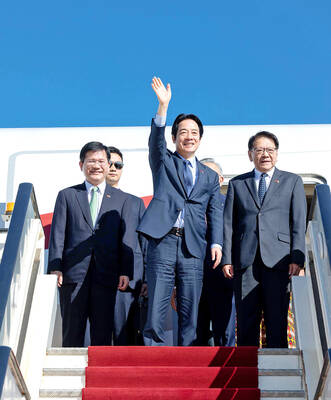
DELAYED BUT DETERMINED: The president’s visit highlights Taiwan’s right to international engagement amid regional pressure from China President Willaim Lai (賴清德) yesterday arrived in Eswatini, more than a week after his planned visit to Taiwan’s sole African ally was suspended because of revoked overflight permits. “The visit, originally scheduled for April 22, was postponed due to unforeseen external factors,” Lai wrote on social media. “After several days of careful arrangements by our diplomatic and national security teams, we successfully arrived today.” Lai said he looked forward to further deepening Taiwan-Eswatini relations through closer cooperation in the economy, agriculture, culture and education, as well as advancing the nation’s international partnerships. The president was initially scheduled to arrive in time to celebrate
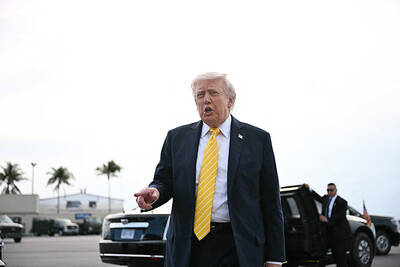
Iran’s Islamic Revolutionary Guard Corp (IRGC) yesterday said the US faced a choice between an “impossible” military operation or a “bad deal” with Tehran, after US President Donald Trump disparaged Iran’s latest peace proposal. Negotiations between the two countries have been deadlocked since a ceasefire came into effect on April 8, with only one round of direct peace talks held so far. Iran’s Tasnim and Fars news agencies reported that Tehran had submitted a 14-point proposal to mediator Pakistan, but Trump was quick to cast doubt on it. “I will soon be reviewing the plan that Iran has just sent to us, but


 RSS
RSS