


The Presidential Office must get approval from Taipei's Bureau of Cultural Affairs before the former official residence of Chiang Kai-shek (
The Presidential Office had planned to open the first floor of the residence in Shihlin (
Bureau officials made the remarks yesterday after learning Thursday of the Presidential Office's plans, which were outlined in a written statement.
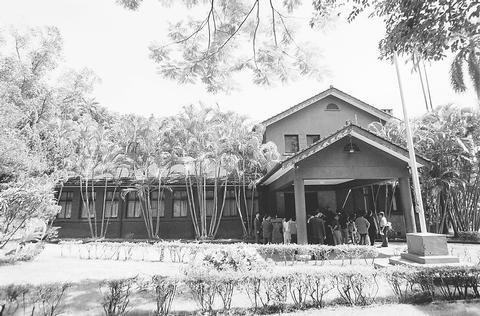
PHOTO: LU CHUN-WEI, TAIPEI TIMES
Huang Tsai-lang (黃才郎), deputy director of the bureau, said yesterday that the agency was surprised to learn of the Presidential Office's "unilateral proclamation."
"Although we favor the idea of opening up the place to the public, we don't think it's an appropriate time to do so because we have to respect the wishes and privacy of Madam Chiang," Huang said.
Chiang, who is now 102 years old and has been living on Long Island, New York, since her husband's death in 1975, now only occassionaly visits Taiwan.
The Presidential Office says that the decision to open the residence was made at an Aug. 30 meeting. At the meeting, Eugene Chien (簡又新), deputy secretary-general to President Chen Shui-bian (陳水扁), said that Chen had received written permission from Chiang in July to open the residence.
But Huang, who was invited to the meeting to discuss the future preservation and maintenance of the residence, denied that a decision was made at the meeting to open the home.
"One thing I'd like to make clear here is that although we talked about opening the main building to the public on Oct. 31, we failed to come to any conclusion," he said. "The consensus reached during the meeting focused on two things: we all agreed that the main building needs to be open to the public in the future, and that the Presidential Office needs to send the project proposal to the bureau for further examination and approval before the main building is open to the public."
The compound, which is under the management and maintenance of the Presidential Office, was designated by the bureau as the city's 93rd municipal heritage site on April 20 this year.
The bureau plans to make the home into a center for local and global study of the life and times of the Chiangs.
After having been closed to the public for 50 years, the main building was unveiled to the media for the first time in July.
Built in 1950, the two-story building was the second official residence for the Chiangs after they fled to Taiwan from China in 1949 with nationalist forces after conceding defeat to the communists.
Their first official residence was the Tsaoshan Royal Guest House (草山御賓館) on Yangmingshan.
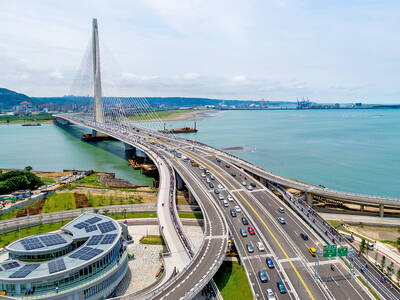
The Ministry of Transportation and Communications yesterday inaugurated the Danjiang Bridge across the Tamsui River in New Taipei City, saying that the structure would be an architectural icon and traffic artery for Taiwan. Feted as a major engineering achievement, the Danjiang Bridge is 920m long, 211m tall at the top of its pylon, and is the longest single-pylon asymmetric cable-stayed bridge in the world, the government’s Web site for the structure said. It was designed by late Iraqi-British architect Zaha Hadid. The structure, with a maximum deck of 70m, accommodates road and light rail traffic, and affords a 200m navigation channel for boats,

Taiwan Semiconductor Manufacturing Co (TSMC, 台積電), the world’s largest foundry service provider, yesterday said that global semiconductor revenue is projected to hit US$1.5 trillion in 2030, after the figure exceeds US$1 trillion this year, as artificial intelligence (AI) demand boosts consumption of token and compute power. “We are still at the beginning of the AI revolution, but we already see a significant impact across the whole semiconductor ecosystem,” TSMC deputy cochief operating officer Kevin Zhang (張曉強) said at the company’s annual technology symposium in Hsinchu City. “It is fair to say that in the past decade, smartphones and other mobile devices were
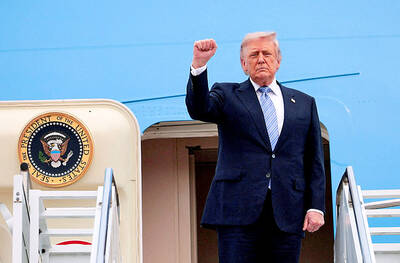
US-CHINA SUMMIT: MOFA welcomed US reassurance of no change in its Taiwan policy; Trump said he did not comment when Xi talked of opposing independence US President Donald Trump yesterday said he has not made a decision on whether to move forward with a major arms package for Taiwan after hearing concerns about it from Chinese President Xi Jinping (習近平). Trump’s comments on Taiwan came as he flew back to Washington after wrapping up critical talks in which both leaders said important progress was made in stabilizing US-China relations even as deep differences persist between the world’s two biggest powers on Iran and Taiwan. “I will make a determination,” Trump said, adding: “I’ll be making decisions. But, you know, I think the last thing we need right

TAIWAN ISSUE: US treasury secretary Scott Bessent said on the first day of meetings that ‘it wouldn’t be a US-China summit without the Taiwan issue coming up’ There were no surprises on the first day of the summit between US President Donald Trump and Chinese President Xi Jinping (習近平), the Mainland Affairs Council (MAC) said yesterday, as the government reiterated that cross-strait stability is crucial to the Asia-Pacific region, as well as the world. As the two presidents met for a highly anticipated summit yesterday, Chinese state media reported that Xi warned Trump that missteps regarding Taiwan could push their two countries into “conflict.” Trump arrived in China with accolades for his host, calling Xi a “great leader” and “friend,” and extending an invitation to visit the White House


 RSS
RSS