


Minister of National Defense Wu Shih-wen (伍世文), awarded yesterday with a medal for his contribution to military reform during his term as deputy defense minister, is Taiwan's 22nd defense minister -- a post which is notable in Taiwan's history for its number of incumbents and not how long they served.
The defense ministry's greatest struggle of late has been to wrest ultimate control of defense matters from the Chief of the General Staff. The minister of defense's supremacy in the military chain of command was finally enshrined in the National Defense Law on Jan. 15 this year.
In the 54 years before Wu took office, Taiwan saw 21 ministers of national defense and 17 chiefs of the general staff, fewer than would have been the case had the current fixed term of two years, laid down by the Ministry of Defense Organization Law -- also passed on Jan. 14 this year -- applied.
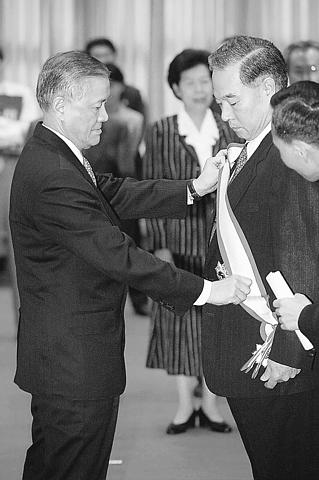
PHOTO: CNA.
There have been more defense ministers than chiefs of the general staff (CGS) mainly because the appointment of the former has been more easily subject to political influence, according to a retired top-ranking military official who declined to be identified.
The first defense minister was General Pai Chung-hsi (
He held the position for nearly two years, a term whose duration is unremarkable in terms of the new fixed term, but which was not to be repeated for many of the intervening years.
The next five defense ministers served an average of less than five months each, between June 1948 and April 1950. Three of those, Hsu Yung-chang (
Ho is also one of only five to have occupied both the position of defense minister and chief of the general staff. His first term having lasted five months, he served a one-month second term from May to June, 1949, while also serving as premier
Yen, Ho's successor, also held the premiership and the defense portfolio at the same time, for seven months. Within the almost two-year period, none of the five ministers held office long enough to promote and groom successors, a trend indicative of the political instability of the time.
"It has a lot to do with then-president Chiang Kai-shek's (
"One of the first things Chiang did after regaining power was to offer renowned weaponry specialist Yu Ta-wei (
A degree of stability was achieved for a while when Kuo Chi-chiao (
"But Kuo was not a choice widely accepted by the military leadership and was therefore somewhat ineffectual as defense minister, especially in light of the greater power enjoyed by chief of the general staff, Chou Chih-ju (
The first truly powerful defense minister was Kuo's successor, Yu Ta-wei, who had refused the job at the first invitation. He was also the first civilian defense minister.
Yu held the post for an unrivalled almost 11-year term and helped to improve the fragile defense structure, making the job easier for his successor Chiang Ching-kuo (
Ching-kuo was no less powerful a minister than Yu -- in part because he was heir-apparent to the president, and in part because of Yu's organizational accomplishments within the ministry.
After defense affairs became increasingly institutionalized through successive efforts by Yu and Chiang, the president was able to appoint defense ministers in accordance with more universally accepted approaches to military leadership, involving, in particular, seniority.
The next three defense ministers, from 1968 to 1981, were promoted on the basis of seniority.
Huang Chieh (
The ranks of appointees to the post after the senior Chiang's death in 1975, carry the hallmark of the personal preferences of his son and successor, Chiang Ching-kuo. The first of these was Sung Chang-chih (宋長志), the first naval general to take the post, his appointment meeting with no objections from the other branches of the military.
Chiang's next two defense ministers were both said to be of a mild temperament, which is likely to have served his political needs at the time. One was from the National Security Council.
After former President Lee Teng-hui (
At the same time, in order to establish his control over the military, Lee appointed two hand-picked civilians to succeed Hau. Neither was successful in establishing his authority over the Chief of the General Staff and Lee turned once again to the military.
The strategy worked and has remained effective up to the present, the succeeding two defense ministers, Chiang Chung-ling (
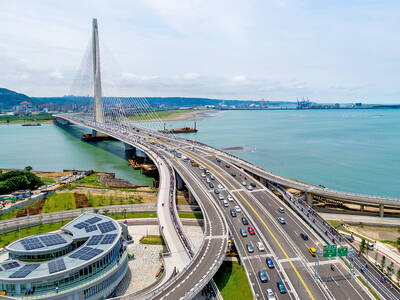
The Ministry of Transportation and Communications yesterday inaugurated the Danjiang Bridge across the Tamsui River in New Taipei City, saying that the structure would be an architectural icon and traffic artery for Taiwan. Feted as a major engineering achievement, the Danjiang Bridge is 920m long, 211m tall at the top of its pylon, and is the longest single-pylon asymmetric cable-stayed bridge in the world, the government’s Web site for the structure said. It was designed by late Iraqi-British architect Zaha Hadid. The structure, with a maximum deck of 70m, accommodates road and light rail traffic, and affords a 200m navigation channel for boats,

Taiwan Semiconductor Manufacturing Co (TSMC, 台積電), the world’s largest foundry service provider, yesterday said that global semiconductor revenue is projected to hit US$1.5 trillion in 2030, after the figure exceeds US$1 trillion this year, as artificial intelligence (AI) demand boosts consumption of token and compute power. “We are still at the beginning of the AI revolution, but we already see a significant impact across the whole semiconductor ecosystem,” TSMC deputy cochief operating officer Kevin Zhang (張曉強) said at the company’s annual technology symposium in Hsinchu City. “It is fair to say that in the past decade, smartphones and other mobile devices were
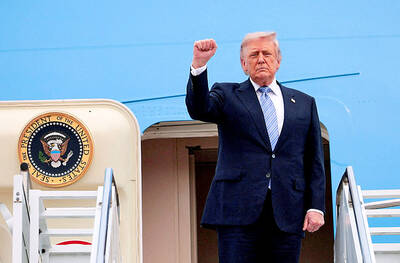
US-CHINA SUMMIT: MOFA welcomed US reassurance of no change in its Taiwan policy; Trump said he did not comment when Xi talked of opposing independence US President Donald Trump yesterday said he has not made a decision on whether to move forward with a major arms package for Taiwan after hearing concerns about it from Chinese President Xi Jinping (習近平). Trump’s comments on Taiwan came as he flew back to Washington after wrapping up critical talks in which both leaders said important progress was made in stabilizing US-China relations even as deep differences persist between the world’s two biggest powers on Iran and Taiwan. “I will make a determination,” Trump said, adding: “I’ll be making decisions. But, you know, I think the last thing we need right
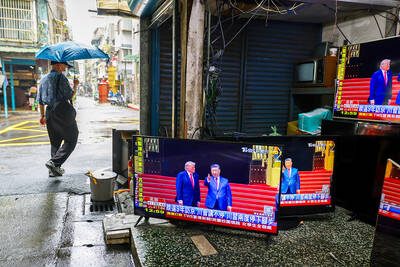
TAIWAN ISSUE: US treasury secretary Scott Bessent said on the first day of meetings that ‘it wouldn’t be a US-China summit without the Taiwan issue coming up’ There were no surprises on the first day of the summit between US President Donald Trump and Chinese President Xi Jinping (習近平), the Mainland Affairs Council (MAC) said yesterday, as the government reiterated that cross-strait stability is crucial to the Asia-Pacific region, as well as the world. As the two presidents met for a highly anticipated summit yesterday, Chinese state media reported that Xi warned Trump that missteps regarding Taiwan could push their two countries into “conflict.” Trump arrived in China with accolades for his host, calling Xi a “great leader” and “friend,” and extending an invitation to visit the White House


 RSS
RSS