


Offered two opportunities during a news conference yesterday to attack China's "scoring of political points" over 921 earthquake relief, President Lee Teng-hui (
Lee gave a news conference at the presidential office yesterday dedicated to issues related with the 921 earthquake.
After the Sept. 21 quake that killed more than 2,000 people, China on several occasions has used the disaster to reinforce its claim of sovereignty over Taiwan. China's foreign ministry, for example, thanked the world for extending assistance to Taiwan -- while the UN, before sending a rescue team to Taiwan, had to ask China's permission.
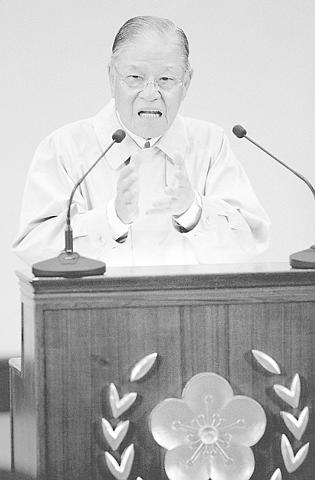
PHOTO: GEORGE TSORNG, TAIPEI TIMES
Referring to such actions from Beijing, two separate but similar questions were posed to Lee.
At first, he brushed away the question by saying that he had been too busy visiting quake-stricken areas and had not had time to read newspapers, and did not know what China was doing.
When the question was raised again, Lee said: "That's why I said cross-Strait relations are `special state-to-state relations.'"
"If [China] goes on in this way, [we] cannot do anything," he said.
But he still refused to give a more specific statement.
"I am not going to make any comment," he said. "You [reporters] write [your comments]. I'm not going to say [anything about it]."
Lee is well-known for his candor, but when -- as yesterday -- he is not his usual straightforward self, observers are left baffled.
"I am surprised," said Joseph Wu (
"People are angry with what China did to us during the quake. If he had had angry words for China, it would have been the right thing to do," Wu said.
"It's weird. Maybe he thinks that what's been said [about China] in the newspapers is enough."
Avoiding comment on cross-Strait issues was a way of showing the government's priorities, presidential office officials said.
"President Lee hopes to concentrate on issues surrounding disaster relief. It is also a reflection of what people most want," said Lin Bih-jaw (
Lee did, however, defend the government's actions after the earthquake and thanking both domestic and foreign rescue workers.
"Our most important task is to leave the shadow of sadness behind us and rebuild our homes," he said.
Lee said Taiwan had moved much faster than Japan and Turkey to rescue people and provide compensation to victims' relatives.
The president said Japanese legislators told him that Taiwan's response was faster than Japan's was when a 7.2-magnitude quake hit Kobe in 1995, killing 6,000 people.
Lee refuted reports that the government was inefficient enough after the quake.
"A Japanese lawmaker who is very familiar with relief work of the Great Hanshin Earthquake told me that we were three times more efficient than the Japanese government," Lee said.
"I know the government could not possibly make everyone happy after the great disaster, but I am confident that we will do a good job in rebuilding our homes," he said.
Lee also dismissed suggestions that the central government was considering setting up a large-scale rescue force such as the US' Federal Emergency Management Agency (FEMA) in preparation for future disasters.
"We are a small country, so the National Fire Administration we have now should be enough," he said. "What we need to do is to reinforce its equipment and training."
Despite the confusion over Lee's comments, Wu said the press conference was not a time for policy pronouncements.
The meeting was more form than substance, he said, as details of new policies are supposed to be supplied by the premier.
"This is an occasion to narrow the gap between the government and people, especially when it is a time that people have some misunderstanding about the government," he said.
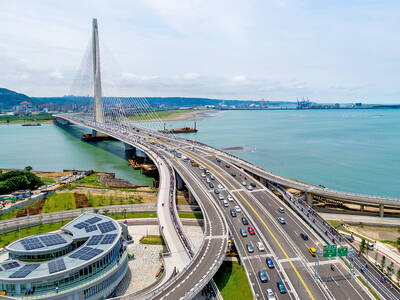
The Ministry of Transportation and Communications yesterday inaugurated the Danjiang Bridge across the Tamsui River in New Taipei City, saying that the structure would be an architectural icon and traffic artery for Taiwan. Feted as a major engineering achievement, the Danjiang Bridge is 920m long, 211m tall at the top of its pylon, and is the longest single-pylon asymmetric cable-stayed bridge in the world, the government’s Web site for the structure said. It was designed by late Iraqi-British architect Zaha Hadid. The structure, with a maximum deck of 70m, accommodates road and light rail traffic, and affords a 200m navigation channel for boats,
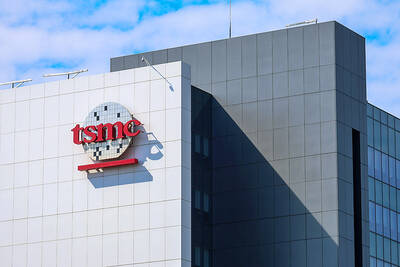
Taiwan Semiconductor Manufacturing Co (TSMC, 台積電), the world’s largest foundry service provider, yesterday said that global semiconductor revenue is projected to hit US$1.5 trillion in 2030, after the figure exceeds US$1 trillion this year, as artificial intelligence (AI) demand boosts consumption of token and compute power. “We are still at the beginning of the AI revolution, but we already see a significant impact across the whole semiconductor ecosystem,” TSMC deputy cochief operating officer Kevin Zhang (張曉強) said at the company’s annual technology symposium in Hsinchu City. “It is fair to say that in the past decade, smartphones and other mobile devices were
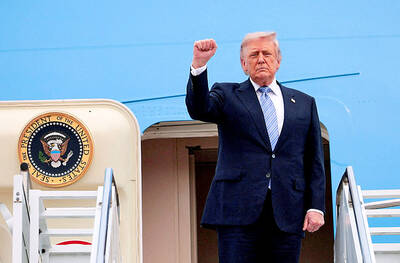
US-CHINA SUMMIT: MOFA welcomed US reassurance of no change in its Taiwan policy; Trump said he did not comment when Xi talked of opposing independence US President Donald Trump yesterday said he has not made a decision on whether to move forward with a major arms package for Taiwan after hearing concerns about it from Chinese President Xi Jinping (習近平). Trump’s comments on Taiwan came as he flew back to Washington after wrapping up critical talks in which both leaders said important progress was made in stabilizing US-China relations even as deep differences persist between the world’s two biggest powers on Iran and Taiwan. “I will make a determination,” Trump said, adding: “I’ll be making decisions. But, you know, I think the last thing we need right
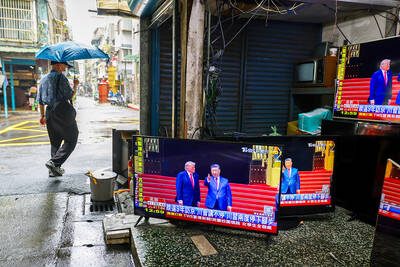
TAIWAN ISSUE: US treasury secretary Scott Bessent said on the first day of meetings that ‘it wouldn’t be a US-China summit without the Taiwan issue coming up’ There were no surprises on the first day of the summit between US President Donald Trump and Chinese President Xi Jinping (習近平), the Mainland Affairs Council (MAC) said yesterday, as the government reiterated that cross-strait stability is crucial to the Asia-Pacific region, as well as the world. As the two presidents met for a highly anticipated summit yesterday, Chinese state media reported that Xi warned Trump that missteps regarding Taiwan could push their two countries into “conflict.” Trump arrived in China with accolades for his host, calling Xi a “great leader” and “friend,” and extending an invitation to visit the White House


 RSS
RSS