


Who was the most-streamed singer on your Spotify playlist for last year? According to the online music giant, the King of Mando-pop Jay Chou was once again the most-streamed act in Taiwan, topping the annual music chart for three consecutive years. Global K-pop sensation BTS took the second spot, while Canada’s Justin Bieber came third.
The most-streamed songs for last year included “Your Name Engraved Herein” by singer Crowd Lu, “Oh Love, You Are Much Greater Than I Imagined” by rock band EggPlantEgg, and “Where I Lost Us” by rock band Accusefive. All three were theme songs from a blockbuster film or a TV drama. Rapper E.SO’s first solo album ”Outta Body” was the most-streamed album.
As for the category of Podcast — a blend of “iPod” and “broadcast” — “Gooaye,” a show about stock market investment, replaced “Bailingguo News” to top the playlist on Spotify. The two were followed by “Froggy,” hosted by YouTuber-turned-Taipei City Councilor Chiu Wei-chieh, better known as Froggy.

Photo: Chen Yi-kuan, Liberty Times 照片:自由時報陳逸寬
(Eddy Chang, Taipei Times)
誰是你去年最愛收聽的歌手呢?據音樂串流龍頭Spotify的統計顯示,華語天王周杰倫是去年台灣最常播放的歌手,連續三年稱霸串流排行榜榜首。韓流天團防彈少年團勇奪亞軍,加拿大歌手小賈斯汀位居第三。
去年台灣收聽次數最多的歌曲,依序是歌手盧廣仲的《刻在我心底的名字》、樂團茄子蛋的《愛情你比我想的閣較偉大》、樂團告五人的《在這座城市遺失了你》,前三名都是熱門電影或電視劇主題曲。而瘦子單飛後的首張個人專輯《靈魂出竅》,則是去年收聽次數最高的專輯。
至於播客項目——該字「Podcast」是由「iPod」和「broadcast」所拼綴而成——股市投資節目《股癌》成功取代前年冠軍《百靈果》,第三名是《呱吉》,該節目由網紅轉型的台北市議員邱威傑(呱吉)主持。
(台北時報張聖恩)
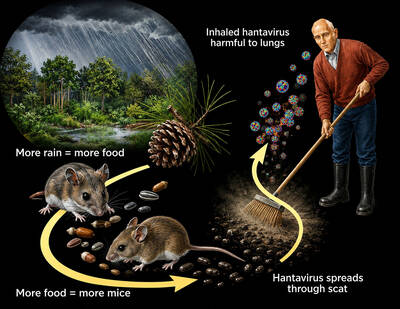
An outbreak aboard a cruise ship of a rare rodent-borne illness called hantavirus has left three passengers dead and sickened others, but global health officials say the risk to the general public remains low because the germ does not easily spread between people. “This is not the next COVID, but it is a serious infectious disease,” said Maria Van Kerkhove, director of epidemic and pandemic preparedness at the World Health Organization (WHO). “Most people will never be exposed to this.” The virus usually spreads when people inhale contaminated residue of rodent droppings. Hantaviruses have been around for centuries and are thought to

Have you ever wondered how people navigate the world when they can’t see a map? For individuals with visual impairments, conventional maps are nearly impossible to use. This is where tactile maps come in — essential tools that allow people to “see” the world through touch. A tactile map is specially designed with raised lines, textures, and symbols to represent geographical features such as roads, rivers, and buildings. Users explore it with their fingertips. However, these maps are not exclusively for people with visual disabilities. They serve as valuable multisensory learning tools that enhance spatial understanding for everyone, making

1. 他病了三天。 ˇ He has been sick for three days. χ He has been sick since three days. 註︰這裡現在完成時態 have / has been 表示從過去某一時日到現在的一段時間存在的行為或狀態,與它連用的時間副詞應為 「for +若干時」,如 for a year, for three hours 等,意思是歷時多少。 2. 他自從星期三以來都很忙。 ˇ He has been busy since Wednesday. χ He has been busy from Wednesday. 註︰「自從……以來」,該用 since。說從某一天(某一時刻)到某一天(某一時刻)才用 from,如 from Monday till Friday。 3. 房間角落裡散放著一些零星物件。 ˇ There were some odds and ends lying in the corner of the room. χ There were some odds and ends lying at the corner of the room. 註︰「在房間角落裡」該用介詞 in。例如: He stood in the corner. There is a lamp in the corner of the room. at the corner 指房子外部的拐角。例如: A little boy

A: In early May, there were concerts by Icyball, Chyi Yu, Korea’s EXO and Japan’s Anisama, but I missed them all. What a shame. B: That’s OK. There are shows coming up by various artists, including Power Station, Accusefive, Japanese singer Mika Nakashima, Chinese-Icelandic jazzer Laufey, and even Singaporean diva Stefanie Sun. A: After a 12-year hiatus, Stefanie is finally returning to Taipei again. B: In late May, there will be more shows by Crowd Lu, WeiBird, Korea’s Donghae, 2AM, EXID, and Thailand’s BUS. A: The Thai boyband is so popular. It looks like “T-pop” is catching up with J-pop


 RSS
RSS