


Scientists have figured out how to calculate the age of whale sharks — Earth’s largest fish — with some guidance from the radioactive fallout spawned by Cold War-era atomic bomb testing.
By measuring levels of carbon-14, a naturally occurring radioactive element that also is a by-product of nuclear explosions, the researchers determined that distinct bands present inside the shark’s cartilaginous vertebrae are formed annually, like a tree’s growth rings. It was already known that these bands existed and increased in number as a shark aged. But it was unclear whether new rings appeared yearly or every six months.
The researchers compared carbon-14 levels in the rings to data on fluctuations in its global presence during the busy years of atmospheric nuclear tests in the 1950s and 1960s. “These elevated levels of carbon-14 first saturated the atmosphere, then oceans and moved through food webs into animals, producing elevated levels in structures such as the vertebrae of whale sharks,” said marine ecologist Joyce Ong of Rutgers University in New Jersey, lead author of the study published on April 6 in the journal Frontiers in Marine Science.
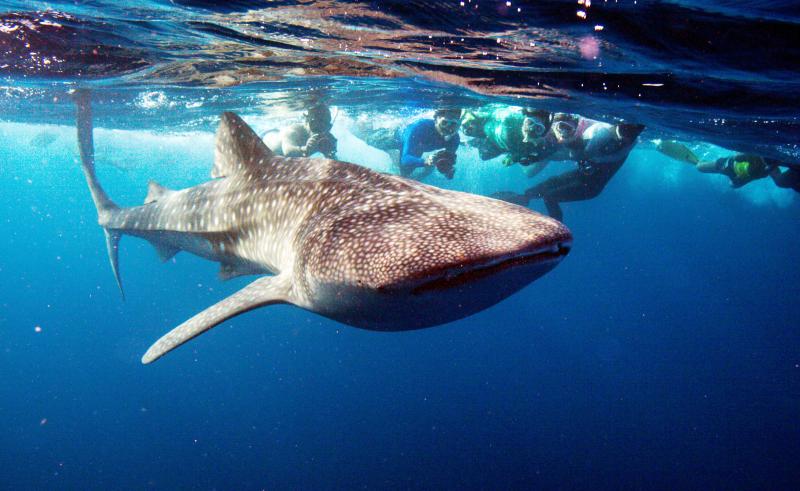
Photo: Reuters
照片:路透
Scientists now will be able to calculate a whale shark’s age after its death — one ring equals one year. But just as importantly the study established that these endangered marine giants possess a very slow growth rate.
“For the management of any marine species, knowledge of growth rate is critical as it determines the resilience of populations to threats such as fishing. Fast-growing species have fast rates of replacement and can withstand relatively high losses, whereas slow-growing species have low rates of replacement and are much less resilient,” said marine biologist and study co-author Mark Meekan of the Australian Institute of Marine Science in Perth.
Whale sharks are filter feeders, swimming great distances through the world’s tropical oceans to find enough plankton to sustain themselves. They have a brownish-grayish color on the back and sides with white spots, with a white underside.
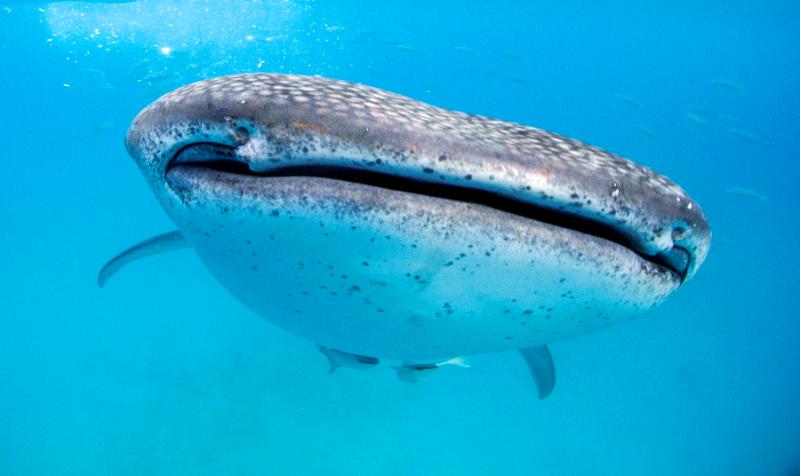
Photo: Reuters
照片:路透
The researchers tested carbon-14 levels in long-dead whale sharks whose remains were stored in laboratories. The oldest one tested, stored in Pakistan, had lived 50 years. “We thought that it was possible that they could reach ages of as much as 100 years, but we weren’t really sure as we had no validated data on age,” Meekan said.
“We still can’t say for certain if these sharks live to be 100 years old, but it now seems much more likely given that our largest shark was 50 years old at 10m in length and it is well documented that these sharks can get almost double this size, to around 18m in length.”
(Reuters)
科學家近日從冷戰時代原子彈試爆產生的放射性落塵獲得指引,想出了如何計算地球上最大型魚類──鯨鯊──年齡的方法。
藉由測量碳十四的含量,研究人員判斷鯨鯊軟骨脊椎裡面的獨特圓形紋路是每年都會形成的,就像是樹木的年輪。碳十四是一種自然產生的放射性物質,同時也是核爆的副產品。科學家先前已知這類生長紋的存在,也了解紋路數量會隨著鯨鯊年紀增加,但是當時並不能確定鯨鯊是每年還是每六個月就會長出一圈新的生長紋。
一九五○和一九六○年代是各國頻繁進行高空核試驗的時期。研究人員遂將鯨鯊生長紋裡面的碳十四含量和這些年間全球碳十四含量變化的數據相互對照。這篇研究在四月六日發表於期刊《海洋科學前沿》,主要作者為美國紐澤西羅格斯大學的海洋生態學家喬依絲‧翁(音譯),她指出:「核試爆增加的碳十四含量先是充斥在大氣層中,再進入海洋,然後經由食物網進入動物體內,造成動物生理結構中──例如鯨鯊的脊椎骨──出現高含量的碳十四。」
科學家現在能夠藉此在鯨鯊死後計算出它的年齡──生長紋一圈代表一歲。但是,這篇研究還提出另一項同樣重要的論點:這類瀕危的巨大海洋動物生長速率非常緩慢。
該研究的共同作者、澳洲海洋科學研究所的海洋生物學家馬克.米肯表示:「對於任何海洋物種的管理而言,生長速率是至關重要的知識,因為這項因素直接影響海洋生物族群面對包括漁業在內等威脅的恢復能力。長得快的物種替換速率也快,因此可以耐受相對高強度的數量損失;相較之下,生長緩慢的物種替換速率較低,族群恢復能力也比較弱。」
鯨鯊是濾食型動物,每每要穿梭於世界各地的熱帶海洋中、游上好遠的距離才能夠找到足夠餵飽它們的浮游生物。鯨鯊背部呈現褐灰色,兩側帶有白色的斑點,腹部也是白色的。
研究人員進行碳十四含量測驗的對象來自於死亡已久、身體保存在世界各地實驗室裡的鯨鯊。測驗對象中最年長的一隻保存在巴基斯坦,它活了五十年。米肯指出:「我們之前以為,鯨鯊最高可以活到一百歲,但是我們沒有有效的資料佐證,不能完全確定。」
米肯表示:「我們目前還是不能肯定地說這些鯊魚可以活到一百歲,不過這個推測現在看起來更有可能發生,因為我們測驗的最大隻鯨鯊活到了五十歲,身長十公尺,在此同時,有充分的紀錄顯示這些鯊魚可以長到將近兩倍的長度,也就是大約十八公尺。」
(台北時報章厚明譯)
Many consumers are guilty of filling drawers or closets with old laptops, cellphones, fitness trackers and other electronic devices once they are no longer needed. It’s hard to know where to recycle such items, or it seems costly and inconvenient to do so. The world generates millions of tons of electronic waste — also called e-waste — each year. According to the UN’s most recent estimate, people worldwide produced 62 million metric tons of e-waste in 2022, and only about 22 percent of it was properly recycled. The US’ Environmental Protection Agency estimates that less than a quarter of e-waste is

You’re sitting in class when a classmate asks to borrow a pencil. It seems like a small favor, so you agree without hesitation. The following week, the same classmate asks to share your notes. Later, they request help with a group project. You agree each time — after all, you helped out the first time — but before you know it, it has become automatic. This scenario demonstrates the “foot-in-the-door technique,” a psychological concept that shows how agreeing to small, acceptable demands makes it easier to accept larger ones later on. The name for this strategy comes from door-to-door

A: The four-day Tomb Sweeping Day long weekend begins Friday and will run until Monday. Are you going to sweep your ancestors’ tombs? B: I did in advance last weekend, so I can go to Kaohsiung to see the musical “The Phantom of the Opera.” A: Wow, is “Phantom” touring Taiwan again? It debuted in 1986, so this year marks the 40th anniversary of the show. B: And it’s not just touring Kaohsiung starting March 31, but also Taipei starting April 21 and Taichung starting May 26. A: “Phantom” is one of the world’s Four Major Musicals. I’ve seen all of them, except “Les

Dos & Don’ts — 想想看,這句話英語該怎麼說? 1. 我們很早到達電影院。 ˇ We arrived at the theater very early. χ We arrived the theater very early. 註︰arrive 為不及物動詞,後面如果有受詞要用 at 或 in。例如:They arrived in Taipei yesterday.。一般大地方,如國家、省、大城市等前面用 in,凡小地方城鎮、學校等則用 at。 2. 開車半小時以後,我們到達了海灘。 ˇ After half an hour’s drive, we got to the beach. χ After half an hour’s drive, we got the beach. 註︰come, go, get(來、去、到達)某地時,在表示地點的名詞前面應該用 to,如 go to school, go to Taipei, come to Shanghai 等。如果這些動詞後面所跟的是 here, there, home 等副詞,則不用 to。 3. 明天我會回辦公室。 ˇ I will be back in the office tomorrow. χ I will be back to office tomorrow. 註︰to be back 一語裡的 back 是副詞,不是介詞,所以後面要用 at (the market) 或 in (the office)。 假如假期結束,要回學校上課了則可說: ? Kids will be back


 RSS
RSS