


Does this tower look familiar to you? It's built to look like a very famous building in France called the Eiffel Tower. Although this tower was made out of French bread, it was actually built in Tokyo, Japan. The real Eiffel Tower is in Paris, France.
The man and woman in this picture are serving customers a kind of French bread called a canape. Canapes are either fried or toasted. You can eat canapes plain, but if you are creative, you can add many different kinds of food to the top of canapes. Meat, cheese and even goose liver are all often eaten with canapes.
Canapes originally came from France, but they are commonly eaten all over Europe. They have a different name in almost every country. However, you don't have to go to Europe to get canapes -- ?and you don't have to go to Paris to see what the Eiffel Tower looks like. (Kayleen Hartman, Staff writer)
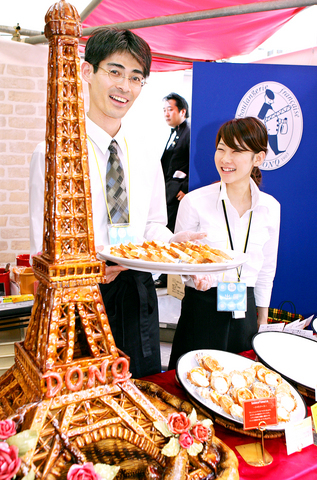
PHOTO: AFP
這座塔看起來很眼熟嗎?它是仿造法國極為著名的建築「艾菲爾鐵塔」所製,原料雖是法國麵包,卻是在日本東京烘培而成。真正的艾菲爾鐵塔坐落於法國巴黎。
照片中的先生女士正招待顧客一種叫「canape」的法國麵包。「canape」只有炸或烤兩種作法,可以直接吃,不過你如果想來點變化,可以在上面添加許多不同的食物,通常可搭配肉類、起司,甚至鵝肝醬。
「Canape」最初源自法國,但全歐洲普遍都有,在每個國家都有不同的稱呼。不過,要吃「canape」不必到歐洲,想看艾菲爾鐵塔長什麼樣子也不必到巴黎。 (翻譯:鄭湘儀)

The debate surrounding Taipower’s recent corporate identity reboot has gone well beyond the design community. The controversy began after Taipower replaced the familiar “Taiwan Power Company” wording — widely regarded as the calligraphy of Yu You-ren (1879-1964), former Control Yuan president and master calligrapher — with a modern logotype by designer Aaron Nieh’s team, Aaron Nieh Workshop. Taipower said the change was not a wholesale replacement of old signage, but an “optimization of its identity system,” aimed at meeting the needs of digital media, electronic bills, apps, social media graphics and various small-format applications. Existing physical markings, such as building

Since 2005, the third Monday in January has come to be known as “Blue Monday.” In other words, that day is believed to be the most depressing day of the year. This concept seems logical at first. After all, Monday marks the start of the school or workweek after two days of rest and fun. Also, blue is a color that is often associated with sadness. Furthermore, in many parts of the world, January is a time when the weather is cold, rainy, and gloomy. But is there any scientific proof that this January day is truly sadder than any of

Continued from yesterday(延續自昨日) https://www.taipeitimes.com/News/lang For the most part, the idea of “Blue Monday” has been rejected as a myth. Some mental health experts also say there is a danger in labeling a certain day as the most depressing time of the entire year. Some argue that if people expect to feel sadder on the third Monday in January, this belief alone may increase their anxiety. One group that is worried about the negative effect of believing in Blue Monday is Samaritans. A mental health charity based in the UK, Samaritans is working to turn Blue Monday into “Brew Monday.” In this
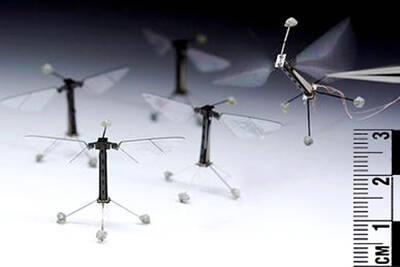
As bee populations around the world continue to decline at an alarming rate, scientists are developing an innovative solution: robotic bees. Recent advances at research institutions like Massachusetts Institute of Technology (MIT) in the US have produced tiny flying robots capable of performing pollination tasks similar to those of real bees. These tiny machines represent an impressive technological achievement. MIT’s latest models can hover in the air for over 1,000 seconds and perform complex movements, demonstrating the agility needed for successful pollination. The robots are designed to mimic the flight patterns of natural bees, offering potential support to agriculture


 RSS
RSS