


The US, India, Australia and Japan yesterday announced new maritime and critical minerals cooperation, reviving a forum viewed suspiciously by China following questions over the US’ commitment and disagreement on Iran.
US Secretary of State Marco Rubio took part in the Quadrilateral Security Dialogue (Quad) meeting in New Delhi, 10 days after US President Donald Trump paid a friendly state visit to China and spoke glowingly of the two powers working together as a “G2” — a concept that the US’ partners, which view Beijing’s rise warily, fear could shut them out.
Meeting his counterparts in India, Rubio said the Quad comprised countries “who share strong values — strong, vibrant democracies — who also are committed to many of the same concepts with regards to economic development and have many aligned interests.”
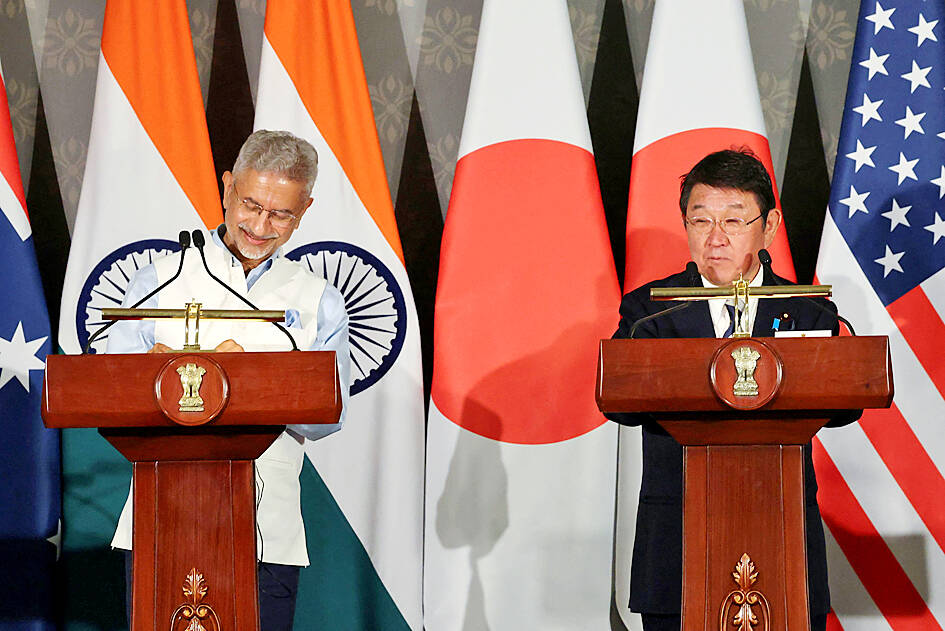
Photo: Reuters
Rubio said the four powers would work together on two maritime initiatives — one that combines their surveillance capabilities, and another that would provide enhanced real-time information to commercial traffic at sea.
In a first, Australian Minister for Foreign Affairs Penny Wong (黃英賢) said that the Quad was cooperating on assisting port development in Fiji — a key island nation in the South Pacific, where China has made a concerted push for greater influence.
“We recognize our obligation — our responsibility — to provide real choices, particularly as strategic circumstances in our region are deteriorating,” Wong said.
Rubio said the Quad would also step up four-way efforts to secure the supply of critical minerals, a rare area in which the Trump administration has turned to the more traditional diplomacy of building networks with allies, alarmed at the dominance of China in resources key to the high-end technology sector.
Reacting to the meeting, Chinese Ministry of Foreign Affairs spokeswoman Mao Ning (毛寧) said that cooperation “should not be directed against any third party.”
“We also do not support exclusive cliques or bloc confrontations,” she told reporters.
Trump has repeatedly been dismissive of major allies, saying they unfairly burden the US financially.
While Rubio held two Quad meetings last year, including one hours after taking office, Trump declined to commit to a four-way leaders’ summit.
It marked a strong contrast to his predecessor, former US president Joe Biden, who put a top priority on alliances and vowed that Quad summits were “here to stay.”
Rubio said the Trump administration wanted the Quad to focus more on deliverables than meetings, and said cooperation was progressing “pretty aggressively.”
Indian Minister of External Affairs Subrahmanyam Jaishankar said the focus of the talks would be “the Indo-Pacific, which is the specific limit of the Quad.”
India has differed with the other Quad nations on Russia’s invasion of Ukraine by refusing to sever its long-standing relationship with Moscow.

A signaling system malfunction disrupted high-speed rail (HSR) services beginning at 8am today, with trains temporarily reduced to three northbound and three southbound trains per hour as authorities conduct inspections. The malfunction occurred on a section of track in Miaoli County during pre-operation checks early this morning, forcing northbound and southbound trains to use a single track, the HSR operator said. The regular schedule has been replaced with three hourly trains offering only nonreserved seating in each direction, stopping at every station, it said, adding that business class cars would still have reserved seating. Departures from terminal stations are scheduled at the top
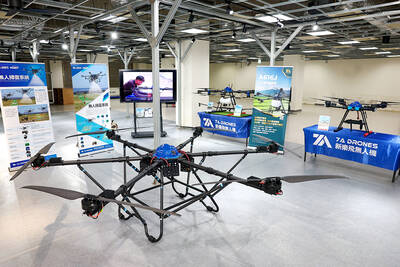
DRONE CENTRAL: Taiwan aims to become Asia’s democratic hub for drones, with most exports focused on high-quality military-grade models, an official said Taiwan’s drone industry is expected to expand significantly by 2030, producing 100,000 units per month and exporting half of them, the Ministry of Economic Affairs said yesterday. Current drone production capacity is about 15,000 units per month, but the industry can quickly scale up as demand increases, Industrial Development Administration Director-General Chiou Chyou-huey (邱求慧) told a news conference in Taipei. Taiwan’s drone output grew 2.5-fold last year to NT$12.9 billion (US$408.3 million) under a government program to develop the uncrewed vehicle sector, he said. The Executive Yuan in October last year approved plans to invest NT$44.2 billion into domestic production of uncrewed aerial

VERBOSE VESSELS: A CGA cutter and a China Coast Guard exchanged verbal barbs for more than a day in Taiwanese-controlled waters before the Chinese vessel left The Taiwanese and Chinese coast guards had a standoff near the strategically located Pratas Islands (Dongsha Islands, 東沙群島) in the north of the South China Sea, the Coast Guard Administration (CGA) said yesterday. The two sides engaged in intense radio exchanges over sovereignty claims during the 33-hour standoff. China Coast Guard vessel 3501 eventually left the restricted waters, 26.6 nautical miles (49.2km) west of the Pratas Islands, at 5pm yesterday, the CGA said. Lying approximately between southern Taiwan and Hong Kong, the Taiwan-controlled Pratas are seen by some security experts as vulnerable to Chinese attack due to their distance — more than
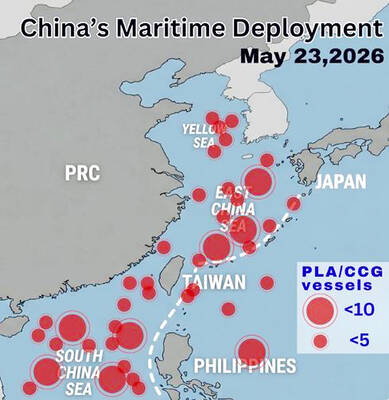
WARNING: China should stop engaging in actions that undermine regional peace and stability, as it would only build resentment among people across the Strait, the CGA said China has deployed more than 100 navy, coast guard and other vessels in waters from the Yellow Sea to the South China Sea and the western Pacific since US President Donald Trump and Chinese President Xi Jinping (習近平) met in Beijing, National Security Council Secretary-General Joseph Wu (吳釗燮) said yesterday. “In this part of the world, #China is the one & only PROBLEM wrecking the #StatusQuo & threatening regional peace & stability,” Wu wrote on X. In a separate post, he said Beijing was coercing Taiwan’s maritime domain, calling it illegal and provocative, after the Coast Guard Administration (CGA) expelled a


 RSS
RSS