


The Supreme Court on Thursday finalized a seven-year sentence for air force captain Hsu Chan-cheng (許展誠), who was found guilty of collecting military information for China, including data on Hsiung Feng III (Brave Wind III, 雄風) anti-ship missiles.
In a second-instance trial in February, the Taichung branch of the High Court sentenced Hsu to seven years in prison and stripped him of his civil rights for five years.
The Taichung court in March last year also sentenced former air force pilot Shih Chun-cheng (史濬程) for recruiting Hsu to provide sensitive information on the military’s response measures to Chinese aircraft incursions and training data in exchange for cash.
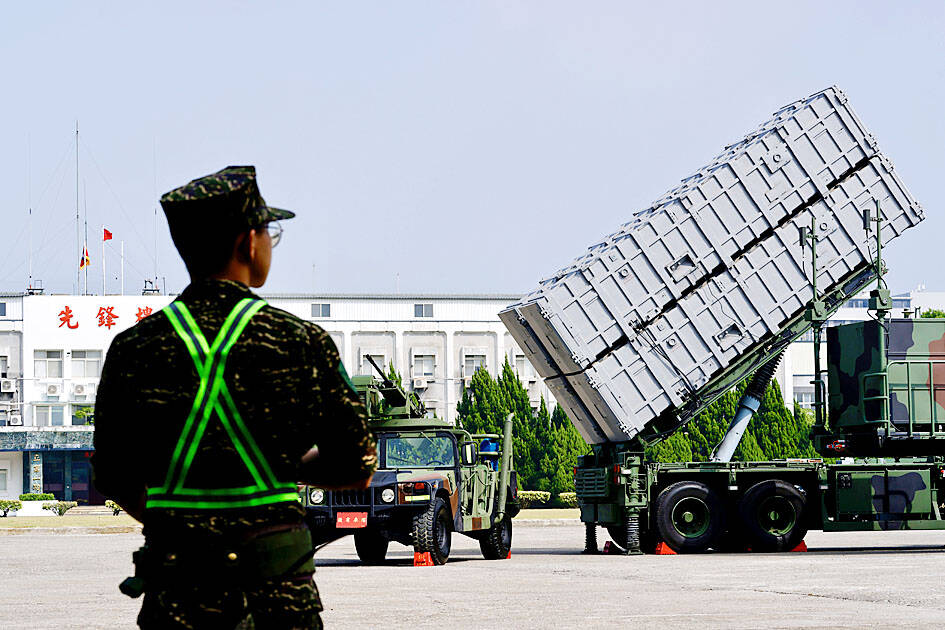
Photo: Ritchie B. Tongo, EPA-EFE
Shih retired from the air force in 2008 and in 2019 became acquainted with a Chinese intelligence operative known as Ziwen (子文), prosecutors said.
After accepting NT$2.1 million (US$66,523) in bribes, Shih recruited Hsu, then a captain in the air force’s Tactical Air Control Wing, prosecutors said.
Over four years, Hsu handed classified military documents to Shih, who paid him between NT$30,000 and NT$50,000 each time for a total of NT$226,000, prosecutors said.
Shih gave the documents to Ziwen using channels including WeChat, they said.
Hsu provided materials covering Taiwan’s military exercise and training data, response plans to Chinese military aircraft incursions and defense secrets related to the Indigenous Defense Fighter carrying Hsiung Feng III missiles, prosecutors said.
The Taichung District Court — which handled Hsu’s initial trials due to jurisdiction factors — ruled that the materials provided by Hsu would help China understand military information from Taiwan, harming national security and interests.
Hsu admitted guilt and returned more than NT$220,000 of the bribes, but as an active-duty service member, he disregarded the state’s investment in his training and betrayed his country, the district court said.
Hsu was found guilty of contravening the National Security Act (國家安全法) and the Anti-Corruption Act (貪污治罪條例), and was sentenced to seven years and four months in prison, stripped of his civil rights for five years and had his criminal proceeds confiscated.
The High Court reduced the sentence to seven years.
Hsu appealed to the Supreme Court, but it found no errors in the second-instance ruling and rejected his appeal, finalizing the case.
In Shih’s case, the High Court found him guilty of two contraventions of the National Security Act for “collecting classified official documents for China” — one completed offense and one attempted offense.
It sentenced him to two years and two months in prison for the completed offense, and 10 months for the attempted offense, for a combined sentence of two years and six months.
Shih appealed and the Supreme Court upheld the sentence for the completed offense, while remanding the attempted offense for a retrial.
In the second-instance trial for the attempted offense, the High Court convicted Shih of corruption and sentenced him to one year and six months in prison, and suspended his civil rights for two years.
Last month, the Supreme Court upheld the ruling, finalizing Shih’s combined sentence at three years and two months.
Additional reporting by CNA
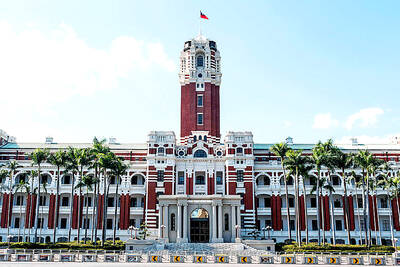
SECURITY: Taipei presses the US for arms supplies, saying the arms sales are not only a reflection of the US security commitment to Taiwan but also serve as a mutual deterrent against regional threats Taiwan is committed to preserving the cross-strait “status quo” and contributing to regional peace and stability, the Presidential Office said yesterday. “It is an undeniable fact that the Republic of China is a sovereign and independent democratic nation,” Presidential Office spokeswoman Karen Kuo (郭雅慧) reiterated, adding that Beijing has no right to claim sovereignty over Taiwan. The statements came after US President Donald Trump warned against Taiwanese independence. Trump wrapped up a state visit to Beijing on Friday, during which Chinese President Xi Jinping (習近平) had pressed him not to support Taiwan. Taiwan depends heavily on US security backing to deter China from carrying
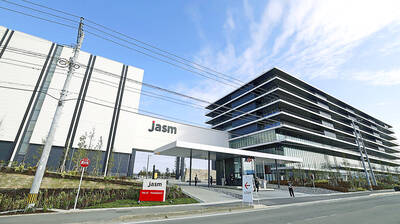
The subsidiary of Taiwan Semiconductor Manufacturing Co (TSMC, 台積電) in Kumamoto, Japan, turned a profit in the first quarter of this year, marking the first time the first fab of the unit has become profitable since mass production started at the end of 2024. According to the contract chipmaker’s financial statement released on Friday, Japan Advanced Semiconductor Manufacturing Inc (JASM), a joint venture running the fab in Kumamoto, posted NT$951 million (US$30.19 million) in profit in the January-to-March period, compared with a loss of NT$1.39 billion in the previous quarter, and a loss of NT$3.25 billion in the first quarter of
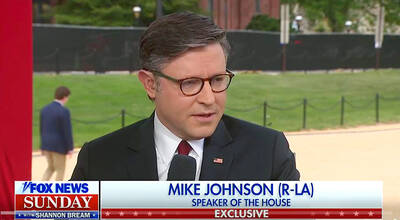
RESOLUTE BACKING: Two Republican senators are planning to introduce legislation that would impose immediate sanctions on China if it attempts to invade Taiwan US House of Representatives Speaker Mike Johnson on Sunday reaffirmed US congressional support for Taiwan, saying the US and “all freedom-loving people” have a stake in preventing China from seizing Taiwan by force. Johnson made the remarks in an interview with Fox News Sunday on US President Donald Trump’s summit with Chinese President Xi Jinping (習近平) last week. In an interview that aired on Friday on Fox News, just as Trump wrapped up a high-stakes visit to China, he said he has yet to green-light a new US$14 billion arms package to Taiwan and that it “depends on China.” “It’s a very good
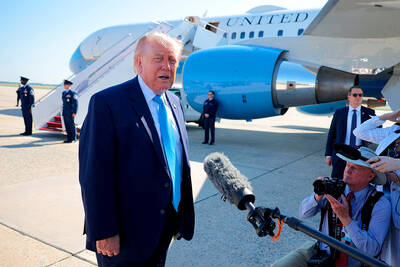
US President Donald Trump yesterday said he would speak to President William Lai (賴清德) as his administration considers whether to move ahead with a US$14 billion weapons sale to Taiwan — a potential arms deal that has drawn criticism from China. “Well, I’ll speak to him. I speak to everybody,” Trump told reporters yesterday when asked if he had any plans to call his counterpart, although he did not offer a time frame for when such a conversation could take place. Trump previously said he would speak to the person “that’s running Taiwan,” without specifying who he meant. “We have that situation very


 RSS
RSS