


The World Health Assembly (WHA) has become a stage for China‘s manipulation of the UN system and international legal order, as Beijing attempts to disrupt the cross-strait “status quo,” the Foundation of Medical Professionals Alliance in Taiwan (MPAT) said in a news release yesterday.
The WHO’s 79th annual WHA commenced yesterday in Geneva, Switzerland. Taiwan did not receive an invitation for the 10th consecutive year, having last observed the assembly in 2016.
Yesterday, the assembly’s General Committee and the Plenary Session again rejected a proposal calling for Taiwan to be invited to attend the WHA as an observer.
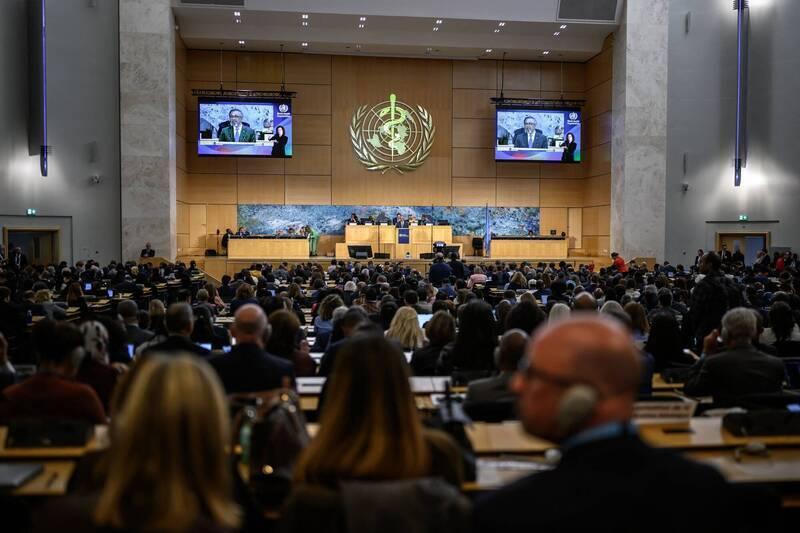
Photo: AFP
The assembly held a plenary hearing to discuss Taiwan’s participation in the WHA, hearing from China and Pakistan advocating for its continued exclusion, as Taiwanese allies Palau and Paraguay voiced support for Taiwan’s participation.
China invoked the three core tenets of its “one China” principle, stating that there is only one China in the world, Taiwan is a part of China and the People’s Republic of China (PRC) is the sole legitimate government representing all of China, the alliance said.
Beijing further distorted the meaning of UN Resolution 2758, it said.
The resolution, passed in 1971, states that the PRC is the only legitimate government of China, which allowed it to replace the Republic of China as a permanent member of the UN Security Council.
It also referenced WHA Resolution 25.1 of 1972, which appointed the PRC as the sole legitimate representative of China within the WHO, expelling Taiwan.
Taiwan has already held eight democratic elections and its lawmakers are elected by the public, the alliance said.
China’s deliberate manipulation of UN Resolution 2758 and WHA Resolution 25.1 cannot negate the fact that only the independent, democratically elected Taiwanese government can represent the people of Taiwan on the international stage, it said.
Beijing repeatedly states that it is Taiwan attempting to disrupt the “status quo,” but it is China that is manipulating the state of cross-strait relations and using the UN and the WHA to provoke tensions, alliance executive director Lin Shih-chia (林世嘉) said.
Taiwan’s public healthcare and National Health Insurance system are world-renowned, and as the world’s “silicon island,” it is a key proponent of intelligent healthcare worldwide, he said.
For many years, Taiwan has hosted various events alongside the WHA in Geneva, promoted the development of “smart” healthcare systems worldwide and demonstrated key achievements, such as meeting the WHO’s hepatitis C elimination goals five years ahead of target, he said.
Taiwan’s public health performance is worthy of serving as a global model, he added.
During yesterday’s hearing, Chinese Representative to the UN at Geneva Jia Guide (賈桂德) said that Taiwan’s ruling Democratic Progressive Party has “stubbornly adhered to the separatist position of Taiwan independence,” negating the possibility for Taiwan to participate in the WHA.
Jia called on Taiwan’s allies to “stop politicizing health issues” by supporting Taiwan’s participation in the WHA for their “own selfish reasons,” calling the action a breach of the UN charter.
He further said that any gap in the international epidemic prevention system is “nothing but sheer nonsense,” and that Taiwan’s exclusion from the WHA does not impact technical exchanges between Taiwan and the WHO.
Lastly, China requested that the WHA president make a decisive ruling to reject the inclusion of Taiwan-related proposals in the assembly’s agenda.
China’s stance was echoed by Pakistan, which said that the issue “falls beyond the mandate” of the WHA and urged member states to focus instead on the technical health agenda.
Palau and Paraguay supported Taiwan, rejecting China’s interpretation of Resolution 2758 and referencing Taiwan’s contributions during the COVID-19 pandemic.
Excluding Taiwan weakens global disease surveillance, delays information sharing and undermines collective preparedness, Palau said, adding that this is not a political issue, but a “public health imperative.”
Paraguay said that attaining the highest possible standard of health is a fundamental human right, and with the resurgence of infectious diseases and zoonotic threats, the exclusion of any actor with proven capacities is “a risk for all of us.”
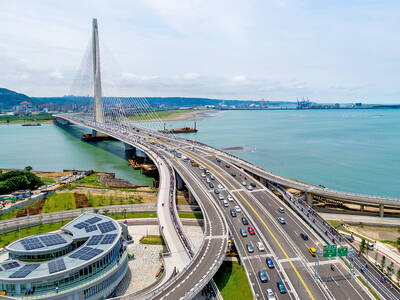
The Ministry of Transportation and Communications yesterday inaugurated the Danjiang Bridge across the Tamsui River in New Taipei City, saying that the structure would be an architectural icon and traffic artery for Taiwan. Feted as a major engineering achievement, the Danjiang Bridge is 920m long, 211m tall at the top of its pylon, and is the longest single-pylon asymmetric cable-stayed bridge in the world, the government’s Web site for the structure said. It was designed by late Iraqi-British architect Zaha Hadid. The structure, with a maximum deck of 70m, accommodates road and light rail traffic, and affords a 200m navigation channel for boats,
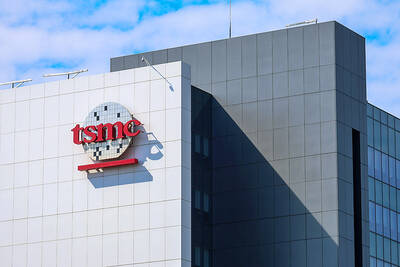
Taiwan Semiconductor Manufacturing Co (TSMC, 台積電), the world’s largest foundry service provider, yesterday said that global semiconductor revenue is projected to hit US$1.5 trillion in 2030, after the figure exceeds US$1 trillion this year, as artificial intelligence (AI) demand boosts consumption of token and compute power. “We are still at the beginning of the AI revolution, but we already see a significant impact across the whole semiconductor ecosystem,” TSMC deputy cochief operating officer Kevin Zhang (張曉強) said at the company’s annual technology symposium in Hsinchu City. “It is fair to say that in the past decade, smartphones and other mobile devices were
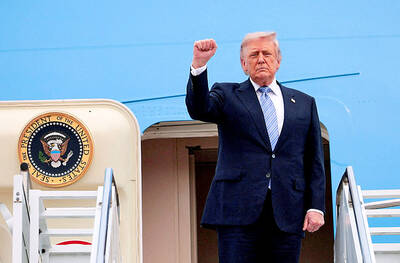
US-CHINA SUMMIT: MOFA welcomed US reassurance of no change in its Taiwan policy; Trump said he did not comment when Xi talked of opposing independence US President Donald Trump yesterday said he has not made a decision on whether to move forward with a major arms package for Taiwan after hearing concerns about it from Chinese President Xi Jinping (習近平). Trump’s comments on Taiwan came as he flew back to Washington after wrapping up critical talks in which both leaders said important progress was made in stabilizing US-China relations even as deep differences persist between the world’s two biggest powers on Iran and Taiwan. “I will make a determination,” Trump said, adding: “I’ll be making decisions. But, you know, I think the last thing we need right
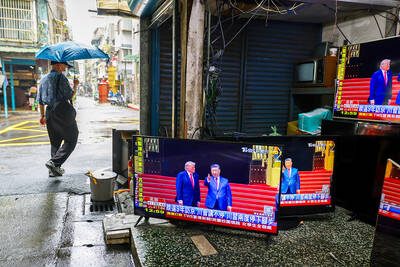
TAIWAN ISSUE: US treasury secretary Scott Bessent said on the first day of meetings that ‘it wouldn’t be a US-China summit without the Taiwan issue coming up’ There were no surprises on the first day of the summit between US President Donald Trump and Chinese President Xi Jinping (習近平), the Mainland Affairs Council (MAC) said yesterday, as the government reiterated that cross-strait stability is crucial to the Asia-Pacific region, as well as the world. As the two presidents met for a highly anticipated summit yesterday, Chinese state media reported that Xi warned Trump that missteps regarding Taiwan could push their two countries into “conflict.” Trump arrived in China with accolades for his host, calling Xi a “great leader” and “friend,” and extending an invitation to visit the White House


 RSS
RSS