


Bilateral visits between heads of state are a “basic right” and should not be seen as “breakthroughs,” President William Lai (賴清德) said yesterday upon returning from a delayed trip to the Kingdom of Eswatini.
“Some media outlets described [overcoming] external [Chinese] interference as a breakthrough,” he said at Taiwan Taoyuan International Airport. “But, in fact, bilateral visits between heads of state, just like friends going out to meet one another, are only normal and the basic right of every country.”
“This trip was faced with obstruction at one point, but it only showed the world Taiwan’s resolve to engage with the world,” he said.
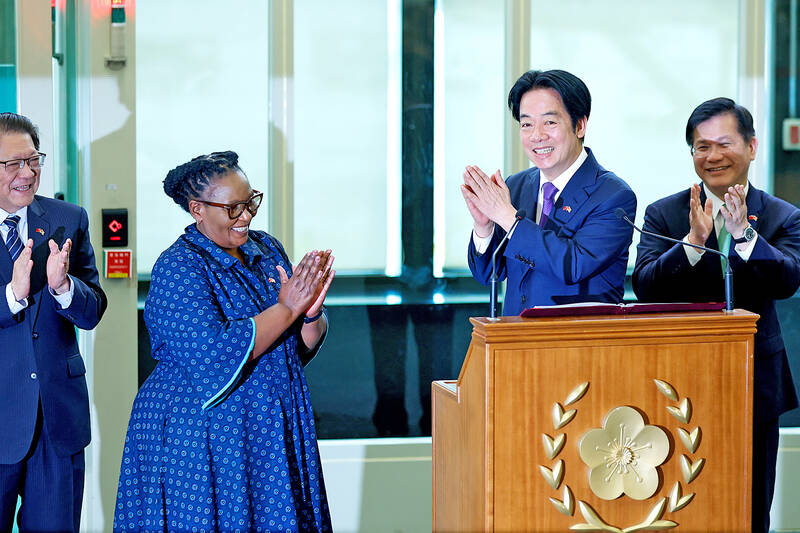
Photo: Ritchie B. Tongo, EPA
Lai was originally scheduled to depart for Eswatini on April 22, but canceled his trip the previous evening after the Seychelles, Mauritius and Madagascar abruptly revoked overflight clearance for his chartered aircraft.
The Presidential Office attributed the revocation of flight permits to Chinese “economic coercion” of the African states, while quietly working to relaunch the trip.
Lai on Saturday last week announced that he had arrived in Eswatini. Local media reports said that he traveled to Eswatini aboard King Mswati III’s private jet, flying directly from Taipei to the southern African nation.
Eswatini Deputy Prime Minister Thulisile Dladla traveled to Taiwan on Thursday last week aboard the king’s chartered plane, with her key mission being to formally invite Lai to visit Eswatini on the king’s aircraft, sources said.
Lai thanked Dladla, who escorted him on his return flight to Taiwan yesterday.
“Madam Deputy Prime Minister, you must be the best leading actress in Driving Miss Daisy if it were set in the skies,” Lai told Dladla, referring to Jessica Tandy’s performance in the 1989 Oscar-winning drama.
Lai said that during his visit, he witnessed comprehensive bilateral exchanges spanning energy security, agriculture, smart healthcare, women’s empowerment, culture and education.
“These cooperation initiatives not only underscore the friendship between the two countries spanning more than half a century, but also highlight Taiwan’s concrete actions with an international partner to bring about security, prosperity and development,” he said.
“The Republic of China, Taiwan, has proven through its actions that national power is demonstrated not through subordinating others, but through bringing happiness to all,” he added.
Academics said that Lai’s return from a state visit to Eswatini on a near-maximum-range flight demonstrated Taiwan’s strategic resilience in the face of pressure from Beijing.
His return flight, instead of taking a direct route, detoured south, covering about 13,000km without refueling and bringing the total round-trip distance to about 25,000km.
According to flight tracking data from Flightradar24, the Airbus A340-300 used for the trip, the official aircraft of King Mswati III, departed at about 6:40pm on Monday and initially headed southeast, avoiding a shorter northeastern route that would have passed through the flight information regions (FIRs) of the Seychelles, Madagascar and Mauritius.
The aircraft instead flew south of 45 degrees latitude in the southern Indian Ocean, before turning north after passing French southern territories and entering the Melbourne FIR. It then continued via Jakarta and over Philippine airspace before returning to Taiwan.
The journey pushed the limits of the A340’s operational range, with no stopovers for refueling, and drew significant global attention, with more than 3,000 users tracking the flight online at one point.
Su Tzu-yun (蘇紫雲), a research fellow at the government-funded Institute for National Defense and Security Research, said the mission combined logistical expertise, the use of an allied nation’s aircraft and an “arrive then announce” approach to complete what he described as a diplomatic breakthrough.
The aircraft, previously operated by state-run China Airlines (中華航空), is familiar to Taiwan’s maintenance system, he said, adding that qualified Taiwanese pilots might have been on board as backup to ensure flight safety.
Using allied aircraft for transport is also not unprecedented, Su said, citing Ukrainian President Volodymyr Zelensky, who has frequently been transported by foreign aircraft since Russia's invasion of Ukraine.
Regarding airspace restrictions, Su said while sovereign nations have full authority over their territorial airspace, aircraft operating in FIRs beyond the contiguous zone that extends 24 miles from a country's coastline generally have greater flexibility under international norms, particularly for military or official flights.
Su said the combination of flexible use of FIR rules, strong logistical support, allied cooperation and the ATA model could serve as a template for Taiwan in ensuring future presidential travel amid mounting pressure from China.
Wang Hung-jen (王宏仁), CEO of the Institute for National Policy Research, said Beijing's current approach is to make it increasingly difficult for Taiwan's leaders to travel abroad.
"This raises the cost of Taiwan's international engagement and risks normalizing such disruptions," Wang said, adding that such "abnormal" interference should not become the new normal.
Responding to criticism from some opposition figures that the trip was conducted "secretively," Wang said such views failed to reflect the current geopolitical environment.
"The procedures surrounding presidential travel have become more complex due to Beijing's efforts to constrain Taiwan's international space," he said. "Taiwan must explore all possible ways to break through these constraints, rather than framing such efforts as 'secretive.'"
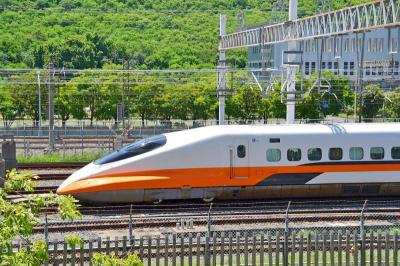
A signaling system malfunction disrupted high-speed rail (HSR) services beginning at 8am today, with trains temporarily reduced to three northbound and three southbound trains per hour as authorities conduct inspections. The malfunction occurred on a section of track in Miaoli County during pre-operation checks early this morning, forcing northbound and southbound trains to use a single track, the HSR operator said. The regular schedule has been replaced with three hourly trains offering only nonreserved seating in each direction, stopping at every station, it said, adding that business class cars would still have reserved seating. Departures from terminal stations are scheduled at the top
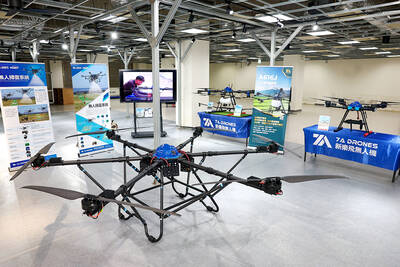
DRONE CENTRAL: Taiwan aims to become Asia’s democratic hub for drones, with most exports focused on high-quality military-grade models, an official said Taiwan’s drone industry is expected to expand significantly by 2030, producing 100,000 units per month and exporting half of them, the Ministry of Economic Affairs said yesterday. Current drone production capacity is about 15,000 units per month, but the industry can quickly scale up as demand increases, Industrial Development Administration Director-General Chiou Chyou-huey (邱求慧) told a news conference in Taipei. Taiwan’s drone output grew 2.5-fold last year to NT$12.9 billion (US$408.3 million) under a government program to develop the uncrewed vehicle sector, he said. The Executive Yuan in October last year approved plans to invest NT$44.2 billion into domestic production of uncrewed aerial
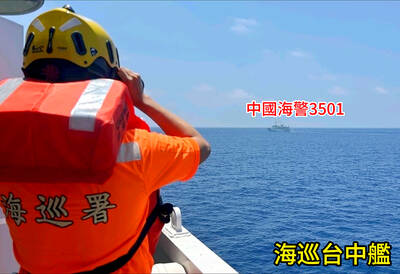
VERBOSE VESSELS: A CGA cutter and a China Coast Guard exchanged verbal barbs for more than a day in Taiwanese-controlled waters before the Chinese vessel left The Taiwanese and Chinese coast guards had a standoff near the strategically located Pratas Islands (Dongsha Islands, 東沙群島) in the north of the South China Sea, the Coast Guard Administration (CGA) said yesterday. The two sides engaged in intense radio exchanges over sovereignty claims during the 33-hour standoff. China Coast Guard vessel 3501 eventually left the restricted waters, 26.6 nautical miles (49.2km) west of the Pratas Islands, at 5pm yesterday, the CGA said. Lying approximately between southern Taiwan and Hong Kong, the Taiwan-controlled Pratas are seen by some security experts as vulnerable to Chinese attack due to their distance — more than
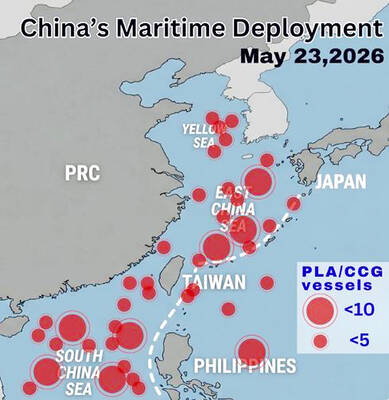
WARNING: China should stop engaging in actions that undermine regional peace and stability, as it would only build resentment among people across the Strait, the CGA said China has deployed more than 100 navy, coast guard and other vessels in waters from the Yellow Sea to the South China Sea and the western Pacific since US President Donald Trump and Chinese President Xi Jinping (習近平) met in Beijing, National Security Council Secretary-General Joseph Wu (吳釗燮) said yesterday. “In this part of the world, #China is the one & only PROBLEM wrecking the #StatusQuo & threatening regional peace & stability,” Wu wrote on X. In a separate post, he said Beijing was coercing Taiwan’s maritime domain, calling it illegal and provocative, after the Coast Guard Administration (CGA) expelled a


 RSS
RSS