


The government is planning a major coast guard overhaul to counter growing “gray zone” threats from China, President William Lai (賴清德) said yesterday.
Lai made the remarks during the Coast Guard Administration’s (CGA) inaugural “National Sea Light Awards” ceremony, where he honored award recipients for their outstanding contributions to national security, maritime law enforcement and rescue operations.
In his address, Lai said that Taiwan is a maritime nation and its security extends beyond land to the seas.
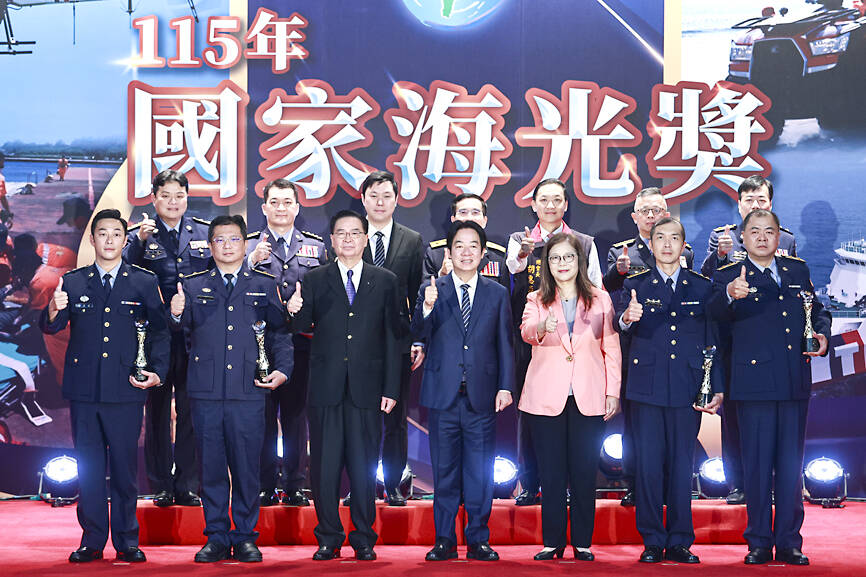
Photo: CNA
China has sought to establish a “new normal” that challenges the “status quo,” with repeated incursions and harassment placing significant pressure on frontline personnel, he said.
Despite this, the coast guard has remained steadfast, continuing its work in cross-border anti-narcotics operations, interdiction of illegal activities, and maritime search and rescue, he added.
“Under growing ‘gray zone’ pressures, coast guard personnel have teamed up with other government agencies to protect the security of undersea cables, ensuring that national operations remain unaffected,” he said.
Meanwhile, in the face of ongoing harassment from Chinese coast guard vessels, the coast guard has been vigilant, monitoring and responding to incidents, securing the safety of Taiwan’s waters, as well as vessels traveling through the area, he added.
Expressing his gratitude, Lai said that “while most people rest during the most challenging weather conditions, coast guard officers remain steadfast at their posts. The dedication is crucial to the nation’s stability and the public’s sense of security.”
Lai announced that the government is to launch a comprehensive transformation plan for the coast guard.
The initiative would focus on integrating sea and air monitoring capabilities, introducing next-generation radar systems and advanced protective equipment, expanding drone usage, and strengthening operational capacity, he said.
The government also plans to improve personnel benefits and renovate outdated facilities nationwide, ensuring better logistical support, and fostering closer collaboration between professional and civilian forces, he added.
Ocean Affairs Council Minister Kuan Bi-ling (管碧玲), whose agency oversees the CGA, said that Taiwan sits along a key Indo-Pacific shipping route, with the coast guard playing a frontline role in maintaining maritime order that not only safeguards national sovereignty but also helps ensure the stability of global supply chains.
The international community has increasingly viewed Taiwan as an important democratic pillar in the Indo-Pacific region, Kuan said.
Stressing that “where the coast guard stands, sovereignty also stands,” she said the council would continue to implement its vision of an integrated sea and air capability, and a highly capable coast guard, ensuring better equipment and faster response times.
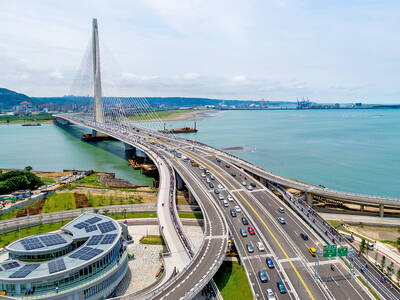
The Ministry of Transportation and Communications yesterday inaugurated the Danjiang Bridge across the Tamsui River in New Taipei City, saying that the structure would be an architectural icon and traffic artery for Taiwan. Feted as a major engineering achievement, the Danjiang Bridge is 920m long, 211m tall at the top of its pylon, and is the longest single-pylon asymmetric cable-stayed bridge in the world, the government’s Web site for the structure said. It was designed by late Iraqi-British architect Zaha Hadid. The structure, with a maximum deck of 70m, accommodates road and light rail traffic, and affords a 200m navigation channel for boats,
Taiwan Semiconductor Manufacturing Co (TSMC, 台積電), the world’s largest foundry service provider, yesterday said that global semiconductor revenue is projected to hit US$1.5 trillion in 2030, after the figure exceeds US$1 trillion this year, as artificial intelligence (AI) demand boosts consumption of token and compute power. “We are still at the beginning of the AI revolution, but we already see a significant impact across the whole semiconductor ecosystem,” TSMC deputy cochief operating officer Kevin Zhang (張曉強) said at the company’s annual technology symposium in Hsinchu City. “It is fair to say that in the past decade, smartphones and other mobile devices were
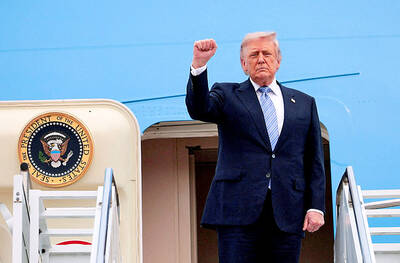
US-CHINA SUMMIT: MOFA welcomed US reassurance of no change in its Taiwan policy; Trump said he did not comment when Xi talked of opposing independence US President Donald Trump yesterday said he has not made a decision on whether to move forward with a major arms package for Taiwan after hearing concerns about it from Chinese President Xi Jinping (習近平). Trump’s comments on Taiwan came as he flew back to Washington after wrapping up critical talks in which both leaders said important progress was made in stabilizing US-China relations even as deep differences persist between the world’s two biggest powers on Iran and Taiwan. “I will make a determination,” Trump said, adding: “I’ll be making decisions. But, you know, I think the last thing we need right
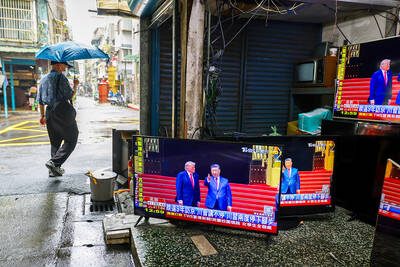
TAIWAN ISSUE: US treasury secretary Scott Bessent said on the first day of meetings that ‘it wouldn’t be a US-China summit without the Taiwan issue coming up’ There were no surprises on the first day of the summit between US President Donald Trump and Chinese President Xi Jinping (習近平), the Mainland Affairs Council (MAC) said yesterday, as the government reiterated that cross-strait stability is crucial to the Asia-Pacific region, as well as the world. As the two presidents met for a highly anticipated summit yesterday, Chinese state media reported that Xi warned Trump that missteps regarding Taiwan could push their two countries into “conflict.” Trump arrived in China with accolades for his host, calling Xi a “great leader” and “friend,” and extending an invitation to visit the White House


 RSS
RSS