


The Lebanese Ministry of Public Health said Israeli strikes on the country’s south on Sunday killed 14 people, the deadliest day since a ceasefire in the Israel-Hezbollah war came into force more than a week ago.
It came as Israel and the Iran-backed group traded fresh accusations of breaching the fragile truce, with Israeli Prime Minister Benjamin Netanyahu saying the military was “vigorously” targeting Hezbollah and the group vowing to keep responding to “violations.”
Israel’s military has carried out repeated strikes in Lebanon since the April 17 ceasefire, which on Thursday last week was extended for three weeks, after six weeks of war in which Israel also invaded the nation’s south.
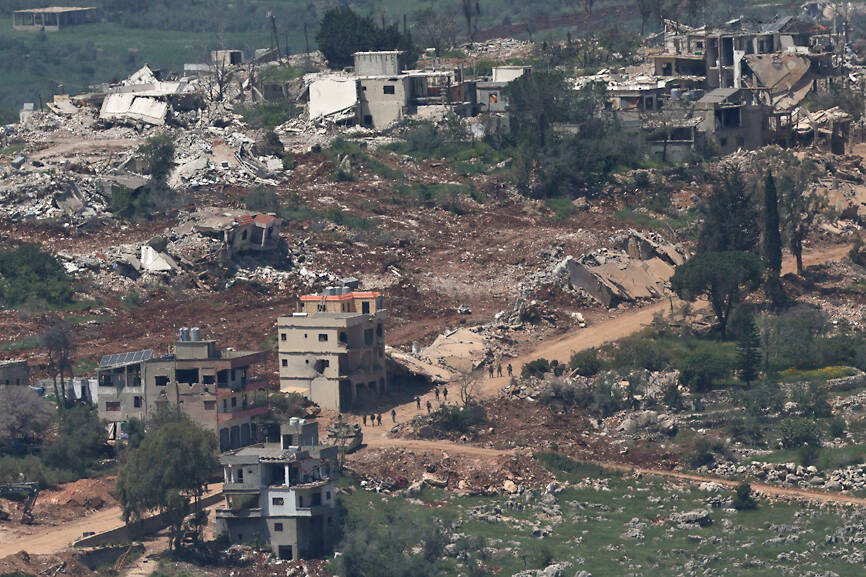
Photo: Reuters
Israeli troops are operating inside an Israeli-announced “yellow line,” which demarcates a ribbon of Lebanese territory about 10km deep along the length of the border, where residents have been warned not to return.
The ministry on Sunday said that the dead included two women and two children, adding that 37 other people were wounded.
Israeli strikes have killed at least 36 people since the truce began, according to a tally of ministry figures.
Israel’s military on Sunday said that one of its soldiers was killed “during combat” in southern Lebanon and six were wounded, four of them severely.
Lebanon’s state-run National News Agency (NNA) reported Israeli strikes in multiple locations in the south, both in areas where Israel issued an evacuation warning and elsewhere.
Correspondents reported heavy traffic heading north as people fled following the warning and intensified raids.
“Hezbollah’s violations are, in practice, dismantling the ceasefire,” Netanyahu told a weekly Cabinet meeting.
Tehran-backed Hezbollah drew Lebanon into the Middle East war on March 2 by firing rockets at Israel to avenge the death of Iranian supreme leader Ali Khamenei in US-Israeli strikes.
“We are acting vigorously in accordance with arrangements agreed with the United States and, incidentally, also with Lebanon,” Netanyahu said.
Under the truce, which came after a landmark meeting between Israeli and Lebanese officials that angered Hezbollah, Israel reserves the right to respond to “planned, imminent or ongoing attacks.”
“This means freedom of action not only to respond to attacks ... but also to pre-empt immediate threats and even emerging threats,” Netanyahu said.
Hezbollah said that Israel’s “continued ceasefire violations ... and above all its continued occupation of Lebanese territory and violations of its sovereignty will be met with a response”
It said its fighters targeted Israeli troops and positions in south Lebanon in response to ceasefire violations and attacks on Lebanese villages.
Israel’s military issued evacuation orders for residents of seven towns and villages in the south on Sunday. Shortly afterward, the NNA said Israeli warplanes struck in Kfar Tibnit, causing casualties, while a raid on Zawtar al-Sharqiyah destroyed a mosque and another religious building.
The NNA also reported Israeli shelling in several border villages. Correspondents saw clouds of gray smoke rise over Nabatieh al-Fawqa and several other locations after Israeli strikes.
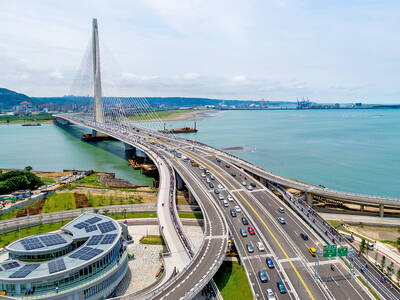
The Ministry of Transportation and Communications yesterday inaugurated the Danjiang Bridge across the Tamsui River in New Taipei City, saying that the structure would be an architectural icon and traffic artery for Taiwan. Feted as a major engineering achievement, the Danjiang Bridge is 920m long, 211m tall at the top of its pylon, and is the longest single-pylon asymmetric cable-stayed bridge in the world, the government’s Web site for the structure said. It was designed by late Iraqi-British architect Zaha Hadid. The structure, with a maximum deck of 70m, accommodates road and light rail traffic, and affords a 200m navigation channel for boats,

Taiwan Semiconductor Manufacturing Co (TSMC, 台積電), the world’s largest foundry service provider, yesterday said that global semiconductor revenue is projected to hit US$1.5 trillion in 2030, after the figure exceeds US$1 trillion this year, as artificial intelligence (AI) demand boosts consumption of token and compute power. “We are still at the beginning of the AI revolution, but we already see a significant impact across the whole semiconductor ecosystem,” TSMC deputy cochief operating officer Kevin Zhang (張曉強) said at the company’s annual technology symposium in Hsinchu City. “It is fair to say that in the past decade, smartphones and other mobile devices were
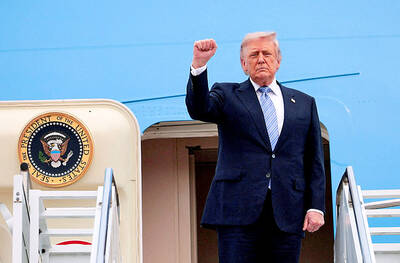
US-CHINA SUMMIT: MOFA welcomed US reassurance of no change in its Taiwan policy; Trump said he did not comment when Xi talked of opposing independence US President Donald Trump yesterday said he has not made a decision on whether to move forward with a major arms package for Taiwan after hearing concerns about it from Chinese President Xi Jinping (習近平). Trump’s comments on Taiwan came as he flew back to Washington after wrapping up critical talks in which both leaders said important progress was made in stabilizing US-China relations even as deep differences persist between the world’s two biggest powers on Iran and Taiwan. “I will make a determination,” Trump said, adding: “I’ll be making decisions. But, you know, I think the last thing we need right

TAIWAN ISSUE: US treasury secretary Scott Bessent said on the first day of meetings that ‘it wouldn’t be a US-China summit without the Taiwan issue coming up’ There were no surprises on the first day of the summit between US President Donald Trump and Chinese President Xi Jinping (習近平), the Mainland Affairs Council (MAC) said yesterday, as the government reiterated that cross-strait stability is crucial to the Asia-Pacific region, as well as the world. As the two presidents met for a highly anticipated summit yesterday, Chinese state media reported that Xi warned Trump that missteps regarding Taiwan could push their two countries into “conflict.” Trump arrived in China with accolades for his host, calling Xi a “great leader” and “friend,” and extending an invitation to visit the White House


 RSS
RSS