


The central government’s general budget for this fiscal year was yesterday sent to legislative committees for review after a presentation by Premier Cho Jung-tai (卓榮泰), in another step toward ending the budget impasse that has been ongoing for more than six months.
Addressing the Legislative Yuan in Taipei, Cho expressed his gratitude to all party caucuses for their positive interactions, and commitment to fiscal discipline and national development.
Despite severe challenges, Taiwan’s economic growth last year reached 8.68 percent, the highest in 15 years, thanks to the collective efforts of every citizen, he said.
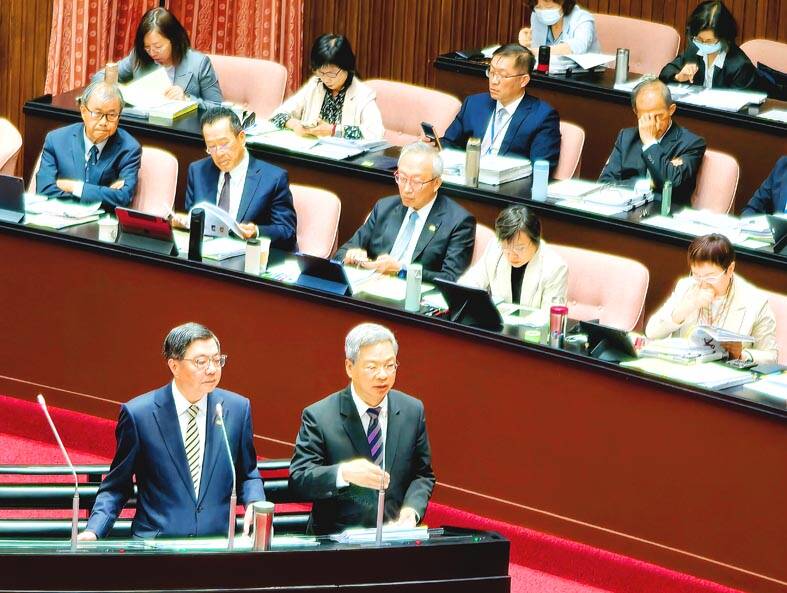
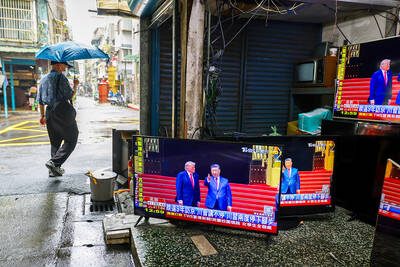
Photo: Wang Yi-sung, Taipei Times
Taiwan rose two spots to sixth place in last year’s IMD World Competitiveness Ranking published by the International Institute for Management Development, and retained its position as the world’s most competitive economy among economies with populations of more than 20 million for a fifth consecutive year, he said.
Taiwan’s market capitalization also rose to US$4.14 trillion as of Wednesday last week, making it the world’s seventh-largest stock market, he added.
The general budget for this fiscal year was formulated in light of domestic and international economic conditions, while taking into account policy priorities and development needs, Cho said.
By the end of this year, the ratio of outstanding central government debt to the average nominal GDP of the previous three years is projected to fall to 26.4 percent, down 1 percentage point from the end of last year, he said.
The budget projects NT$2.8623 trillion (US$90.9 billion) in revenue, down 9.6 percent from last year, and NT$3.035 trillion in expenditure, up 0.9 percent, Cho said.
The resulting deficit of NT$172.7 billion, combined with NT$126.5 billion for debt repayment, leaves a gap of NT$299.2 billion that would be covered through further borrowing, he said.
The Cabinet would pursue a policy of building “a more open, more prosperous and more secure nation” to support Taiwan’s upward development, and enhance national resilience and security, he said.
On Wednesday last week, the party caucuses reached a consensus to invite Cho to report on the general budget and field questions, after which the bill would immediately be sent to committee review.
They also agreed that within six months of the budget being sent to committee review, the Executive Yuan should propose amendments increasing benefits for military personnel, civil servants and public-school teachers — an issue the opposition has cited as reason for delaying approval of the budget.
In his report, Cho said that the government has spared no effort in taking care of police, firefighters and military personnel.
Salaries have been raised four times since 2016, amounting to a cumulative increase of 14 percent, he said.
However, considering equity among different types of civil servants and constitutional issues, the Cabinet temporarily suspended the allocation of related budgets passed by the Legislative Yuan and filed a request for a constitutional interpretation and a preliminary injunction with the Constitutional Court on Aug. 22 last year.
The government would develop a more reasonable method for adjusting salaries in line with inflation, as well as a plan to adjust professional allowances that more closely aligns with the actual operations of the civil service system, Cho said.
Additional reporting by CNA
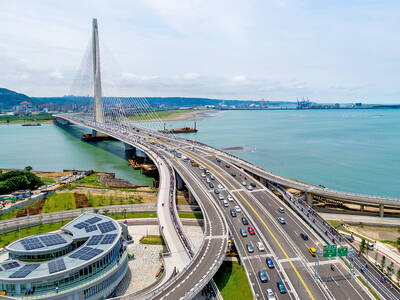
The Ministry of Transportation and Communications yesterday inaugurated the Danjiang Bridge across the Tamsui River in New Taipei City, saying that the structure would be an architectural icon and traffic artery for Taiwan. Feted as a major engineering achievement, the Danjiang Bridge is 920m long, 211m tall at the top of its pylon, and is the longest single-pylon asymmetric cable-stayed bridge in the world, the government’s Web site for the structure said. It was designed by late Iraqi-British architect Zaha Hadid. The structure, with a maximum deck of 70m, accommodates road and light rail traffic, and affords a 200m navigation channel for boats,
Taiwan Semiconductor Manufacturing Co (TSMC, 台積電), the world’s largest foundry service provider, yesterday said that global semiconductor revenue is projected to hit US$1.5 trillion in 2030, after the figure exceeds US$1 trillion this year, as artificial intelligence (AI) demand boosts consumption of token and compute power. “We are still at the beginning of the AI revolution, but we already see a significant impact across the whole semiconductor ecosystem,” TSMC deputy cochief operating officer Kevin Zhang (張曉強) said at the company’s annual technology symposium in Hsinchu City. “It is fair to say that in the past decade, smartphones and other mobile devices were
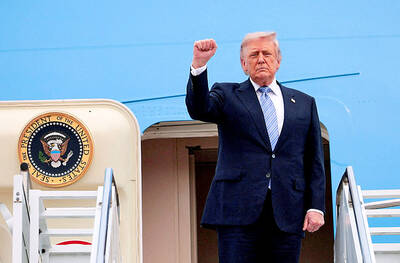
US-CHINA SUMMIT: MOFA welcomed US reassurance of no change in its Taiwan policy; Trump said he did not comment when Xi talked of opposing independence US President Donald Trump yesterday said he has not made a decision on whether to move forward with a major arms package for Taiwan after hearing concerns about it from Chinese President Xi Jinping (習近平). Trump’s comments on Taiwan came as he flew back to Washington after wrapping up critical talks in which both leaders said important progress was made in stabilizing US-China relations even as deep differences persist between the world’s two biggest powers on Iran and Taiwan. “I will make a determination,” Trump said, adding: “I’ll be making decisions. But, you know, I think the last thing we need right
TAIWAN ISSUE: US treasury secretary Scott Bessent said on the first day of meetings that ‘it wouldn’t be a US-China summit without the Taiwan issue coming up’ There were no surprises on the first day of the summit between US President Donald Trump and Chinese President Xi Jinping (習近平), the Mainland Affairs Council (MAC) said yesterday, as the government reiterated that cross-strait stability is crucial to the Asia-Pacific region, as well as the world. As the two presidents met for a highly anticipated summit yesterday, Chinese state media reported that Xi warned Trump that missteps regarding Taiwan could push their two countries into “conflict.” Trump arrived in China with accolades for his host, calling Xi a “great leader” and “friend,” and extending an invitation to visit the White House


 RSS
RSS