


The legislature yesterday agreed to start deliberating the government’s general budget for this fiscal year after an hour of caucus negotiations, potentially ending 230 days of deadlock.
Legislative Speaker Han Kuo-yu (韓國瑜) of the Chinese Nationalist Party (KMT) said that the caucuses had resolved to call Premier Cho Jung-tai (卓榮泰) and other Cabinet officials to present President William Lai’s (賴清德) budget on Tuesday next week.
The caucuses said that the NT$1.25 trillion (US$39.49 billion) special defense budget bill — the focal point of the deadlock between the Lai administration and the opposition parties, the KMT and the Taiwan People’s Party (TPP) — would be sent for another round of negotiations late next week.
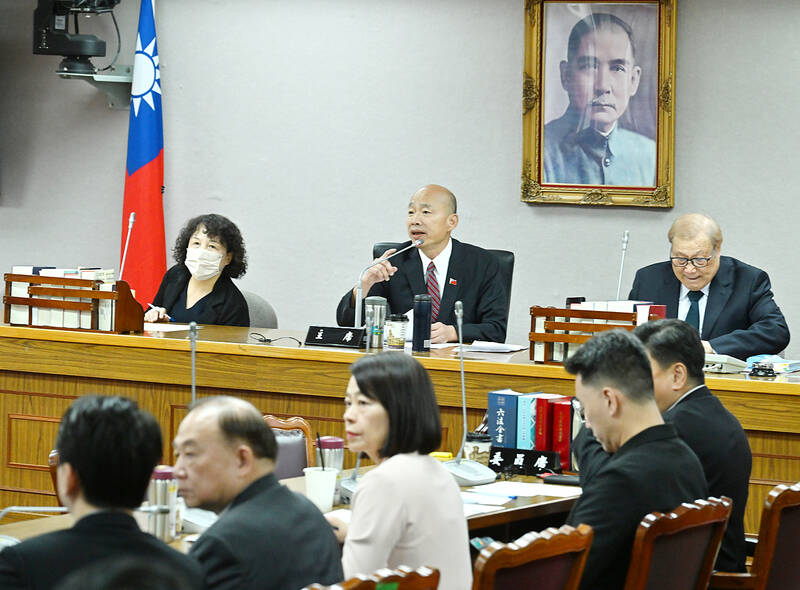
Photo: Tien Yu-hua, Taipei Times
The KMT and the Democratic Progressive Party (DPP) would each appoint five caucus members and the TPP one to conduct the interpolation session, after which the budget would enter the legislative review process, Han said.
A TPP motion to reconsider the general budget was rejected, he said.
The Legislative Yuan Finance Committee is to deliver the agenda and the timetable for the budget review to the legislature’s conference department by 5pm today and the general assembly would process the report the following day, Han said.
The DPP has agreed that the Cabinet would make concessions on the matter of benefits and salaries for military personnel and police by amending legislation within six months of the legislature’s handover of the budget to committees, he said.
The Lai administration would also unfreeze 38 opposition-backed projects valued at NT$71.8 billion — including funding for the TPass system, hydraulic engineering and childbirth subsidies — without cuts or delays, Han said.
The negotiations have settled on naming the special defense budget bill the National Security Defense and Asymmetric Warfare Capabilities Enhancement Program Special Funding Act, as the TPP sought, he said.
The Foreign Affairs and National Defense Committee and DPP Legislator Chen Kuan-ting (陳冠廷) are to separately head discussions about the composition of the bill, while Han would preside over another round of negotiations among the parties, all scheduled for next week, he added.
In response to DPP caucus whip Tsai Chi-chang’s (蔡其昌) pledge to expedite Chen’s report on Monday next week, Han said negotiations by caucus leaders could begin today at the earliest.
The centerpiece of the negotiations would be providing funding for arms procurement and operational expenses, he said.
Minister of National Defense Wellington Koo (顧立雄) said the ministry hopes to save time by discussing the special defense budget with lawmakers as the reports are presented ahead of formal deliberations.
Briefing lawmakers on planned purchases of foreign and domestic weapons systems would ease the passage of the budget plan by shedding light on its design, Koo said.
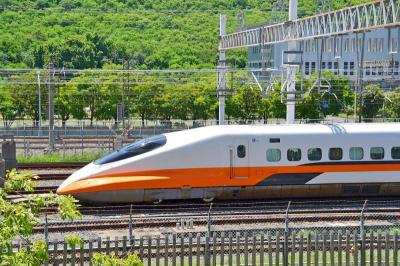
A signaling system malfunction disrupted high-speed rail (HSR) services beginning at 8am today, with trains temporarily reduced to three northbound and three southbound trains per hour as authorities conduct inspections. The malfunction occurred on a section of track in Miaoli County during pre-operation checks early this morning, forcing northbound and southbound trains to use a single track, the HSR operator said. The regular schedule has been replaced with three hourly trains offering only nonreserved seating in each direction, stopping at every station, it said, adding that business class cars would still have reserved seating. Departures from terminal stations are scheduled at the top
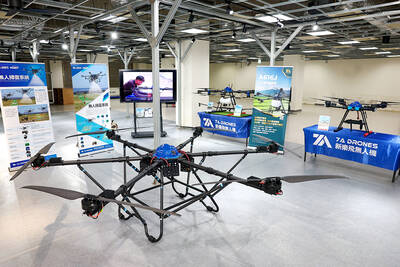
DRONE CENTRAL: Taiwan aims to become Asia’s democratic hub for drones, with most exports focused on high-quality military-grade models, an official said Taiwan’s drone industry is expected to expand significantly by 2030, producing 100,000 units per month and exporting half of them, the Ministry of Economic Affairs said yesterday. Current drone production capacity is about 15,000 units per month, but the industry can quickly scale up as demand increases, Industrial Development Administration Director-General Chiou Chyou-huey (邱求慧) told a news conference in Taipei. Taiwan’s drone output grew 2.5-fold last year to NT$12.9 billion (US$408.3 million) under a government program to develop the uncrewed vehicle sector, he said. The Executive Yuan in October last year approved plans to invest NT$44.2 billion into domestic production of uncrewed aerial
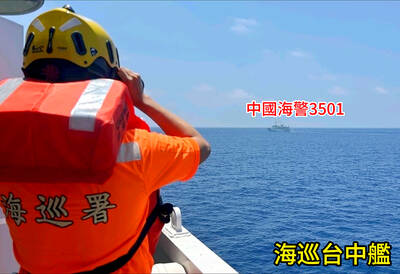
VERBOSE VESSELS: A CGA cutter and a China Coast Guard exchanged verbal barbs for more than a day in Taiwanese-controlled waters before the Chinese vessel left The Taiwanese and Chinese coast guards had a standoff near the strategically located Pratas Islands (Dongsha Islands, 東沙群島) in the north of the South China Sea, the Coast Guard Administration (CGA) said yesterday. The two sides engaged in intense radio exchanges over sovereignty claims during the 33-hour standoff. China Coast Guard vessel 3501 eventually left the restricted waters, 26.6 nautical miles (49.2km) west of the Pratas Islands, at 5pm yesterday, the CGA said. Lying approximately between southern Taiwan and Hong Kong, the Taiwan-controlled Pratas are seen by some security experts as vulnerable to Chinese attack due to their distance — more than
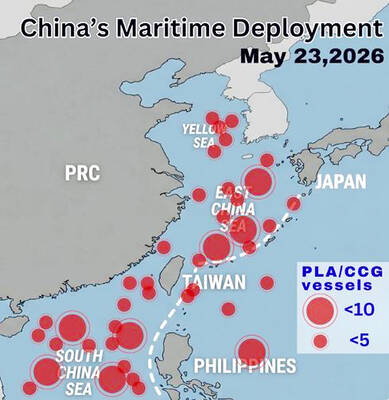
WARNING: China should stop engaging in actions that undermine regional peace and stability, as it would only build resentment among people across the Strait, the CGA said China has deployed more than 100 navy, coast guard and other vessels in waters from the Yellow Sea to the South China Sea and the western Pacific since US President Donald Trump and Chinese President Xi Jinping (習近平) met in Beijing, National Security Council Secretary-General Joseph Wu (吳釗燮) said yesterday. “In this part of the world, #China is the one & only PROBLEM wrecking the #StatusQuo & threatening regional peace & stability,” Wu wrote on X. In a separate post, he said Beijing was coercing Taiwan’s maritime domain, calling it illegal and provocative, after the Coast Guard Administration (CGA) expelled a


 RSS
RSS