


Chinese Nationalist Party (KMT) Chairwoman Cheng Li-wun (鄭麗文) departed today for a six-day visit to China, which might end with a meeting with Chinese President Xi Jinping (習近平).
Thirteen people are accompanying Cheng, including three KMT vice chairpersons, as well as former National Security Council secretary-general Su Chi (蘇起), who admitted making up the term “1992 consensus” in 2000.
The so-called “1992 consensus” refers to a tacit understanding between the KMT and the Chinese Communist Party (CCP) that both sides of the Strait acknowledge there is “one China,” with each side having its own interpretation of what “China” means.
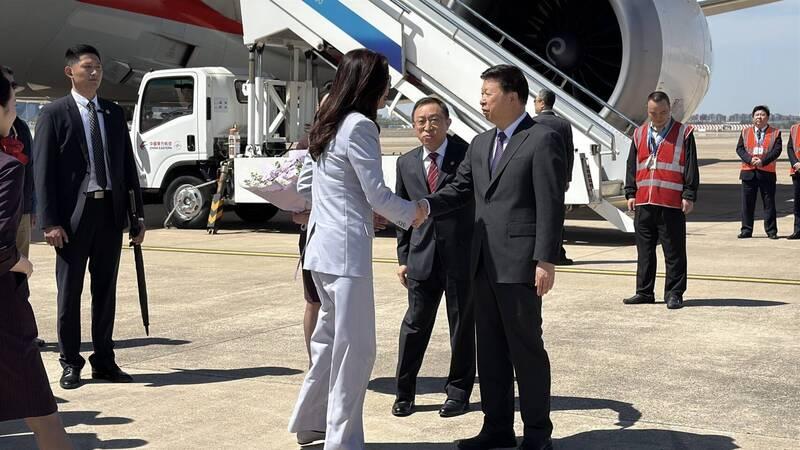
Photo: CNA
The KMT chairperson was invited to lead a KMT delegation on a visit to Jiangsu, Shanghai and Beijing from today to Sunday, but it has not been confirmed whether she is to meet Xi during the trip.
Cheng took a flight to Shanghai from Taipei International Airport (Songshan airport).
Although groups supporting and opposing Cheng's trip gathered at the airport, neither caught sight of her, as she reportedly used the special clearance channel rather than the departure hall.
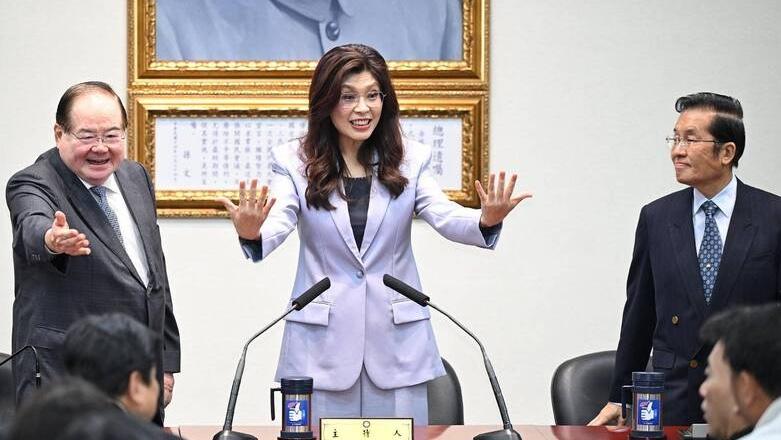
Photo: Chang Chia-ming, Taipei Times
During a news conference in Taipei this morning before her departure, Cheng said that members of the Democratic Progressive Party (DPP) are full of doubts and fear toward China.
“I want to prove to them that peace in the Taiwan Strait is not that difficult,” she said.
If the KMT and the CCP could reconcile and work together for peace, “then why can’t the KMT and the DPP do the same?” she asked.
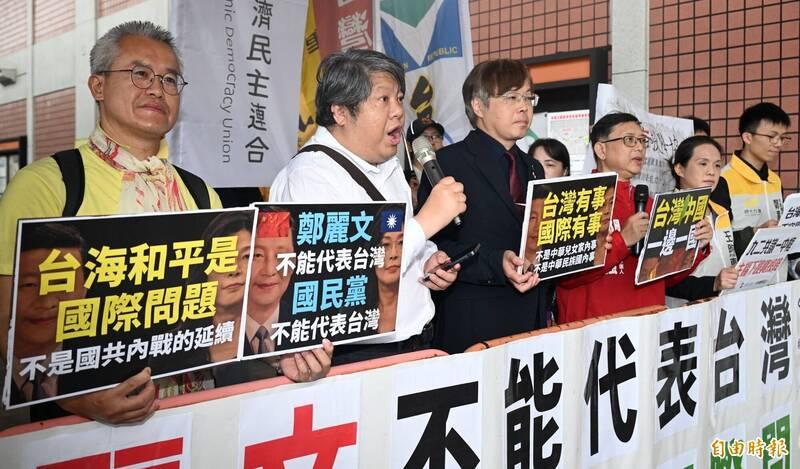
Photo: Liao Chen-huei, Taipei Times
The global environment is undeniably unstable, as conflicts spread and public anxiety rises, she said, adding that the Taiwan Strait has been labeled one of the world's most dangerous flashpoints.
As chairwoman, Cheng said she has the responsibility to not only protect Taiwan's 23 million people, but also maintain regional peace.
She said the purpose of her visit is to show the world that Taiwan is not the only side seeking peace, and that the Chinese leadership is also willing and determined to engage in peaceful dialogue to resolve differences.
Many people doubted whether her trip to China would materialize and could not believe she received a formal invitation from Xi, she said, adding that public reactions in Taiwan have been mixed, with some expressing anticipation, others unease and many remaining skeptical.
While she did not have the opportunity to meet with President William Lai (賴清德) since announcing the trip, Cheng said she believes he has been closely following developments.
“If you truly love Taiwan, you would seize every possible opportunity to prevent war,” she said. “Safeguarding peace is safeguarding Taiwan.”
She said she hopes that upon her return, the DPP and the KMT could reflect on their confrontations, move away from infighting and work quickly to resolve the current constitutional impasse.
Earlier today, Premier Cho Jung-tai (卓榮泰) told reporters he wished the KMT well in its party activities, but would closely monitor the trip.
During a legislative interpellation session, Cho added that any party representative or politically influential figure who makes public contact with the CCP should be subject to intense scrutiny, particularly from the public and the media.
Additional reporting by CNA

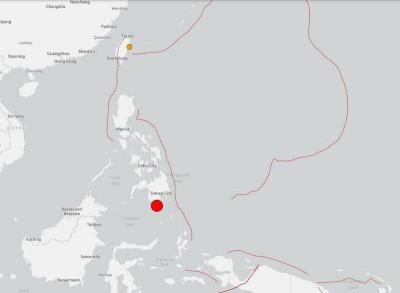
A magnitude 7.8 earthquake struck off the southern coast of Mindanao in the Philippines at 7:38am today, prompting the US Tsunami Warning System to issue an alert for neighboring countries, including Taiwan. The system issued a purple alert indicating a "tsunami threat." The potential threat zone includes Taiwan, the Philippines, Papua New Guinea, Yap and Palau. Philippine authorities were assessing the damage from the quake, with the office of civil defense seeking to verifying initial reports that 15 people had been killed and 129 injured in the region, mostly from falling debris. Arlene Hollero, disaster chief of Maasim town in the Philippines' Sarangani Province,
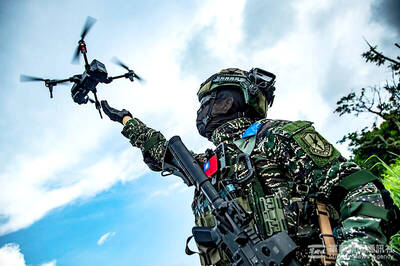
RESILIENCE: Taiwan plays a key role in semiconductors, energy, information infrastructure and advanced manufacturing, AIT Director Raymond Greene said Taiwan’s continued investment in deterrence and resilience remains vital, especially in uncrewed systems and other emerging technologies, American Institute in Taiwan (AIT) Director Raymond Greene said yesterday. Greene made the remarks at the annual National Strategic Summit on Supply Chain Resilience held by the Research Institute for Democracy, Society and Emerging Technology (DSET), a government-backed think tank. As Taiwan last year became the US’ fourth-largest trading partner and supply chain security is becoming more important, cooperation in emerging technologies continues to deepen between the two countries, he said. The US is committed to accelerating innovation, building key infrastructure, strengthening cooperation
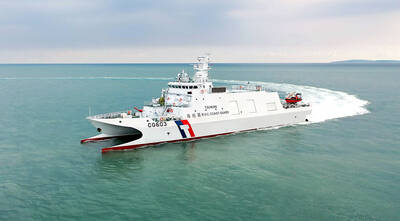
‘GRAY ZONE’ PRESSURE: Beijing’s activities are intended to create the deceitful impression that China has jurisdiction over the area around Taiwan, the CGA said Taiwan’s rights over its territorial waters and exclusive economic zone must not be violated by any country, the Mainland Affairs Council said yesterday, adding that it will not accept any unprovoked actions. The council issued the remarks in response to the China Coast Guard conducting maritime enforcement drills near eastern Taiwan and claiming to fully exercise China’s maritime administrative law enforcement authority. The Coast Guard Administration (CGA) has been closely monitoring the situation and is taking concrete steps to defend the nation’s sovereignty and secure its waters, the council said. China has no sovereign rights over the waters off eastern

The National Chungshan Institute of Science and Technology yesterday showcased its locally developed variants of the Vision 60 robotic patrol dog, which it plans to deploy on the nation’s outlying territories in the South China Sea. The variants were produced under the Joint Lab project — created by the institute and domestic companies — and assembled with domestically produced motors, lenses and artificial intelligence (AI) systems alongside licensed tech from the US, Missile and Rocket Systems Research Division deputy director Jen Kuo-kang (任國光) told the media event at a military base in Taipei’s Dazhi (大直) area. Taiwan has built up its strengths


 RSS
RSS