


Taiwanese gymnast Tang Chia- hung (唐嘉鴻) on Sunday won gold in the men’s horizontal bar event at the Artistic Gymnastics Apparatus World Cup in Antalya, Turkey, finishing with a score of 15.200.
Tang delivered an outstanding performance in the final, earning a difficulty score of 6.500, an execution score of 8.700 for a total of 15.200 points.
Colombia’s Angel Barajas finished second with 14.966 points.
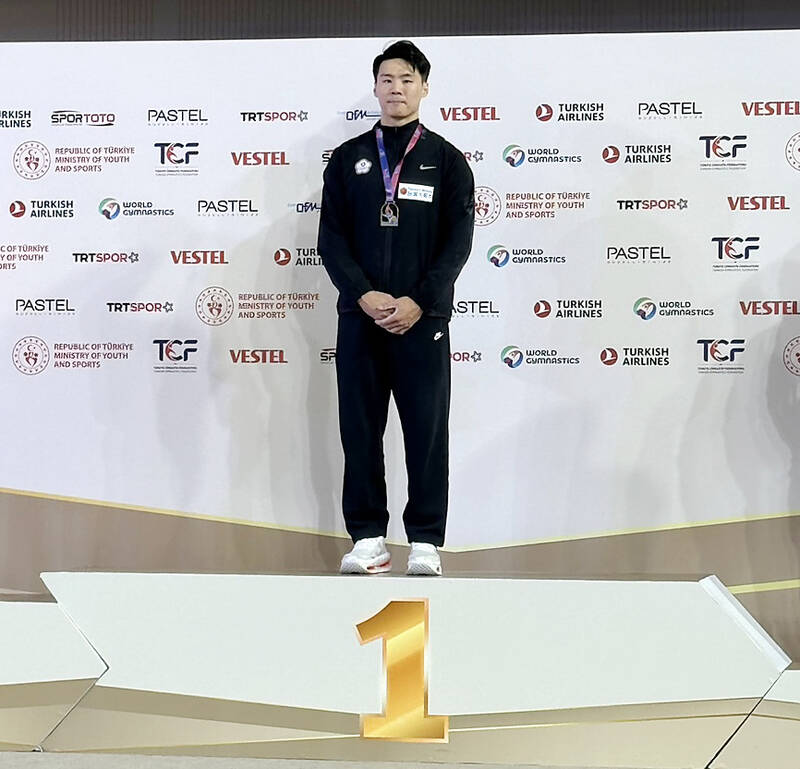
Photo: Huang Bo-rui via CNA
The victory marked Tang’s second gold medal in the world cup series this year, after he won the horizontal bar title in Baku, Azerbaijan, earlier this month.
In Antalya, he also competed in the floor exercise event, but later developed mild cold symptoms and decided to withdraw from the final to rest and focus on the horizontal bar.
His coach, Huang Bo-rui (黃柏瑞), said that after traveling from Baku and dealing with Turkey’s dry climate, Tang developed a cold, which affected his practice.
Tang was aiming to win high scores in the first two apparatus world cup series events this year, as performing well could help create a favorable impression on judges in future competitions, Huang said.
Tang said his current training is focused on becoming an all-around gymnast.
In addition to working on individual events, he hopes to contribute to the team’s results at the Asian Championships next month and at the Gymnastics World Championships later this year, he said.
“As I get older, I really have to cherish the chance to keep training and competing,” Tang said. “Of course, I’m very grateful to the Taiwan Sports Training Center and the entire team for their support, which allows us to extend our athletic careers.”
With the completion of his gold-winning performances at the two World Cup events, the Taiwanese gymnast is returning home for a short rest.
He planned to compete in Egypt, Croatia and Qatar, starting on April 3, but due to the instability in the Middle East he would now only participate in the tournament in Croatia on April 9, he said.

Japan has deployed long-range missiles in a southwestern region near China, the Japanese defense minister said yesterday, at a time when ties with Beijing are at their lowest in recent years. The missiles were installed in Kumamoto in the southern region of Kyushu, as Japan is attempting to shore up its military capacity as China steps up naval activity in the East China Sea. “Standoff defense capabilities enable us to counter the threat of enemy forces attempting to invade our country ... while ensuring the safety of our personnel,” Japanese Minister of Defense Shinjiro Koizumi said. “This is an extremely important initiative for

MORE POPULAR: Taiwan Pass sales increased by 59 percent during the first quarter compared with the same period last year, the Tourism Administration said The Tourism Administration yesterday said that it has streamlined the Taiwan Pass, with two versions available for purchase beginning today. The tourism agency has made the pass available to international tourists since 2024, allowing them to access the high-speed rail, Taiwan Railway Corp services, four MRT systems and four Taiwan Tourist Shuttles. Previously, five types of Taiwan Pass were available, but some tourists have said that the offerings were too complicated. The agency said only two types of Taiwan Pass would be available, starting from a three-day pass with the high-speed rail and a three-day pass with Taiwan Railway Corp. The former costs NT$2,800

POLLS CONCERNS: There are concerns within the KMT that a Cheng Li-wun-Xi Jinping meeting could trigger a voter backlash in elections in November Chinese Nationalist Party (KMT) Chairwoman Cheng Li-wun (鄭麗文) accepted an invitation from Chinese President Xi Jinping (習近平) to visit next month, her party and Chinese state media reported yesterday. Cheng, who took up her role in November last year, “gladly accepted” the invitation to lead a delegation to China, the KMT said in a statement, confirming a Xinhua news agency report. Cheng “looks forward to joint efforts by both parties to advance the peaceful development of cross-strait relations, promote cross-strait exchanges and cooperation, and work for peace in the Taiwan Strait and greater well-being for people on both sides,” the statement said. Chinese
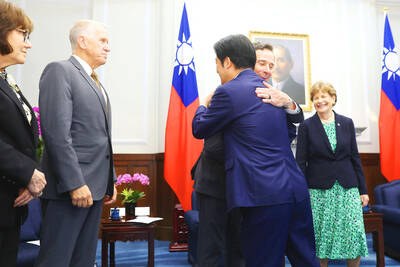
SIGNIFICANT TO THE WORLD: The delegation’s visit aims to send a clear message that bipartisan support for Taiwan is consistent, US Senator Jeanne Shaheen said The US Senate’s bipartisan support for Taiwan remains strong and Taiwan-US ties would continue for decades to come, a US Senate delegation said in Taipei yesterday, while calling on the legislature to swiftly pass a special defense budget bill. A US delegation led by Democratic US Senator Jeanne Shaheen and Republican US Senator John Curtis — both members of the US Senate Committee on Foreign Relations — arrived in Taiwan yesterday for a two-day visit. The other senators of the delegation included Senate Taiwan Caucus cochair Thom Tillis and Senate Committee on Armed Services senior member Jacky Rosen. Shaheen told a news


 RSS
RSS