


North Korea yesterday fired about 10 ballistic missiles to the sea toward Japan, the South Korean Joint Chiefs of Staff (JCS) said, days after Pyongyang warned of “terrible consequences” over ongoing South Korea-US military drills.
Pyongyang recently dashed hopes of a diplomatic thaw with Seoul, Washington’s security ally, describing its latest peace efforts as a “clumsy, deceptive farce.”
Seoul’s military detected “around 10 ballistic missiles launched from the Sunan area in North Korea toward the East Sea [Sea of Japan] at around 1:20pm,” JCS said in a statement, referring to South Korea’s name for the body of water.

Photo: AP
The missiles flew a distance of about 350km, they said adding that South Korean and US authorities are analyzing their exact specifications.
The South’s military is ready to “respond overwhelmingly to any provocation,” the JCS added.
The Japanese Ministry of Defense also confirmed North Korea launched multiple ballistic missiles that reached a maximum altitude of about 80km and fell outside Japan’s exclusive economic zone near the Korean Peninsula’s east coast.
Seoul’s presidential Blue House condemned the launches as a “provocation that violates United Nations Security Council resolutions” and urged Pyongyang to immediately stop such acts.
It also ordered agencies to maintain readiness, as the launch occurred during the joint US-South Korea military drills.
The launches came hours after South Korean Prime Minister Kim Min-seok said that US President Donald Trump thinks a meeting with Pyongyang’s leader Kim Jong-un would be “good.”
Washington has for decades led efforts to dismantle North Korea’s nuclear program, but summits, sanctions and diplomatic pressure have had little impact.
The Trump administration has pushed in the past few months to revive high-level talks with Pyongyang, eyeing a possible summit with Kim Jong-un this year, potentially during Trump’s visit to Beijing at the end of this month.
Trump said during a trip to Asia in October last year that he was “100 percent” open to meeting with Kim Jong-un, a remark that went unanswered by the North.
After largely ignoring those overtures for months, Kim Jong-un recently said that the two nations could “get along” if Washington accepted Pyongyang’s nuclear status.
The number of the missiles launched yesterday was unusual, and that the timing was notable, analysts said.
“Global attention is currently focused on the war in the Middle East, and North Korea has historically carried out military provocations when it wants to draw attention to its presence,” Korea Institute for Military Affairs senior researcher Hong Sung-pyo said. “And that motive likely underlies this launch as well.”
Seoul and Washington on Monday started their springtime military drills “Freedom Shield,” which involves about 18,000 South Korean troops and runs until Thursday.
The nuclear-armed North, which attacked its neighbor in 1950 triggering the Korean War, has long described such exercises as rehearsals for invasion.
Earlier this week, Kim Yo-jong, a powerful confidante of her brother, Kim Jong-un, said the joint drills “may cause unimaginably terrible consequences.”

The Tourism Administration yesterday announced that it would reward repeat international visitors with incentives of up to NT$8,000 to boost inbound tourism. The incentives are available to all international tourists, it said, adding that repeat visitors would be rewarded with NT$5,000 and would receive an additional NT$3,000 if they bring travel companions. The nation received 2,990,657 inbound visitors during the first quarter, marking a 3.8 percent increase from the same period last year, agency data showed. Japanese nationals are among groups visiting Taiwan the most. About 1.48 million Japanese tourists arrived last year, a year-on-year increase of more than 12
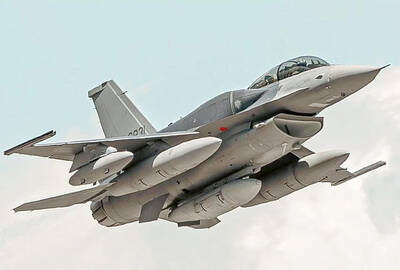
66 FIGHTER JETS: The aircraft is likely undergoing preparations for its transfer to Taiwan — a significant step forward in the nation’s modernization program, a lawmaker said The first of Taiwan’s order of F-16V Block 70 aircraft has been sighted in Texas ahead of delivery, Democratic Progressive Party (DPP) Legislator Wang Ting-yu (王定宇) said. Taiwan’s first F-16V Block 70 two-seat aircraft, tail number 6831, was seen flying from Lockheed Martin’s production facility in Greenville, South Carolina, to Naval Air Station Joint Reserve Base Fort Worth in Texas, Wang wrote on Facebook yesterday. The plane is likely undergoing preparations for its transfer to Taiwan, marking a significant step forward in the Republic of China Air Force’s modernization program, Wang said, citing military analysts. The F-16V Block 70 is a new-build version
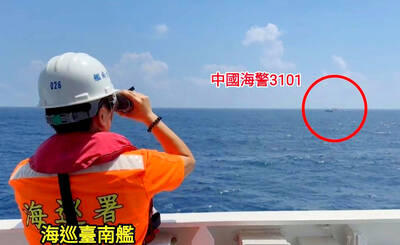
‘BRAZEN’: The holiday did not stop China from activities that infringe on Taiwan’s maritime jurisdiction, but the CGA is ready to defend the nation, Kuan Bi-ling said Beijing is intensifying maritime pressure on Taiwan, but the nation will never yield, Ocean Affairs Council Deputy Minister Sung Chen-en (宋承恩) said. The Coast Guard Administration (CGA) has adopted a “shadowing and monitoring” approach to avoid falling into a Chinese trap to escalate tensions and deepen the conflict, Sung said in an interview published yesterday in the Chinese-language Liberty Times (the Taipei Times’ sister newspaper). China Coast Guard formations patrolling waters east of Taiwan, as well as official Chinese vessels entering areas around Itu Aba Island (Taiping Island, 太平島) and Pratas Islands (Dongsha Islands, 東沙群島) show Beijing’s attempts to significantly step up
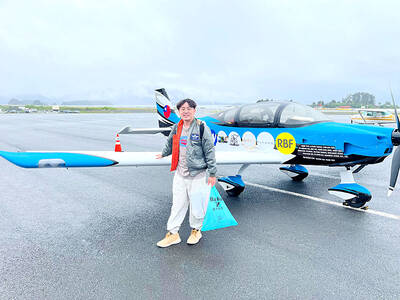
Taiwanese aviator Roger Lin (林睿哲) returned to Taiwan on Saturday after completing a nine-day round-the-world journey in a single-engine aircraft, becoming the first Taiwanese pilot to achieve the feat. Lin departed on June 5 from Los Angeles, California, and continued through Alaska, Japan, Taiwan, the Philippines, Indonesia, Malaysia, Thailand, Nepal, Jordan, Norway, Iceland and Canada before landing at the Taipei International Airport (Songshan) via Los Angeles and Japan. Lin shared numerous photos and videos of his journey on a Facebook page titled “Pilot Roger’s Around the World Flight,” including a video showing his aircraft flying over the Danjiang Bridge and


 RSS
RSS