


New attacks yesterday hit three commercial ships in the Gulf, setting at least one vessel on fire, as Iran pressed its campaign against its energy-exporting neighbors and forced world governments to dip into their strategic oil reserves.
Oil prices surged higher by more than 5 percent in early trading and markets have seesawed since the end of last month, when the US and Israel attacked Iran, killed its supreme leader and plunged the Middle East into war.
As the conflict entered its 12th day, Iran vowed to target “economic centers and banks” that it deems linked to US and Israeli interests, and all eyes were on the Strait of Hormuz, the vital sea lane connecting Gulf oil and gas export terminals to the world economy.

Photo: AFP
The Iranian military’s operational command declared on state television that any vessel that belongs to the US, Israel or their allies would be considered a legitimate target and repeated a warning that it would “not allow a single liter of oil to transit” the strait.
German Minister for Economic Affairs and Energy Katherina Reiche said the International Energy Agency (IEAD) had asked G7 member states to release 400 million barrels of oil and that Germany would comply.
Japan is ready to take the lead and to release oil reserves by Monday next week, without waiting for an IEA decision, Japanese Prime Minister Sanae Takaichi said.
Iran’s missile and drone strikes, and threats have all but shut the Strait of Hormuz, through which 20 percent of global crude and liquefied natural gas passes. Since the start of the war, only a tiny fraction of the vessels that used to navigate the strategic waterway have made it through, while some have ended up in flames.
A prolonged closure of the strait, which also carries a third of the fertilizer for world food production, would have a devastating effect on the economy, particularly in Asia and Europe, analysts said.
The Pentagon on Tuesday said US forces had carried out strikes that destroyed 16 mine-laying vessels that could have been used to block the strait, but attacks with drones or missiles continued yesterday with at least three ships hit.
“If for any reason mines were placed, and they are not removed forthwith, the military consequences to Iran will be at a level never seen before,” US President Donald Trump posted on social media.
Israel said it had begun a new “wide-scale wave of strikes” across Iran and against Hezbollah targets in Lebanon’s capital, Beirut.
“This operation will continue without any time limit, as long as necessary,” Israeli Minister of Defense Israel Katz said.
The British Joint Maritime Security Centre said the crew of a cargo vessel in the Strait of Hormuz north of Oman was forced to evacuate when an “unidentified projectile” caused a fire on board.
Separately a bulk carrier and a container ship were hit in the Gulf off the United Arab Emirates.
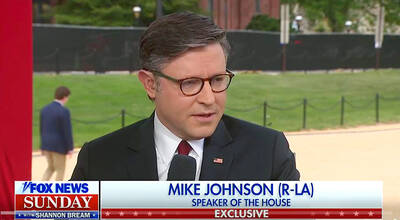
RESOLUTE BACKING: Two Republican senators are planning to introduce legislation that would impose immediate sanctions on China if it attempts to invade Taiwan US House of Representatives Speaker Mike Johnson on Sunday reaffirmed US congressional support for Taiwan, saying the US and “all freedom-loving people” have a stake in preventing China from seizing Taiwan by force. Johnson made the remarks in an interview with Fox News Sunday on US President Donald Trump’s summit with Chinese President Xi Jinping (習近平) last week. In an interview that aired on Friday on Fox News, just as Trump wrapped up a high-stakes visit to China, he said he has yet to green-light a new US$14 billion arms package to Taiwan and that it “depends on China.” “It’s a very good

DRONE CENTRAL: Taiwan aims to become Asia’s democratic hub for drones, with most exports focused on high-quality military-grade models, an official said Taiwan’s drone industry is expected to expand significantly by 2030, producing 100,000 units per month and exporting half of them, the Ministry of Economic Affairs said yesterday. Current drone production capacity is about 15,000 units per month, but the industry can quickly scale up as demand increases, Industrial Development Administration Director-General Chiou Chyou-huey (邱求慧) told a news conference in Taipei. Taiwan’s drone output grew 2.5-fold last year to NT$12.9 billion (US$408.3 million) under a government program to develop the uncrewed vehicle sector, he said. The Executive Yuan in October last year approved plans to invest NT$44.2 billion into domestic production of uncrewed aerial
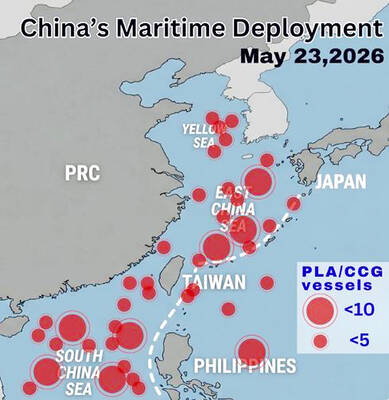
WARNING: China should stop engaging in actions that undermine regional peace and stability, as it would only build resentment among people across the Strait, the CGA said China has deployed more than 100 navy, coast guard and other vessels in waters from the Yellow Sea to the South China Sea and the western Pacific since US President Donald Trump and Chinese President Xi Jinping (習近平) met in Beijing, National Security Council Secretary-General Joseph Wu (吳釗燮) said yesterday. “In this part of the world, #China is the one & only PROBLEM wrecking the #StatusQuo & threatening regional peace & stability,” Wu wrote on X. In a separate post, he said Beijing was coercing Taiwan’s maritime domain, calling it illegal and provocative, after the Coast Guard Administration (CGA) expelled a

More than 8,000 people took part in a rally in Taipei yesterday to express support for more defense spending, after the opposition slashed the Cabinet’s proposed NT$1.25 trillion (US$39.6 billion) special defense budget and capped it at NT$780 billion. The demonstrators urged the Cabinet to propose another bill. Taiwan Economic Democracy Union convener Lai Chung-chiang (賴中強) said the main problem of the passed budget plan is the removal of funding for critical items, not just that the total amount is smaller. Critical budget items included purchasing or developing uncrewed vehicles, Strong Bow (強弓) missile systems, additional ammunition, artificial intelligence-powered combat systems and Taiwan-US


 RSS
RSS