


The US has not approached Taiwan about transfers of weapons to the Middle East, Minister of National Defense Wellington Koo (顧立雄) said yesterday, after South Korea said it was in talks about the possible redeployment of some US Patriot missile systems.
South Korean Minister of Foreign Affairs Cho Hyun on Friday said that the US and South Korean militaries are discussing the possible redeployment of some US Patriot missile defense systems based in South Korea to be used in the war against Iran.
Koo, speaking to reporters at the Legislative Yuan in Taipei, said that if any of their US-made weapons were to be redeployed, that would only happen if the US side made a request.
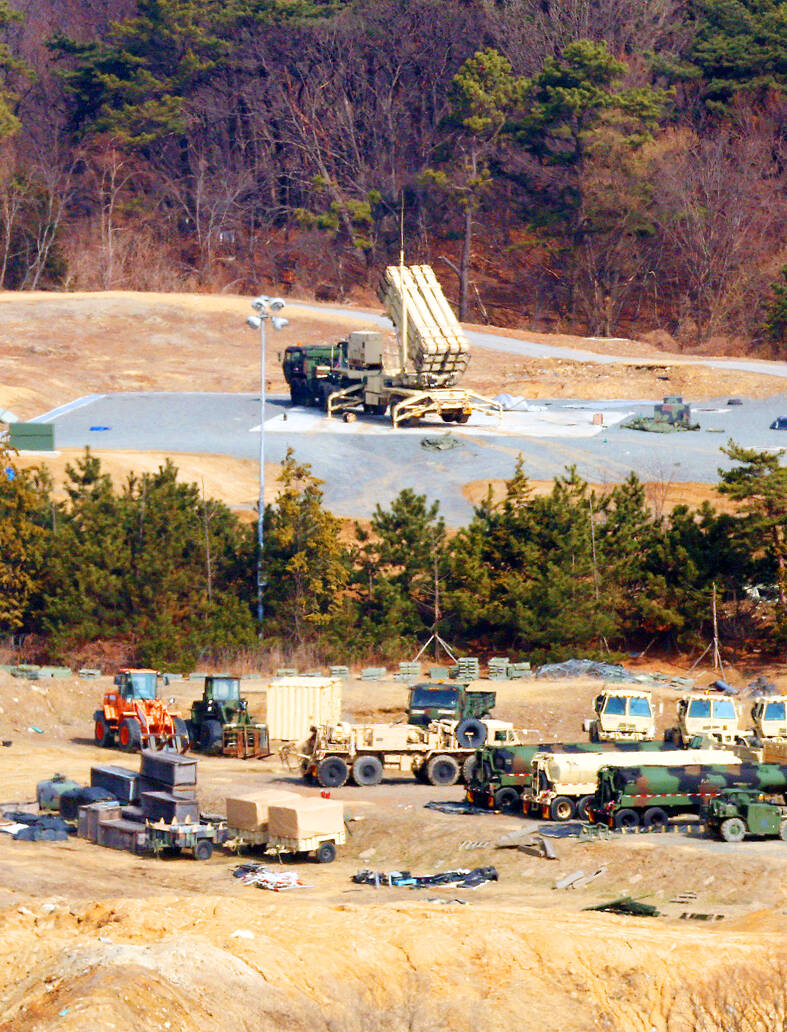
Photo: EPA / Yonhap
Were that to happen, the US would be responsible for transporting them, he added.
“But so far, because of the US–Iran war, they have not approached us about making use of any of our related equipment, he said. “The US is Taiwan’s main arms supplier and Taiwan has Patriot missiles in its arsenal.
SOUTH KOREA DEFENSE
In Seoul, South Korean President Lee Jae-myung yesterday said that even if the US military moves air defense assets out of South Korea as the Iran conflict widens, it would not seriously affect Seoul’s ability to defend itself against nuclear-armed North Korea.
Speaking at a livestreamed Cabinet meeting, Lee added that while he opposed the US redeploying assets out of South Korea, Seoul could not fully “impose our position” on the US military.
The US stations about 28,500 soldiers and multiple missile defense systems, including Patriot missile batteries, in South Korea. Seoul last week confirmed that it was talking to the US Forces Korea about the possible relocation of some assets, as Washington’s conflict with Iran escalates.
“Depending on how the situation develops, the US military may, in accordance with its own needs, relocate certain air defense assets,” Lee said.
However, even if the US relocates missile interceptors “it absolutely would not” cause a serious impact to South Korea’s ability to defend itself against North Korea, Lee said, pointing to Seoul’s heavy spending in the defense sector.
Notwithstanding North Korea’s nuclear weapons, Seoul’s conventional capabilities are “undeniably overwhelming,” he said.
US military transport planes have flown out of South Korea in recent days, flight-tracking data showed. That comes after local media reported that US Forces Korea had been transferring Patriot missile launchers from other sites in South Korea to the Osan air base.
The Pentagon is also moving parts of the Terminal High Altitude Area Defense air defense system from South Korea to the Middle East, the Washington Post reported, citing officials.
Lee’s remarks come shortly after North Korea warned of “terrible consequences” over annual combined exercises that the US and South Korea began on Monday.
“We will have the terrible destructive power that the enemy dare not respond to firmly defend the peace of the country,” Kim Yo-jong, the North Korean leader’s sister, said in a statement carried by the official Korean Central News Agency. “The enemies should never try to test our patience, will and capability.”
This year’s drills by the allies feature fewer field training maneuvers than last year. That is a likely nod to Seoul’s desire to ease tensions with North Korea, which has long claimed that the exercises are a rehearsal for invasion.
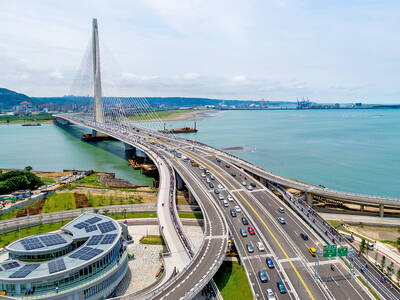
The Ministry of Transportation and Communications yesterday inaugurated the Danjiang Bridge across the Tamsui River in New Taipei City, saying that the structure would be an architectural icon and traffic artery for Taiwan. Feted as a major engineering achievement, the Danjiang Bridge is 920m long, 211m tall at the top of its pylon, and is the longest single-pylon asymmetric cable-stayed bridge in the world, the government’s Web site for the structure said. It was designed by late Iraqi-British architect Zaha Hadid. The structure, with a maximum deck of 70m, accommodates road and light rail traffic, and affords a 200m navigation channel for boats,
Taiwan Semiconductor Manufacturing Co (TSMC, 台積電), the world’s largest foundry service provider, yesterday said that global semiconductor revenue is projected to hit US$1.5 trillion in 2030, after the figure exceeds US$1 trillion this year, as artificial intelligence (AI) demand boosts consumption of token and compute power. “We are still at the beginning of the AI revolution, but we already see a significant impact across the whole semiconductor ecosystem,” TSMC deputy cochief operating officer Kevin Zhang (張曉強) said at the company’s annual technology symposium in Hsinchu City. “It is fair to say that in the past decade, smartphones and other mobile devices were
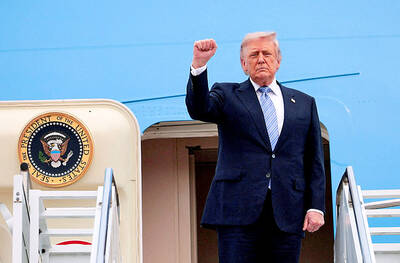
US-CHINA SUMMIT: MOFA welcomed US reassurance of no change in its Taiwan policy; Trump said he did not comment when Xi talked of opposing independence US President Donald Trump yesterday said he has not made a decision on whether to move forward with a major arms package for Taiwan after hearing concerns about it from Chinese President Xi Jinping (習近平). Trump’s comments on Taiwan came as he flew back to Washington after wrapping up critical talks in which both leaders said important progress was made in stabilizing US-China relations even as deep differences persist between the world’s two biggest powers on Iran and Taiwan. “I will make a determination,” Trump said, adding: “I’ll be making decisions. But, you know, I think the last thing we need right
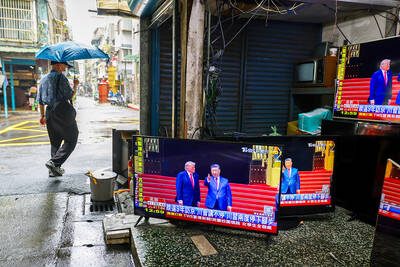
TAIWAN ISSUE: US treasury secretary Scott Bessent said on the first day of meetings that ‘it wouldn’t be a US-China summit without the Taiwan issue coming up’ There were no surprises on the first day of the summit between US President Donald Trump and Chinese President Xi Jinping (習近平), the Mainland Affairs Council (MAC) said yesterday, as the government reiterated that cross-strait stability is crucial to the Asia-Pacific region, as well as the world. As the two presidents met for a highly anticipated summit yesterday, Chinese state media reported that Xi warned Trump that missteps regarding Taiwan could push their two countries into “conflict.” Trump arrived in China with accolades for his host, calling Xi a “great leader” and “friend,” and extending an invitation to visit the White House


 RSS
RSS