


China yesterday announced a 7 percent boost to its defense budget for this year.
The latest rise keeps China’s spending at one-third of that of the US, but it is working to close the gap.
Beijing plans to spend 1.9096 trillion yuan (US$276.8 billion) on defense, according to a report published at the opening of the annual Two Sessions parliamentary meeting.
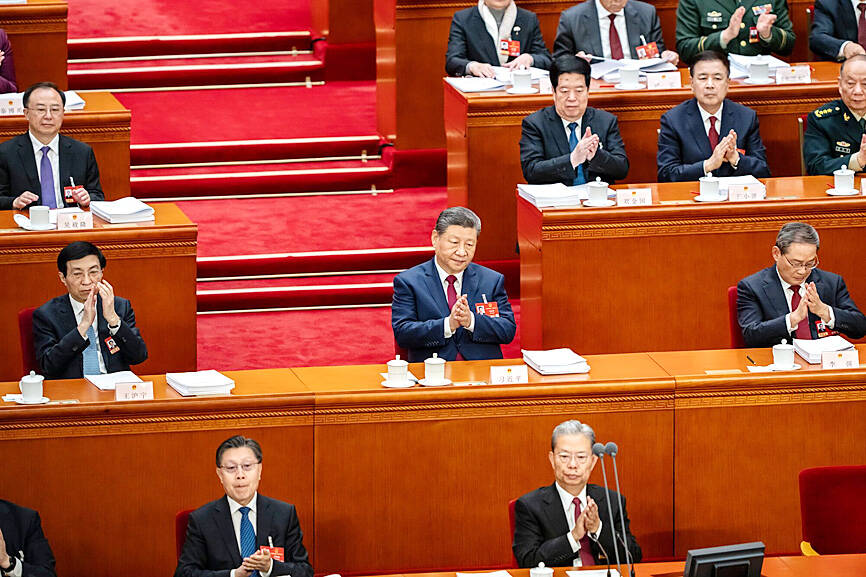
Photo: Bloomberg
Chinese Premier Li Qiang (李強) told delegates that China would bolster the military and “carry out major defense-related projects” over the next five years.
Analysts said that the budget would finance military salary increases, training, maneuvers around Taiwan, cyberwarfare capabilities and advanced equipment purchases, among other things.
Mainland Affairs Council Deputy Minister Liang Wen-chieh (梁文傑) said that China has continued its allocations of large percentages of its national budget on military buildup, despite a weakening economy and a decline in consumer spending.
“China might not be able to compare with the US in terms of the scale of defense expenditure. However, it has surpassed the US in terms of purchasing power parity, meaning that if the Chinese Communist Party were to spend US$1 trillion, the military equipment it could procure and the number of troops it could recruit would far exceed what the US could obtain with the same amount of funding,” Liang said.
Beijing’s defense budget this year is 11 times more than Taiwan’s, Liang said.
A 7 percent increase in Taiwan would mean NT$600 billion (US$18.94 billion) in additional defense spending from last year, he said, adding that if the special defense budget proposed by the Executive Yuan of NT$1.25 trillion is passed, it would only be an annual rise of NT$150 billion.
“That is precisely why Taiwan must accelerate its efforts. Even if we cannot advance at the same pace, we still need to work hard to catch up,” Liang said.
China has had a steady increase in military spending of about 7 to 8 percent each year since 2016, although its military spending compared with GDP was about 1.7 percent in 2024, well behind the US figure of 3.4 percent and Russia’s 7.1 percent, data from independent international research institute SIPRI showed.
However, the increase marks a degree of continuity as Beijing pursues a sweeping anti-graft purge of the Chinese People’s Liberation Army (PLA), which included the ousting of top general Zhang Youxia (張又俠) in January.
“China pursues an independent and self-reliant foreign policy. However, without robust military capabilities and technological prowess, our diplomatic stance would inevitably be subject to coercion or even dictated by certain nations, including the United States,” said military commentator Song Zhongping (宋忠平), a former Chinese army instructor.
As for GDP, China set its lowest annual growth target in decades, at 4.5 to 5 percent, as Beijing outlined plans to tackle sluggish consumption and a flagging property market.
“The achievements of the past year were hard-won,” Li said. “Rarely in many years have we encountered such a grave and complex landscape, where external shocks and challenges were intertwined with domestic difficulties and tough policy choices.”
This year’s growth target is the lowest since 1991, Agence France-Presse research showed.
The only exception was in 2020, when none was set as the economy reeled amid the COVID-19 pandemic.
Additional reporting by Shelley Shan

Japan has deployed long-range missiles in a southwestern region near China, the Japanese defense minister said yesterday, at a time when ties with Beijing are at their lowest in recent years. The missiles were installed in Kumamoto in the southern region of Kyushu, as Japan is attempting to shore up its military capacity as China steps up naval activity in the East China Sea. “Standoff defense capabilities enable us to counter the threat of enemy forces attempting to invade our country ... while ensuring the safety of our personnel,” Japanese Minister of Defense Shinjiro Koizumi said. “This is an extremely important initiative for
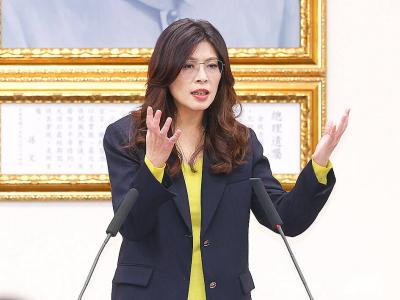
Chinese Nationalist Party (KMT) Chairwoman Cheng Li-wun (鄭麗文) today accepted an invitation from Chinese President Xi Jinping (習近平) to lead a delegation to China next month, saying she hopes to promote the peaceful development of cross-strait relations and bring stability to the Taiwan Strait. “I am grateful and happy to accept this invitation,” Cheng said in a statement from the KMT chairperson’s office. Cheng said she hopes both sides can work together to promote the peaceful development of cross-strait relations, enhance exchange and cooperation, bring stability to the Taiwan Strait and improve people’s livelihoods. At today's news conference, Cheng said any efforts to

The nation’s fastest supercomputer, Nano 4 (晶創26), is scheduled to be launched in the third quarter, and would be used to train large language models in finance and national defense sectors, the National Center for High-Performance Computing (NCHC) said. The supercomputer, which would operate at about 86.05 petaflops, is being tested at a new cloud computing center in the Southern Taiwan Science Park in Tainan. The exterior of the server cabinet features chip circuitry patterns overlaid with a map of Taiwan, highlighting the nation’s central position in the semiconductor industry. The center also houses Taiwania 2, Taiwania 3, Forerunner 1 and

MORE POPULAR: Taiwan Pass sales increased by 59 percent during the first quarter compared with the same period last year, the Tourism Administration said The Tourism Administration yesterday said that it has streamlined the Taiwan Pass, with two versions available for purchase beginning today. The tourism agency has made the pass available to international tourists since 2024, allowing them to access the high-speed rail, Taiwan Railway Corp services, four MRT systems and four Taiwan Tourist Shuttles. Previously, five types of Taiwan Pass were available, but some tourists have said that the offerings were too complicated. The agency said only two types of Taiwan Pass would be available, starting from a three-day pass with the high-speed rail and a three-day pass with Taiwan Railway Corp. The former costs NT$2,800


 RSS
RSS