


The Chinese Nationalist Party (KMT) caucus yesterday said it would propose a special defense budget bill totaling NT$350 billion (US$11.05 billion) to fund eight weapons sales announced by the US in December last year.
The caucus “fully supports” the eight systems listed in US foreign military sales announced on Dec. 17 last year, KMT caucus secretary-general Lin Pei-hsiang (林沛祥) told a news conference at the legislature in Taipei.
The sales include High Mobility Artillery Rocket Systems (HIMARS), Javelin missiles, Altius-700M and Altius-600 drones, TOW missiles, M109A7 self-propelled howitzers, C5ISR integrated technology systems, Harpoon missile follow-on support and helicopter parts at a combined cost of US$11.1 billion, Lin said.
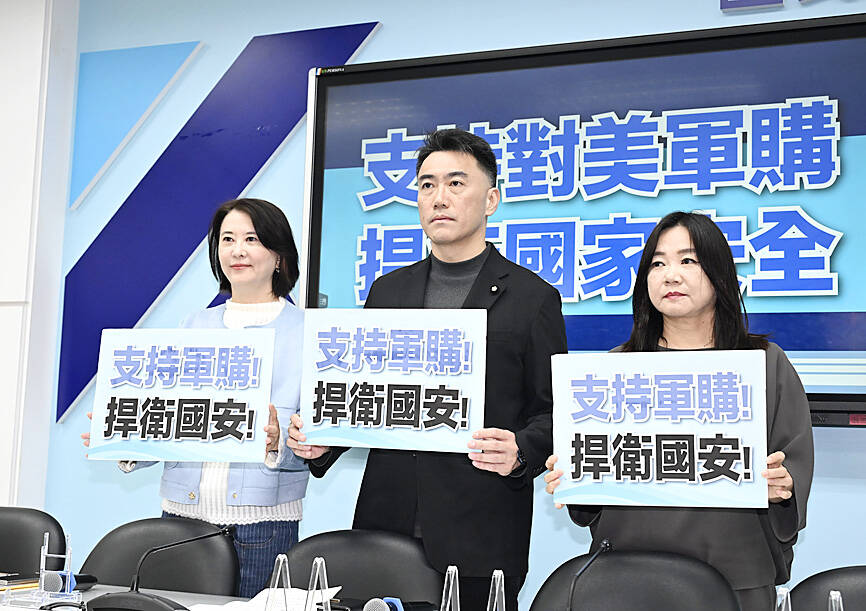
Photo: Lo Pei-de, Taipei Times
In contrast, the Cabinet’s special defense budget bill is NT$1.25 trillion and includes the eight systems, potential US arms sales that the US Congress has not been notified of and procurement plans involving domestic manufacturers such as the “T-Dome” multilayered air defense system and drones.
In the event of a follow-on foreign military sales package, the KMT’s proposal would mandate that the Ministry of National Defense draft a matching special budget bill and submit it to the legislature for review “promptly and without delay,” Lin said.
“We hope to take a phased approach to move arms procurement forward concretely and transparently, as opposed to a one-time authorization of a blank check,” he said.
The caucus was to formally sponsor the bill later yesterday, after final adjustments, he added.
The move came amid pressure from Washington over opposition parties blocking sales.
Senior KMT members, including Taichung Mayor Lu Shiow-yen (盧秀燕) and Legislative Speaker Han Kuo-yu (韓國瑜), have expressed concern that blocking the sales package could sour Taiwan-US relations.
The KMT and the Taiwan People’s Party (TPP) caucuses have blocked review of the Cabinet’s bill 10 times since November last year, saying it was “opaque,” and demanding that President William Lai (賴清德) brief lawmakers and face questions on the budget before review began.
Lin yesterday rejected accusations that the KMT had blocked the arms sales.
The KMT’s bill is meant to distinguish between foreign military sales — the costs of which are specified in letters of acceptance issued by the US — and direct commercial sales, which are often opaque and have sparked major corruption scandals, he said.
“The KMT has always supported US government-to-government arms sales,” the KMT said in a statement. “However, commercial procurement is where corruption and controversy most often occur. These two categories must never be bundled together to pressure the public and the legislature into approving them as a single package.”
Premier Cho Jung-tai (卓榮泰) criticized the idea that the budget should be compiled incrementally.
National defense requires holistic planning and cannot be built piecemeal, otherwise it would be impossible to plan the foundation and layout, Cho told reporters in Hualien County, using a house building metaphor.
The Cabinet’s proposal was meticulously put together based on the nation’s defense needs and overall fiscal planning, “making it a highly precise operation,” he said.
TPP caucus whip Jacky Chen (陳清龍) said that the party would insist on its own version of the bill, although all three versions would undergo substantive committee review today.
The TPP’s draft includes the weapons the US has announced it would sell to Taiwan, Chen said.
Its version also features a comprehensive oversight mechanism, stipulating that after the special budget is passed, the Executive Yuan must provide clear reports to the legislature regarding delivery schedules and financial impacts, he said.
KMT Chairwoman Cheng Li-wun (鄭麗文) asked why the central government proposed a NT$1.25 trillion budget when only NT$350 billion in US arms sales have been confirmed and why the funds were not incorporated into the regular annual defense budget.
Democratic Progressive Party spokesman Justin Wu (吳崢) said that the KMT had not reviewed “a single cent” of this year’s general budget.
A special budget was planned because the procurements are urgent and necessary, Wu said.
Additional reporting by AFP, Hua Meng-ching,Yu Tai-lang and Chen Cheng-yu

A signaling system malfunction disrupted high-speed rail (HSR) services beginning at 8am today, with trains temporarily reduced to three northbound and three southbound trains per hour as authorities conduct inspections. The malfunction occurred on a section of track in Miaoli County during pre-operation checks early this morning, forcing northbound and southbound trains to use a single track, the HSR operator said. The regular schedule has been replaced with three hourly trains offering only nonreserved seating in each direction, stopping at every station, it said, adding that business class cars would still have reserved seating. Departures from terminal stations are scheduled at the top
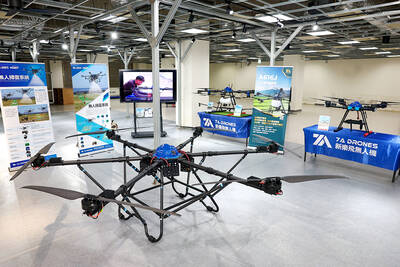
DRONE CENTRAL: Taiwan aims to become Asia’s democratic hub for drones, with most exports focused on high-quality military-grade models, an official said Taiwan’s drone industry is expected to expand significantly by 2030, producing 100,000 units per month and exporting half of them, the Ministry of Economic Affairs said yesterday. Current drone production capacity is about 15,000 units per month, but the industry can quickly scale up as demand increases, Industrial Development Administration Director-General Chiou Chyou-huey (邱求慧) told a news conference in Taipei. Taiwan’s drone output grew 2.5-fold last year to NT$12.9 billion (US$408.3 million) under a government program to develop the uncrewed vehicle sector, he said. The Executive Yuan in October last year approved plans to invest NT$44.2 billion into domestic production of uncrewed aerial

VERBOSE VESSELS: A CGA cutter and a China Coast Guard exchanged verbal barbs for more than a day in Taiwanese-controlled waters before the Chinese vessel left The Taiwanese and Chinese coast guards had a standoff near the strategically located Pratas Islands (Dongsha Islands, 東沙群島) in the north of the South China Sea, the Coast Guard Administration (CGA) said yesterday. The two sides engaged in intense radio exchanges over sovereignty claims during the 33-hour standoff. China Coast Guard vessel 3501 eventually left the restricted waters, 26.6 nautical miles (49.2km) west of the Pratas Islands, at 5pm yesterday, the CGA said. Lying approximately between southern Taiwan and Hong Kong, the Taiwan-controlled Pratas are seen by some security experts as vulnerable to Chinese attack due to their distance — more than
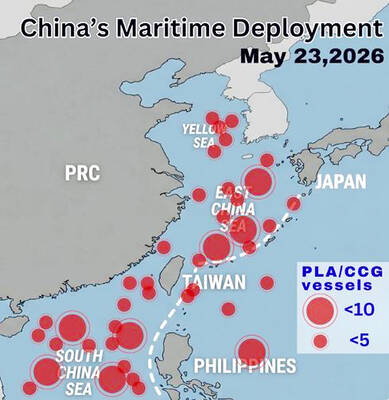
WARNING: China should stop engaging in actions that undermine regional peace and stability, as it would only build resentment among people across the Strait, the CGA said China has deployed more than 100 navy, coast guard and other vessels in waters from the Yellow Sea to the South China Sea and the western Pacific since US President Donald Trump and Chinese President Xi Jinping (習近平) met in Beijing, National Security Council Secretary-General Joseph Wu (吳釗燮) said yesterday. “In this part of the world, #China is the one & only PROBLEM wrecking the #StatusQuo & threatening regional peace & stability,” Wu wrote on X. In a separate post, he said Beijing was coercing Taiwan’s maritime domain, calling it illegal and provocative, after the Coast Guard Administration (CGA) expelled a


 RSS
RSS