


Iran yesterday expanded its targets, striking the US embassy in Saudi Arabia as Washington began to pull many staff out of the Middle East. The US and Israel battered Iran with airstrikes in what US President Donald Trump suggested was just the start of a war that has severely disrupted the world’s supply of oil and gas, international shipping and air travel.
The conflict escalated further on its fourth day, with Israel sending new ground troops into Lebanon and explosions ringing out in Iran’s capital. Hundreds of people have been killed, the vast majority in Iran.
The spiraling nature of the war raised questions about when and how it would end. Trump said it could last four to five weeks, but that the US was prepared to go longer. He seemed to leave open the possibility for more extensive US military involvement, telling the New York Post on Monday that he was not ruling out the possibility of boots on the ground.
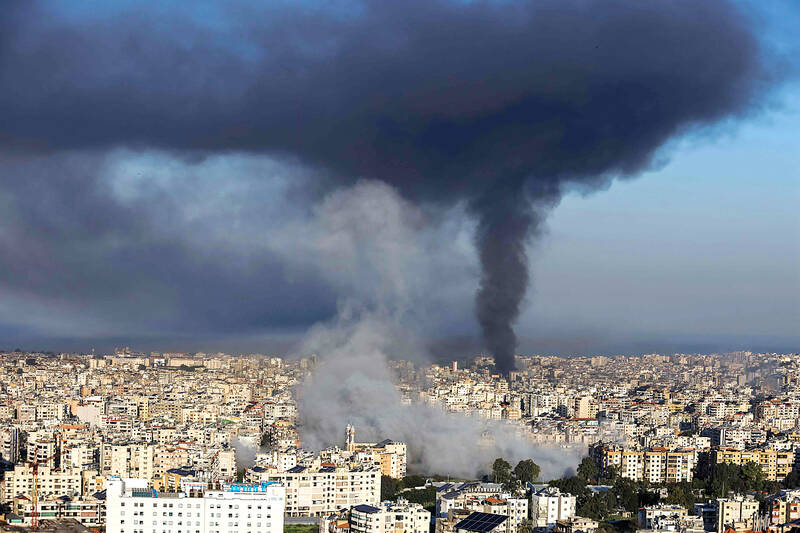
Photo: AFP
Still, the administration’s objectives remain unclear. The initial US-Israeli strikes killed Iranian supreme leader Ayatollah Ali Khamenei and Trump urged Iranians to overthrow their government.
However, since then senior administration officials have said regime change was not the goal. Trump’s initial announcement of the strikes listed several grievances, from concerns about Iran’s nuclear and missile programs to its leadership.
An attack from two drones on the US embassy in Riyadh caused a “limited fire,” the Saudi Arabian Ministry of Defense said, as the embassy urged Americans to avoid the compound. It followed an attack on the US embassy in Kuwait, which yesterday announced it had been closed until further notice.
The US Department of State ordered the evacuation of non-emergency personnel and family in Kuwait, Bahrain, Iraq, Qatar, Jordan and the United Arab Emirates (UAE). In addition, the US has urged Americans to leave more than a dozen Middle Eastern countries, as have many other nations, though with much of the airspace closed many remained stranded.
The US-Israeli strikes have killed at least 787 people, according to the Iranian Red Crescent Society.
In Israel, where Iranian missiles struck several locations, 11 people were killed. The Iran-supported militant group Hezbollah has also attacked Israel, whose retaliatory strikes killed 52 people in Lebanon.
The US military has confirmed six deaths of US service members.
Across Iran’s capital, explosions rang out throughout the night into yesterday, with aircraft heard overhead. Strikes caused two explosions at a broadcasting facility in Tehran, Iranian state TV said, adding that no one was injured.
The International Atomic Energy Agency said that Iran’s Natanz nuclear enrichment site had sustained “some recent damage,” although there was “no radiological consequence expected.”
The US hit Natanz during the 12-day war in June last year, when Israeli and US strikes greatly weakened Iran’s nuclear program.
Israeli Prime Minister Benjamin Netanyahu maintained that Iran was rebuilding “new sites, new places” underground for making nuclear bombs. He offered no evidence to support his claim.
“We had to take the action now and we did,” Netanyahu told Fox News Channel’s Hannity program.
Iran has said it has not enriched uranium since June last year, although it has maintained its right to and says its nuclear program is peaceful.
Satellite photographs showed limited activity at two Iranian nuclear sites before the war. Analysts said Tehran was likely assessing damage from last year’s strikes and possibly salvaging what remained.
The expansion of Iranian retaliation across the Gulf and the intensity of the Israeli and US attacks, Khamenei’s killing and the lack of any apparent exit plan suggested the conflict could be prolonged.
Iran has hit many nations deemed safe havens in the Middle East in retaliation for the US-Israeli strikes. Recent targets included two Amazon data centers in the UAE and one in Bahrain. The centers in the UAE were hit, while a drone struck near the one in Bahrain, causing damage, the company said.
Iran has also struck energy facilities in Qatar and Saudi Arabia, and attacked several ships in the Strait of Hormuz, the narrow mouth of the Persian Gulf through which one-fifth of all oil traded passes, sending global oil and natural gas prices soaring.
“The Strait of Hormuz is closed,” said Iranian Brigadier General Ebrahim Jabbari, an adviser to the paramilitary Revolutionary Guard, vowing that any ships that passed through it would be set on fire.
Qatari Ministry of Foreign Affairs spokesman Majed al-Ansari vowed that Iranian attacks on the gas-rich country “will not go unanswered.”
The conflict has spread to Lebanon, where Hezbollah fired missiles at Israel on Monday, prompting Israel to retaliate.
The Israeli military yesterday said that it had moved additional troops into southern Lebanon and taken new positions at several strategic points close to the border.
Israel also hit Beirut with more airstrikes, saying it was targeting “Hezbollah command centers and weapons storage facilities.”
Explosions could be heard and smoke seen in a southern suburb of Beirut.
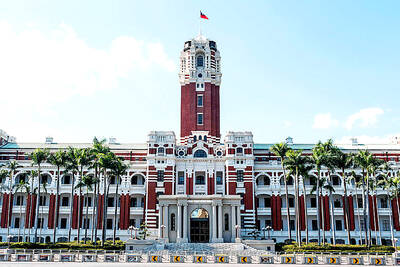
SECURITY: Taipei presses the US for arms supplies, saying the arms sales are not only a reflection of the US security commitment to Taiwan but also serve as a mutual deterrent against regional threats Taiwan is committed to preserving the cross-strait “status quo” and contributing to regional peace and stability, the Presidential Office said yesterday. “It is an undeniable fact that the Republic of China is a sovereign and independent democratic nation,” Presidential Office spokeswoman Karen Kuo (郭雅慧) reiterated, adding that Beijing has no right to claim sovereignty over Taiwan. The statements came after US President Donald Trump warned against Taiwanese independence. Trump wrapped up a state visit to Beijing on Friday, during which Chinese President Xi Jinping (習近平) had pressed him not to support Taiwan. Taiwan depends heavily on US security backing to deter China from carrying
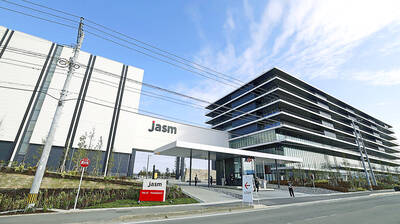
The subsidiary of Taiwan Semiconductor Manufacturing Co (TSMC, 台積電) in Kumamoto, Japan, turned a profit in the first quarter of this year, marking the first time the first fab of the unit has become profitable since mass production started at the end of 2024. According to the contract chipmaker’s financial statement released on Friday, Japan Advanced Semiconductor Manufacturing Inc (JASM), a joint venture running the fab in Kumamoto, posted NT$951 million (US$30.19 million) in profit in the January-to-March period, compared with a loss of NT$1.39 billion in the previous quarter, and a loss of NT$3.25 billion in the first quarter of
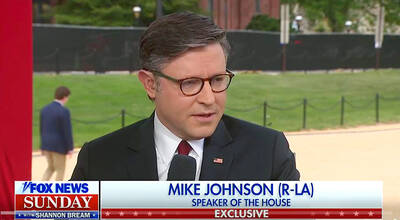
RESOLUTE BACKING: Two Republican senators are planning to introduce legislation that would impose immediate sanctions on China if it attempts to invade Taiwan US House of Representatives Speaker Mike Johnson on Sunday reaffirmed US congressional support for Taiwan, saying the US and “all freedom-loving people” have a stake in preventing China from seizing Taiwan by force. Johnson made the remarks in an interview with Fox News Sunday on US President Donald Trump’s summit with Chinese President Xi Jinping (習近平) last week. In an interview that aired on Friday on Fox News, just as Trump wrapped up a high-stakes visit to China, he said he has yet to green-light a new US$14 billion arms package to Taiwan and that it “depends on China.” “It’s a very good
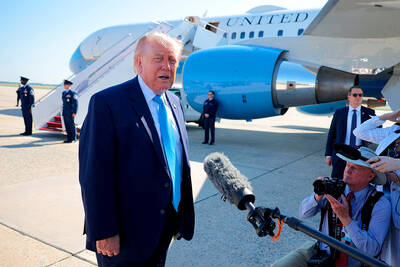
US President Donald Trump yesterday said he would speak to President William Lai (賴清德) as his administration considers whether to move ahead with a US$14 billion weapons sale to Taiwan — a potential arms deal that has drawn criticism from China. “Well, I’ll speak to him. I speak to everybody,” Trump told reporters yesterday when asked if he had any plans to call his counterpart, although he did not offer a time frame for when such a conversation could take place. Trump previously said he would speak to the person “that’s running Taiwan,” without specifying who he meant. “We have that situation very


 RSS
RSS