


Taiwan would not have to resort to power rationing due to a shortage of gas, Minister of Economic Affairs Kung Ming-hsin (龔明鑫) said today, after reports that the Strait of Hormuz was closed amid the conflict in the Middle East.
The government has secured liquefied natural gas (LNG) supplies for this month and contingency measures are in place if the conflict extends to next month, Kung told the Legislative Yuan during an interpellation session.
Chinese Nationalist Party (KMT) caucus secretary-general Lin Pei-hsiang (林沛祥) said that 25 percent of Taiwan’s natural gas supplies are from Qatar and asked about the situation in light of the conflict.
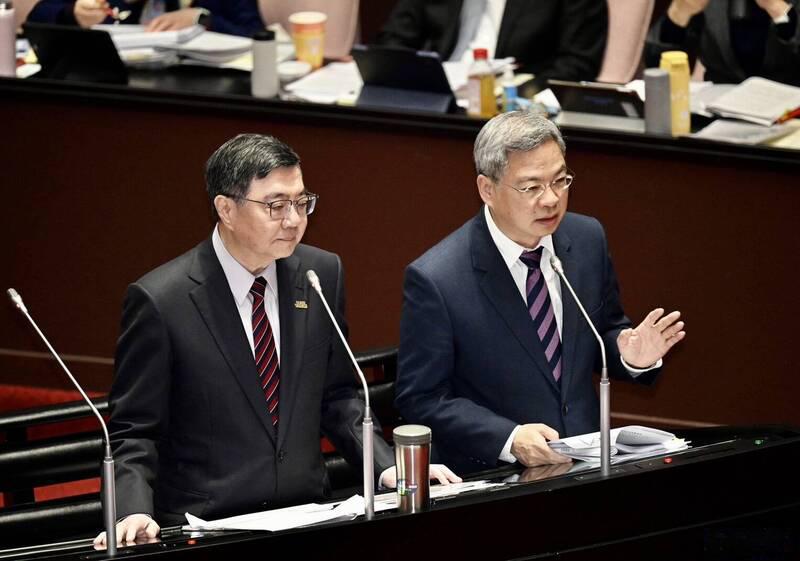
Photo: Lo Pei-de, Taipei Times
President William Lai (賴清德) was briefed by the national security team the day after the war broke out, followed by a meeting yesterday, and the Ministry of Economic Affairs would activate an emergency mechanism, Premier Cho Jung-tai (卓榮泰) said.
There are “no problems” with LNG supplies for the first half of this month, as shipments have already cleared the Strait of Hormuz, Kung said.
Supplies for the latter half of the month have been secured from other markets, while non-gas backup generating units are also available and can be activated at any time, he said.
There would absolutely be no power rationing due to an LNG shortage, Kung said.
In the case of a prolonged blockade by Iran, Taiwan would look to sources outside the Middle East, including Australia and the US, the ministry said in a statement.
Taiwan could also discuss mutual assistance with other LNG buyers, including Japan and South Korea, the ministry said.
Asked if the situation could lead to higher electricity rates or the reactivation of coal-fired power plants, Kung said that any adjustment to electricity prices would be subject to review by the electricity price review committee.
If the conflict proves short-lived or limited in scope, it is less likely to affect power rates, he said, adding that restarting coal-fired power plants would be a last resort.
Starting yesterday, the ministry would convene daily task force meetings to monitor developments, he told the legislature.
Iranian media earlier reported that the Strait of Hormuz was closed and that Iran would fire on any ship trying to pass through it.
"The strait [of Hormuz] is closed. If anyone tries to pass, the heroes of the Revolutionary Guards and the regular navy will set those ships ablaze," Ebrahim Jabari, a senior adviser to the Islamic Revolutionary Guard Corps’ commander-in-chief, said in remarks carried by state media.
Vessels in the area were hit as Iran retaliated against US and Israeli strikes.
The conflict has left at least four tankers damaged, two seafarers killed and 150 ships stranded around the Strait of Hormuz.
About one-fifth of oil consumed globally, as well as large quantities of gas, travel through the strait between Iran and Oman. Qatar, among the world's biggest liquefied natural gas exporters, sends almost all of its LNG through the strait.
Last year, crude oil from the Middle East accounted for 34.9 percent of Taiwan’s total imports, down from 45 percent in 2022, while imports from the US rose to 61.8 percent from 44 percent over the same period, State-run CPC Corp, Taiwan said on Sunday.

SILENCING CRITICS: In addition to blocking Taiwan, China aimed to prevent rights activists from speaking out against authoritarian states, a Cabinet department said The Ministry of Foreign Affairs (MOFA) yesterday condemned transnational repression by Beijing after RightsCon, a major digital human rights conference scheduled to be held in Zambia this week, was abruptly canceled due to Chinese pressure over Taiwanese participation. This year’s RightsCon, the world’s largest conference discussing issues “at the intersection of human rights and technology,” was scheduled to take place from tomorrow to Friday in Lusaka, and expected to draw 2,600 in-person attendees from 150 countries, along with 1,100 online participants. However, organizers were forced to cancel the event due to behind-the-scenes pressure from China, the ministry said, expressing its “strongest condemnation”
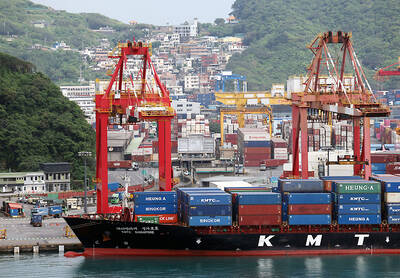
Taiwan’s economy grew far faster than expected in the first quarter, as booming demand for artificial intelligence (AI) applications drove a surge in exports, spilling over into investment and consumption, the Directorate-General of Budget, Accounting and Statistics (DGBAS) said yesterday. GDP growth was 13.69 percent year-on-year during the January-to-March period, beating the DGBAS’ February forecast by 2.23 percentage points and marking the most robust growth in nearly four decades, DGBAS senior official Chiang Hsin-yi (江心怡) told a news conference in Taipei. The result was powered by exports, which remain the backbone of Taiwan’s economy, Chiang said. Outbound shipments jumped 51.12 percent year-on-year to
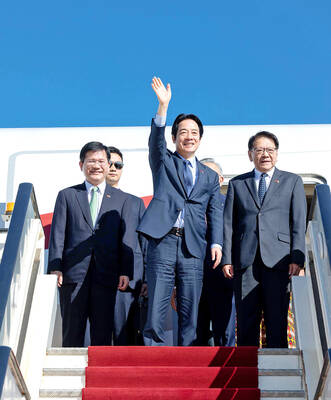
DELAYED BUT DETERMINED: The president’s visit highlights Taiwan’s right to international engagement amid regional pressure from China President Willaim Lai (賴清德) yesterday arrived in Eswatini, more than a week after his planned visit to Taiwan’s sole African ally was suspended because of revoked overflight permits. “The visit, originally scheduled for April 22, was postponed due to unforeseen external factors,” Lai wrote on social media. “After several days of careful arrangements by our diplomatic and national security teams, we successfully arrived today.” Lai said he looked forward to further deepening Taiwan-Eswatini relations through closer cooperation in the economy, agriculture, culture and education, as well as advancing the nation’s international partnerships. The president was initially scheduled to arrive in time to celebrate
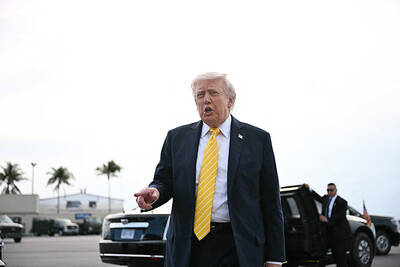
Iran’s Islamic Revolutionary Guard Corp (IRGC) yesterday said the US faced a choice between an “impossible” military operation or a “bad deal” with Tehran, after US President Donald Trump disparaged Iran’s latest peace proposal. Negotiations between the two countries have been deadlocked since a ceasefire came into effect on April 8, with only one round of direct peace talks held so far. Iran’s Tasnim and Fars news agencies reported that Tehran had submitted a 14-point proposal to mediator Pakistan, but Trump was quick to cast doubt on it. “I will soon be reviewing the plan that Iran has just sent to us, but


 RSS
RSS