


The Legislative Yuan is to send the Executive Yuan’s version of a proposed special defense budget to its plenary session on Friday next week, it said yesterday after reaching a cross-party consensus.
The parties concluded that the Cabinet’s version would be reviewed alongside the Taiwan People Party’s (TPP) version that would allocate NT$400 billion (US$12.71 billion) for certain weapons systems at a joint meeting of the legislature’s Foreign Affairs and National Defense and Finance committees.
The Chinese Nationalist Party (KMT) has said it would also propose a version of the expenditure.
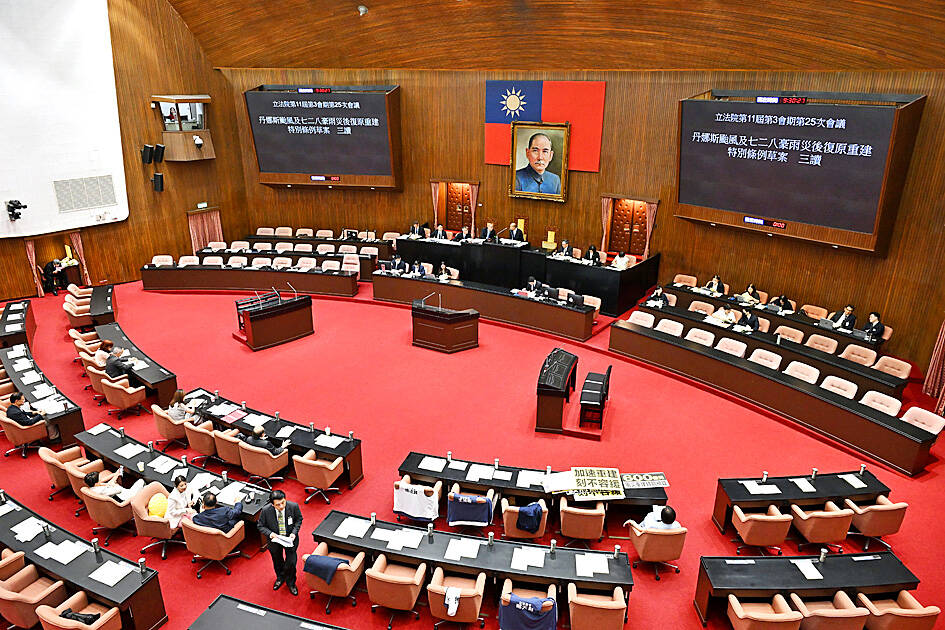
Photo: Chen Yi-kuan, Taipei Times
All other proposals have to be submitted before Thursday next week.
The parties also agreed not to file a motion of reconsideration.
President William Lai (賴清德) in November announced a NT$1.25 trillion special defense budget to be allocated over eight years, including arms purchases from the US.
Opposition lawmakers have refused to deliberate the proposal, saying it lacked clarity.
Speaking to reporters ahead of a legislative meeting, Minister of National Defense Wellington Koo (顧立雄) yesterday said that letters of offer and acceptance (LOA) from the US for three major arms purchases are set to expire on March 15.
The potential purchases include tube-launched, optically tracked, wire-guided anti-tank missiles; Javelin anti-armor missiles; and M109A7 self-propelled howitzers.
Given that budget allocations might not be completed in time, Koo urged the committees to authorize the ministry to sign the LOAs with the US before the budget is formally approved to prevent delays or potential cancelation of the procurement.
Meanwhile, KMT Chairwoman Cheng Li-wun (鄭麗文) yesterday said the Democratic Progressive Party bears the greatest responsibility for delays in arms purchases, accusing the party of failing to share details of the deals or US tariff negotiations with the legislature.
The KMT would take the initiative to secure reasonable and necessary arms purchases with its own version of the bill, she said, adding that the party hoped to communicate with the US.
Before delivering a policy address at the legislature yesterday, Premier Cho Jung-tai (卓榮泰) told reporters that it would be inappropriate for opposition parties to take the lead on the matter, which should be handled by the Ministry of National Defense and the Executive Yuan.
However, he said he welcomed parties taking a step forward hand-in-hand with the government.
The special budget should incorporate items that safeguard national security and defense autonomy, drive local industrial growth and cater to the needs of the national defense industry, he said.
The legislature also held a cross-party negotiation yesterday afternoon on how the president should deliver a state of the nation report to the Legislative Yuan.
On Monday, Legislative Speaker Han Kuo-yu (韓國瑜) told reporters that the president would accept an arrangement in which questions would be submitted at once and answered all together in Lai’s address.
During the negotiations, lawmakers initially focused on dividing the president’s address into a three-stage format that fulfills the constitutional norm: first, the president would deliver the state affairs report; second, each party caucus would send representatives to express their views; and third, the president would respond to the key points raised by the caucuses.
However, disagreements remain over how to allocate time and the number of speakers for each caucus, including whether to assign a fixed number of representatives per party or distribute it proportionally based on caucus seats.
“After more than an hour of discussion, it was clear no consensus could be reached. We will schedule another time to continue discussions on this matter,” Han said.
Additional reporting by Lin Hsin-han
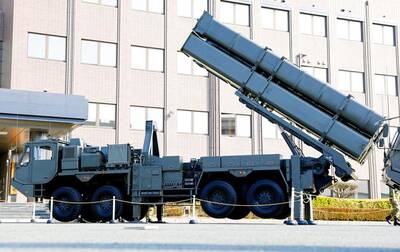
Japan has deployed long-range missiles in a southwestern region near China, the Japanese defense minister said yesterday, at a time when ties with Beijing are at their lowest in recent years. The missiles were installed in Kumamoto in the southern region of Kyushu, as Japan is attempting to shore up its military capacity as China steps up naval activity in the East China Sea. “Standoff defense capabilities enable us to counter the threat of enemy forces attempting to invade our country ... while ensuring the safety of our personnel,” Japanese Minister of Defense Shinjiro Koizumi said. “This is an extremely important initiative for

The nation’s fastest supercomputer, Nano 4 (晶創26), is scheduled to be launched in the third quarter, and would be used to train large language models in finance and national defense sectors, the National Center for High-Performance Computing (NCHC) said. The supercomputer, which would operate at about 86.05 petaflops, is being tested at a new cloud computing center in the Southern Taiwan Science Park in Tainan. The exterior of the server cabinet features chip circuitry patterns overlaid with a map of Taiwan, highlighting the nation’s central position in the semiconductor industry. The center also houses Taiwania 2, Taiwania 3, Forerunner 1 and
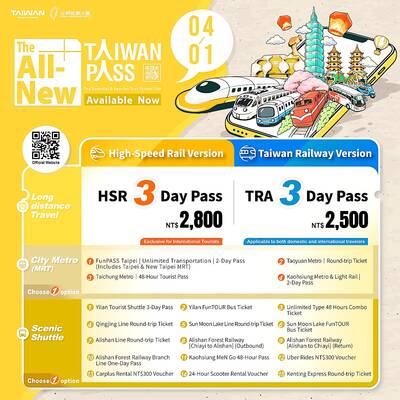
MORE POPULAR: Taiwan Pass sales increased by 59 percent during the first quarter compared with the same period last year, the Tourism Administration said The Tourism Administration yesterday said that it has streamlined the Taiwan Pass, with two versions available for purchase beginning today. The tourism agency has made the pass available to international tourists since 2024, allowing them to access the high-speed rail, Taiwan Railway Corp services, four MRT systems and four Taiwan Tourist Shuttles. Previously, five types of Taiwan Pass were available, but some tourists have said that the offerings were too complicated. The agency said only two types of Taiwan Pass would be available, starting from a three-day pass with the high-speed rail and a three-day pass with Taiwan Railway Corp. The former costs NT$2,800
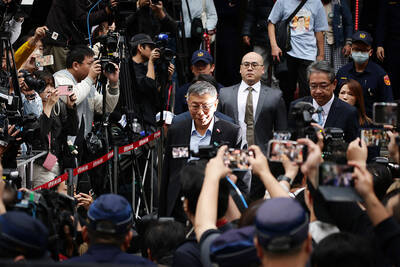
FIRST TRIAL: Ko’s lawyers sought reduced bail and other concessions, as did other defendants, but the bail judge denied their requests, citing the severity of the sentences Former Taipei mayor Ko Wen-je (柯文哲) was yesterday sentenced to 17 years in prison and had his civil rights suspended for six years over corruption, embezzlement and other charges. Taipei prosecutors in December last year asked the Taipei District Court for a combined 28-year, six-month sentence for the four cases against Ko, who founded the Taiwan People’s Party (TPP). The cases were linked to the Core Pacific City (京華城購物中心) redevelopment project and the mismanagement of political donations. Other defendants convicted on separate charges included Chinese Nationalist Party (KMT) Taipei City Councilor Angela Ying (應曉薇), who was handed a 15-year, six-month sentence; Core Pacific


 RSS
RSS