


Russian opposition leader Alexei Navalny was poisoned by the Kremlin with a rare and lethal toxin found in the skin of poison dart frogs, five European countries said on Saturday.
The foreign ministries of the UK, France, Germany, Sweden and the Netherlands said analysis in European labs of samples taken from Navalny’s body “conclusively confirmed the presence of epibatidine.”
The neurotoxin secreted by dart frogs in South America is not found naturally in Russia, they said.
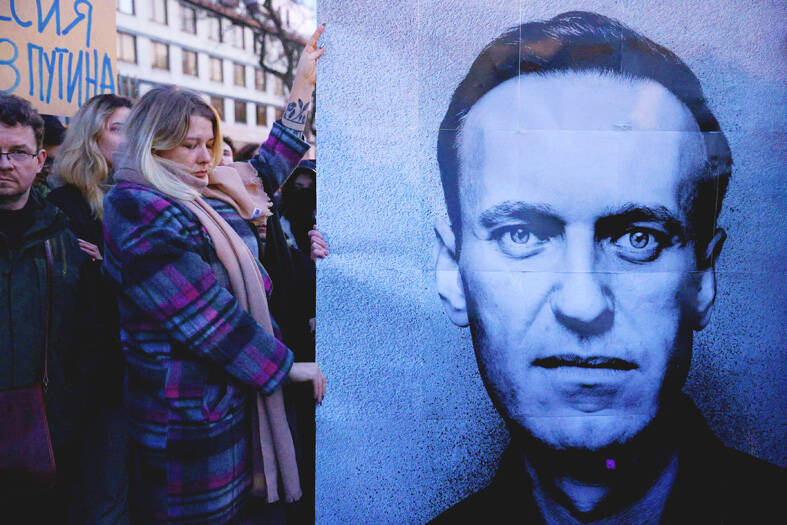
Photo: Agencja Wyborcza.pl via REUTERS
“Russia had the means, motive and opportunity to administer this poison,” a joint statement said.
The five countries said they were reporting Russia to the Organization for the Prohibition of Chemical Weapons for a breach of the Chemical Weapons Convention. There was no immediate comment from the organization.
Navalny, who crusaded against official corruption and staged massive anti-Kremlin protests as Russian President Vladimir Putin’s fiercest foe, died in an Arctic penal colony on Feb. 16, 2024, while serving a 19-year sentence that he believed to be politically motivated.
“Russia saw Navalny as a threat,” British Secretary of State for Foreign, Commonwealth and Development Affairs Yvette Cooper said. “By using this form of poison the Russian state demonstrated the despicable tools it has at its disposal and the overwhelming fear it has of political opposition.”
French Minister for Europe and Foreign Affairs Jean-Noel Barrot wrote on social media that the poisoning of Navalny shows “that Vladimir Putin is prepared to use biological weapons against his own people in order to remain in power.”
The European nations’ assessment came as Navalny’s widow, Yulia Navalnaya, attended the Munich Security Conference in Germany, and just before the second anniversary of Navalny’s death.
She said last year that two independent labs had found that her husband was poisoned shortly before he died.
She has repeatedly blamed Putin for her husband’s death. Russian officials have vehemently denied the accusation.
Navalnaya on Saturday said that she had been “certain from the first day” that her husband had been poisoned, “but now there is proof.”
“Putin killed Alexei with a chemical weapon,” she said, adding that Putin was “a murderer” who “must be held accountable.”
Russian authorities said that the politician became ill after a walk and died from natural causes.
Epibatidine is found naturally in dart frogs in the wild, and can also be manufactured in a lab, which European scientists suspect was the case with the substance used on Navalny. It works on the body in a similar way to nerve agents, causing shortness of breath, convulsions, seizures, a slowed heart rate and ultimately death.
European officials said they had a high degree of confidence in the assessment that Navalny died from epibatidine poisoning.
German Minister of Foreign Affairs Johann Wadephul said that “no one but Putin’s henchmen will be able to say in detail what happened on Feb. 16, 2024, in the Russian penal colony. But it is clear that Russian authorities had the possibility, the motive and the means to administer the poison to Navalny.”
Navalny was the target of a nerve agent attack in 2020 he blamed on the Kremlin, which always denied involvement. His family and allies fought to have him flown to Germany for treatment. Five months later, he returned to Russia, where he was arrested and imprisoned for the last three years of his life.
The UK has accused Russia of repeatedly flouting international bans on chemical and biological weapons. It accused the Kremlin of carrying out a 2018 attack in Salisbury, England, that targeted a former Russian intelligence officer, Sergei Skripal, with the nerve agent Novichok.
Skripal and his daughter became seriously ill, and a British woman, Dawn Sturgess, died after she came across a discarded bottle with traces of the nerve agent.
A British inquiry concluded that the attack “must have been authorized at the highest level, by President Putin.”
The Kremlin has denied involvement. Russia also denied poisoning Alexander Litvinenko, a former Russian agent turned Kremlin critic who died in London in 2006 after ingesting the radioactive isotope polonium-210. A British inquiry concluded that two Russian agents killed Litvinenko, and Putin had “probably approved” the operation.
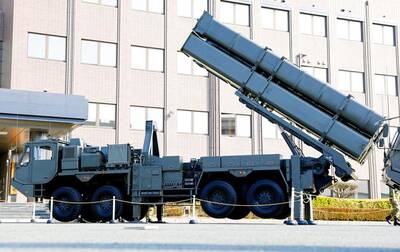
Japan has deployed long-range missiles in a southwestern region near China, the Japanese defense minister said yesterday, at a time when ties with Beijing are at their lowest in recent years. The missiles were installed in Kumamoto in the southern region of Kyushu, as Japan is attempting to shore up its military capacity as China steps up naval activity in the East China Sea. “Standoff defense capabilities enable us to counter the threat of enemy forces attempting to invade our country ... while ensuring the safety of our personnel,” Japanese Minister of Defense Shinjiro Koizumi said. “This is an extremely important initiative for

The nation’s fastest supercomputer, Nano 4 (晶創26), is scheduled to be launched in the third quarter, and would be used to train large language models in finance and national defense sectors, the National Center for High-Performance Computing (NCHC) said. The supercomputer, which would operate at about 86.05 petaflops, is being tested at a new cloud computing center in the Southern Taiwan Science Park in Tainan. The exterior of the server cabinet features chip circuitry patterns overlaid with a map of Taiwan, highlighting the nation’s central position in the semiconductor industry. The center also houses Taiwania 2, Taiwania 3, Forerunner 1 and

MORE POPULAR: Taiwan Pass sales increased by 59 percent during the first quarter compared with the same period last year, the Tourism Administration said The Tourism Administration yesterday said that it has streamlined the Taiwan Pass, with two versions available for purchase beginning today. The tourism agency has made the pass available to international tourists since 2024, allowing them to access the high-speed rail, Taiwan Railway Corp services, four MRT systems and four Taiwan Tourist Shuttles. Previously, five types of Taiwan Pass were available, but some tourists have said that the offerings were too complicated. The agency said only two types of Taiwan Pass would be available, starting from a three-day pass with the high-speed rail and a three-day pass with Taiwan Railway Corp. The former costs NT$2,800

FIRST TRIAL: Ko’s lawyers sought reduced bail and other concessions, as did other defendants, but the bail judge denied their requests, citing the severity of the sentences Former Taipei mayor Ko Wen-je (柯文哲) was yesterday sentenced to 17 years in prison and had his civil rights suspended for six years over corruption, embezzlement and other charges. Taipei prosecutors in December last year asked the Taipei District Court for a combined 28-year, six-month sentence for the four cases against Ko, who founded the Taiwan People’s Party (TPP). The cases were linked to the Core Pacific City (京華城購物中心) redevelopment project and the mismanagement of political donations. Other defendants convicted on separate charges included Chinese Nationalist Party (KMT) Taipei City Councilor Angela Ying (應曉薇), who was handed a 15-year, six-month sentence; Core Pacific


 RSS
RSS