


Taiwan jumped one spot to rank 24th globally in Transparency International’s 2025 Corruption Perceptions Index, marking the country’s best-ever result, the Agency Against Corruption said yesterday.
Taiwan showed steady progress in the evaluation, outperforming 86 percent of the 182 countries and territories assessed, the agency said in a statement.
Taiwan remains among the top tier of globally perceived clean countries, with an upward trend reflecting continued international recognition of the nation’s governance and anti-corruption efforts, it added.
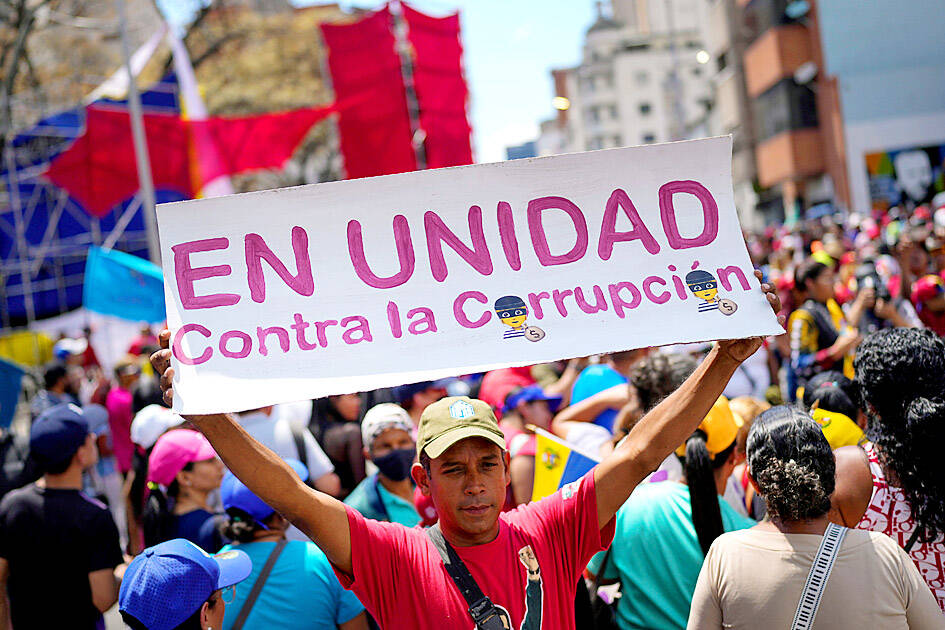
Photo: AP
The agency said it would continue implementing President William Lai’s (賴清德) governance principles, strengthening anti-corruption systems, risk monitoring and oversight, while working with domestic and international partners to promote clean governance and reinforce Taiwan’s international credibility.
Taiwan scored 68 points on a scale of zero (highly corrupt) to 100 (very clean).
Denmark topped last year’s rankings with 89 points, followed by Finland with 88, Singapore with 84, and New Zealand and Norway tied at 81.
At the bottom were South Sudan and Somalia with nine points apiece, followed by Venezuela.
The group said most countries are failing to keep corruption under control, with 122 out of the 182 nations and territories surveyed scoring less than 50 points
China was scored 43 this year, the same as last year, and rakned 76 out of 182 countries.
The global average last year was 42, down one point to the lowest in more than a decade.
Only five countries scored above 80 in last year’s report, down from 12 a decade ago.
The report lamented that “too often, we are seeing a failure of good governance and accountable leadership.”
It also pointed to “a worrying trend of democracies seeing worsening perceived corruption.”
Among those, it pointed even to high-scoring New Zealand, down two points to 81, and Sweden, unchanged on 80; as well as Canada, the UK, France and the US, which scored 75, 70, 66 and 64 points respectively.
The US was down one point from 2024 for its worst showing yet under the methodology Transparency started using for its global ranking in 2012, putting it in 29th place in the first year of US President Donald Trump’s second term.
“While the data has yet to fully reflect developments in 2025, the use of public office to target and restrict independent voices such as NGOs [non-governmental organizations] and journalists, the normalization of conflicted and transactional politics, the politicization of prosecutorial decisionmaking, and actions that undermine judicial independence, among many others, all send a dangerous signal that corrupt practices are acceptable,” the report said.
The US decision “to temporarily freeze and then degrade enforcement of its Foreign Corrupt Practices Act ... sends a dangerous signal that bribery and other corrupt practices are acceptable,” the group said.
Separately, Transparency said that “US aid cuts to funding for overseas civil society groups that scrutinize their governments has undermined anti-corruption efforts around the world.”
It contended that “political leaders in various countries have also taken this as a cue to further target and restrict independent voices, such as NGOs and journalists.”
The organization measures experts’ perception of public-sector corruption around the world according to 13 data sources, including the World Bank, the World Economic Forum, and private risk and consulting companies.
Russia remained close to the bottom of the index with an unchanged score of 22, with Transparency International citing “fully centralized, opaque governance that suppresses media, civil society and political opposition.”
Nearly four years into Russia’s full-scale invasion, Ukraine was up one point at 36 after an energy-sector corruption scandal forced high-level resignations.
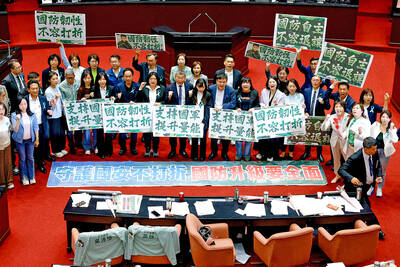
WHAT WAS ALL THAT FOR? Jaw Shaw-kong said that Cheng Li-wen had pushed for more drastic cuts and attacked him, just for the outcome to be nearly identical to his bill The legislature yesterday passed a supplementary budget bill to fund the purchase of separate packages of US military equipment, with the combined amount of spending capped at NT$780 billion (US$24.8 billion). The Chinese Nationalist Party (KMT) and Taiwan People’s Party (TPP) used their legislative majority to pass the bill, which runs until 2033 and has two main funding provisions. One was for NT$300 billion of arms sales already approved by the US for Taiwan on Dec. 17 last year, the other was for NT$480 billion for another arms package expected to be announced by Washington. The bill, which fell short of the NT$1.25
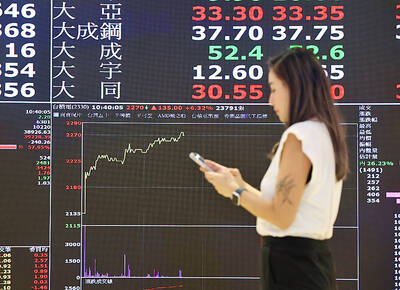
Taiwanese shares yesterday posted a record daily gain of more than 1,700 points to close above 40,000 points for the first time, led by large-cap semiconductor stocks such as Taiwan Semiconductor Manufacturing Co (TSMC, 台積電) and MediaTek Inc (聯發科) amid optimism about the artificial intelligence (AI) boom. The TAIEX ended up 1,778.51 points, or 4.57 percent, at 40,705.14 after moving between 39,228.39 and 40,755.52, while the New Taiwan dollar closed up NT$0.038 at NT$31.610 per US dollar, ending three consecutive sessions of declines. Turnover on the main board totaled NT$1.007 trillion (US$31.9 billion), with foreign institutional investors buying a net NT$66.98 billion

A former television news host and six military personnel — active and retired — have been indicted on espionage charges, Kaohsiung prosecutors said yesterday. Lin Chen-you (林宸佑), a former CTi News host and YouTuber, last year allegedly made videos at the direction of a Chinese agent criticizing the Democratic Progressive Party’s recall campaign, the Ciaotou District Prosecutors’ Office told a news conference in Kaohsiung. He allegedly received 4,325 tether coins for the videos from an unidentified person surnamed Huang (黃), believed to be an agent of a hostile foreign power, they said. Lin, also known as Ma Te (馬德), has a show named
NON-INTERFERENCE: The US called Taiwan a trusted and capable partner, while an African Union leader urged nations to reflect on respect for sovereign choices Taiwan is a “trusted and capable” partner of the US and Taipei’s global relationships, including with Eswatini, provide significant benefits, the US Department of State said of President William Lai’s (賴清德) trip to the southern African kingdom. Lai arrived in the former Swaziland on Saturday on a surprise visit after a planned trip last month was canceled when Seychelles, Mauritius and Madagascar denied overflight permission for his aircraft due to Chinese pressure. “Taiwan is a trusted and capable partner of the United States and many others, and its relationships around the world provide significant benefits to the citizens of those countries,


 RSS
RSS