


The US is committed to deterrence in the first island chain, but it should not bear the burden alone, as “freedom is not free,” American Institute in Taiwan Director Raymond Greene said in a speech at the Institute for National Defense and Security Research’s “Strengthening Resilience: Defense as the Engine of Development” seminar in Taipei yesterday.
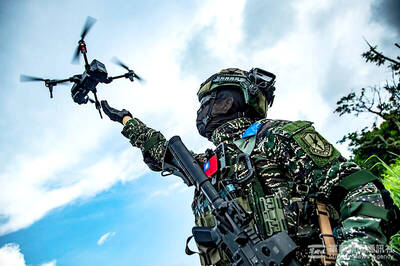
In the speech, titled “Investing Together and a Secure and Prosperous Future,” Greene highlighted the contributions of US President Donald Trump’s administration to Taiwan’s defense efforts, including the establishment of supply chains for drones and autonomous systems, offers of security assistance and the expansion of domestic defense industrial bases.
“We will steadfastly stand by our allies and partners to protect their freedom and promote their security,” he said. “However, freedom is not free. America can only help our friends as much as they help themselves.”
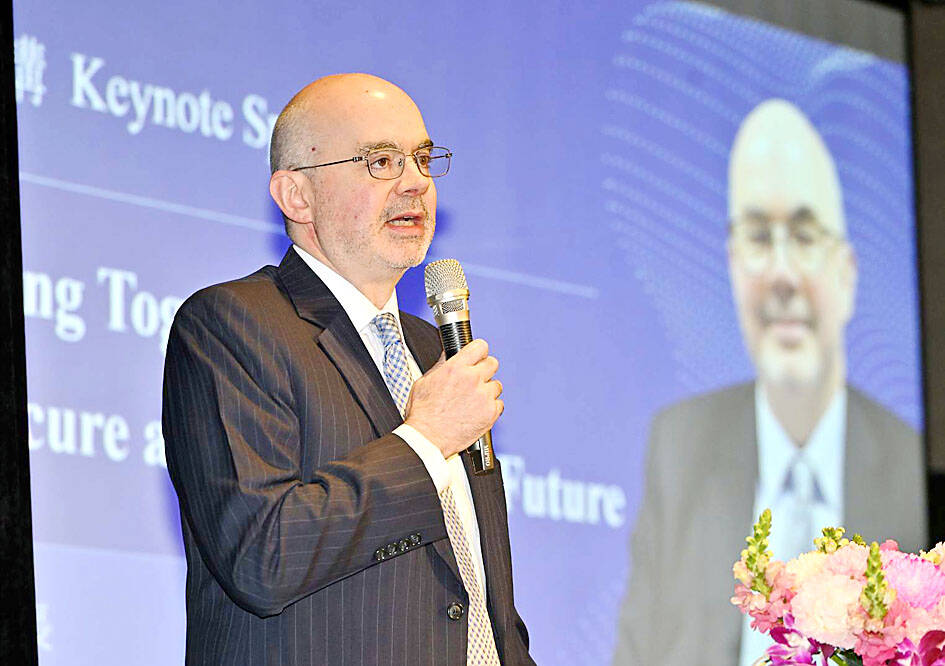
Photo: Tien Yu-hua, Taipei Times
Although Trump’s National Security Strategy says that the US “is committed to maintaining the military capacity to deny aggression anywhere in the first island chain,” Washington “should not bear this burden alone,” Greene said.
To show the US’ commitment to expanding Taiwan’s domestic defense industry, Greene cited a collaboration in which Virginia-based defense company Northrop Grumman installed a medium-caliber ammunition test range in Taiwan, enabling the Ministry of National Defense to test ammunition to global industry standards.
The new project would enable the advancement of indigenous development projects through the transfer of technology, proprietary procedures and expert training, he said.
California-based Anduril Industries has also implemented a strategic supply chain initiative in Taiwan to find suppliers for key components, he said.
The initiative would enhance global supply chain resilience across products such as the Ghost-X, a single-rotor, portable uncrewed aircraft system, which is sold to the US and its international partners, Greene said.
San Diego-based Shield AI has also invested heavily in Taiwan’s supply chain, buying tens of millions of Taiwanese-made components and products, and has formally teamed up with Aerospace Industrial Development Corp (漢翔航空工業), Taiwan’s largest prime contractor, he added.
In the field of artificial intelligence (AI), the US is the world leader in research and development, innovation and applications, while Taiwan provides the manufacturing and hardware backbone, he said.
Combining the two complementary capabilities would develop edge computing and embodied AI applications for drones, command and control systems, and air defense and other platforms that would help with revolutionizing deterrence capabilities, he said.
Taiwan is also contributing to its own defense, including President William Lai’s (賴清德) NT$1.25 trillion (US$39.54 billion) special defense budget and his pledge to increase defense spending to 5 percent of GDP by 2030, Greene said.
Last year’s Han Kuang military drills, extending compulsory military service to 12 months from four months and implementation of Lai’s whole-of-society resilience strategy are other examples of Taiwan’s contributions, he said.
Taiwanese are committed to preserving peace and preparing for conflict, showcased in last year’s urban resilience drills and by the tens of thousands of volunteers who helped communities in Hualien County affected by flooding last year, he said.
Moreover, polls show that more Taiwanese are willing to defend their homeland today than Ukrainians did when asked before February 2022, Greene said, referring to before Russia launched its war against Ukraine.
“Working together, I am confident [Taiwan-US] collaboration will benefit the people of the United States, Taiwan and the rest of the world,” he said.

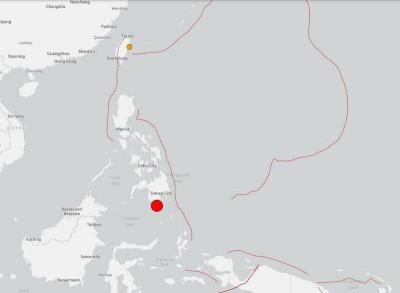
A magnitude 7.8 earthquake struck off the southern coast of Mindanao in the Philippines at 7:38am today, prompting the US Tsunami Warning System to issue an alert for neighboring countries, including Taiwan. The system issued a purple alert indicating a "tsunami threat." The potential threat zone includes Taiwan, the Philippines, Papua New Guinea, Yap and Palau. A spokesperson for Indonesia disaster mitigation agency said there were no reports of damage so far. Arlene Hollero, disaster chief of Maasim town in the Philippines' Sarangani Province, said their evacuation was underway in coastal villages and there were no reported casualties so far. DZBB radio, broadcasting from the
RESILIENCE: Taiwan plays a key role in semiconductors, energy, information infrastructure and advanced manufacturing, AIT Director Raymond Greene said Taiwan’s continued investment in deterrence and resilience remains vital, especially in uncrewed systems and other emerging technologies, American Institute in Taiwan (AIT) Director Raymond Greene said yesterday. Greene made the remarks at the annual National Strategic Summit on Supply Chain Resilience held by the Research Institute for Democracy, Society and Emerging Technology (DSET), a government-backed think tank. As Taiwan last year became the US’ fourth-largest trading partner and supply chain security is becoming more important, cooperation in emerging technologies continues to deepen between the two countries, he said. The US is committed to accelerating innovation, building key infrastructure, strengthening cooperation

The National Chungshan Institute of Science and Technology yesterday showcased its locally developed variants of the Vision 60 robotic patrol dog, which it plans to deploy on the nation’s outlying territories in the South China Sea. The variants were produced under the Joint Lab project — created by the institute and domestic companies — and assembled with domestically produced motors, lenses and artificial intelligence (AI) systems alongside licensed tech from the US, Missile and Rocket Systems Research Division deputy director Jen Kuo-kang (任國光) told the media event at a military base in Taipei’s Dazhi (大直) area. Taiwan has built up its strengths

RIGHT DIRECTION: Taiwan’s efforts to prevent forced labor include a proposal to ‘fully prohibit’ employers from withholding workers’ documents, an official said Taiwan is to establish a mechanism to restrict imports of goods linked to forced labor, the Executive Yuan said yesterday, after the US proposed imposing additional tariffs on Taiwanese goods over labor concerns. “The Ministry of Labor and the Ministry of Economic Affairs are to establish an interministerial review procedure,” Executive Yuan spokesperson Michelle Lee (李慧芝) said at a news briefing in Taipei. “The government is to use the Foreign Trade Act [貿易法] as the legal basis to restrict imports of goods produced with forced labor” and bring its supply chain governance more in line with international standards on human rights, resilience


 RSS
RSS